Blog

  • Best Vanilla French Beignets That Puff Up Light

    Best Vanilla French Beignets That Puff Up Light

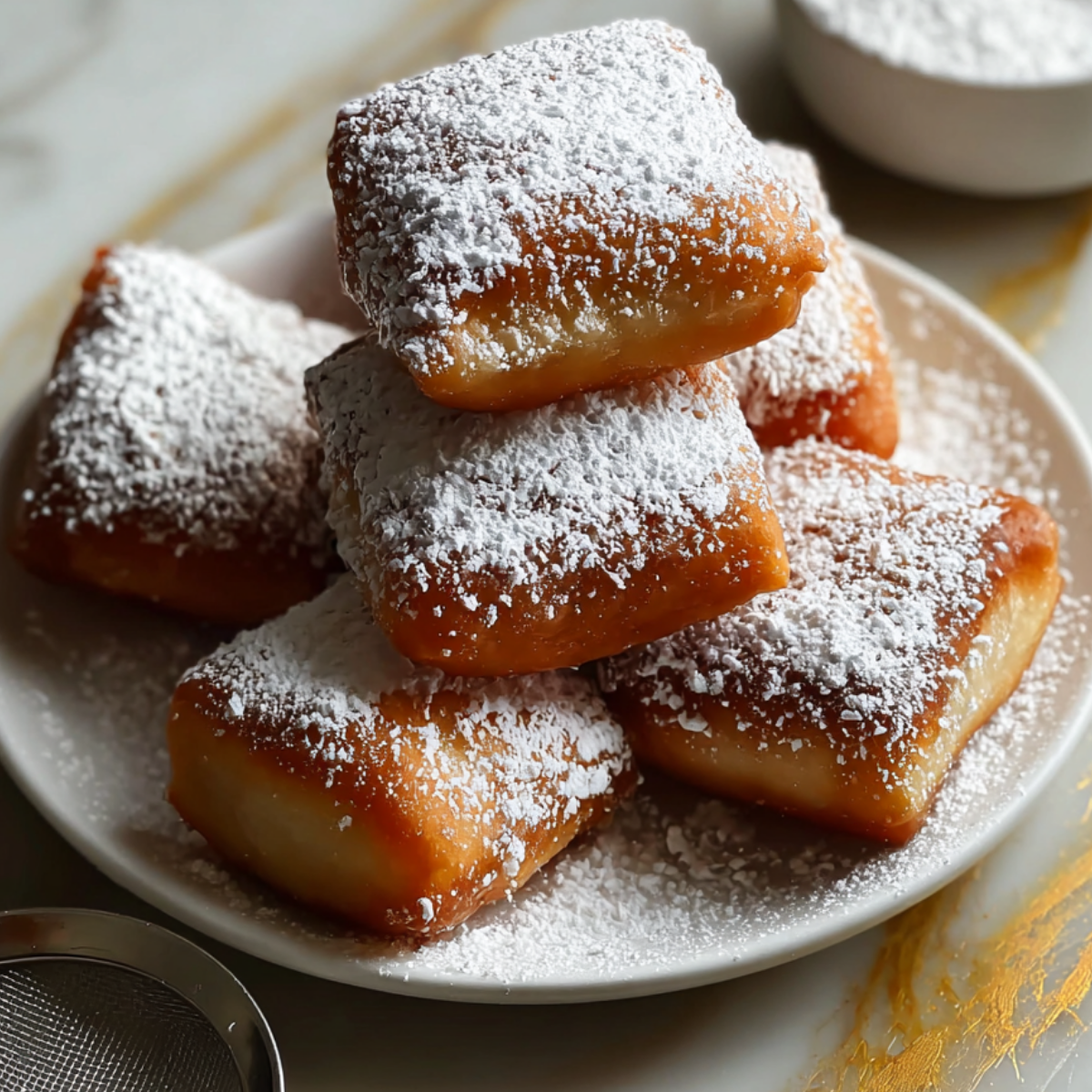
    The oil was not hot enough, and every single one absorbed it like a sponge. Ben picked one up; it was visibly heavy, and said “this is not right.” Mia ate one out of loyalty and said “still good.” They were not. But once I got the temperature right, these vanilla French beignets became the most magical thing I have ever made in this kitchen.

    Why This Recipe Is Special

    Beignets are one of those things that feel genuinely celebratory every single time they appear on the table. The dough is pillowy and soft inside, the outside is golden and just barely crisp, and the powdered sugar goes everywhere in the best possible way. The vanilla in this recipe is not subtle; it perfumes the whole dough and gives every bite a warmth that plain beignets simply do not have. Mia takes one bite, closes her eyes for a second, and then immediately reaches for another. That is the only review that matters to me.

    How To Make Vanilla French Beignets

    The successful batch happened on a Sunday afternoon when both kids had declared the day officially boring and needed a project. Mia was measuring the flour with the focus of someone taking an exam. Ben was reading the yeast packet out loud and asking follow-up questions about what yeast actually does, which led to a genuinely good five-minute conversation about fermentation that I had not planned for. When the dough came together and felt soft and elastic and pillowy under my hands, I let both of them have a turn pressing it, which Mia described as “the best part.” Ben agreed and then pressed it one more time for good measure.

    The oil temperature lesson was the one that changed everything. Beignets need oil at exactly 350 to 360 degrees F. Too cold, and they absorb oil and go heavy. Too hot and the outside burns before the inside cooks through. I now use a thermometer every single time, and Ben has appointed himself the official temperature reader, which means he announces “three fifty-two” in a very authoritative voice approximately every thirty seconds while I fry. The beignets have been perfect ever since.

    Main Ingredients

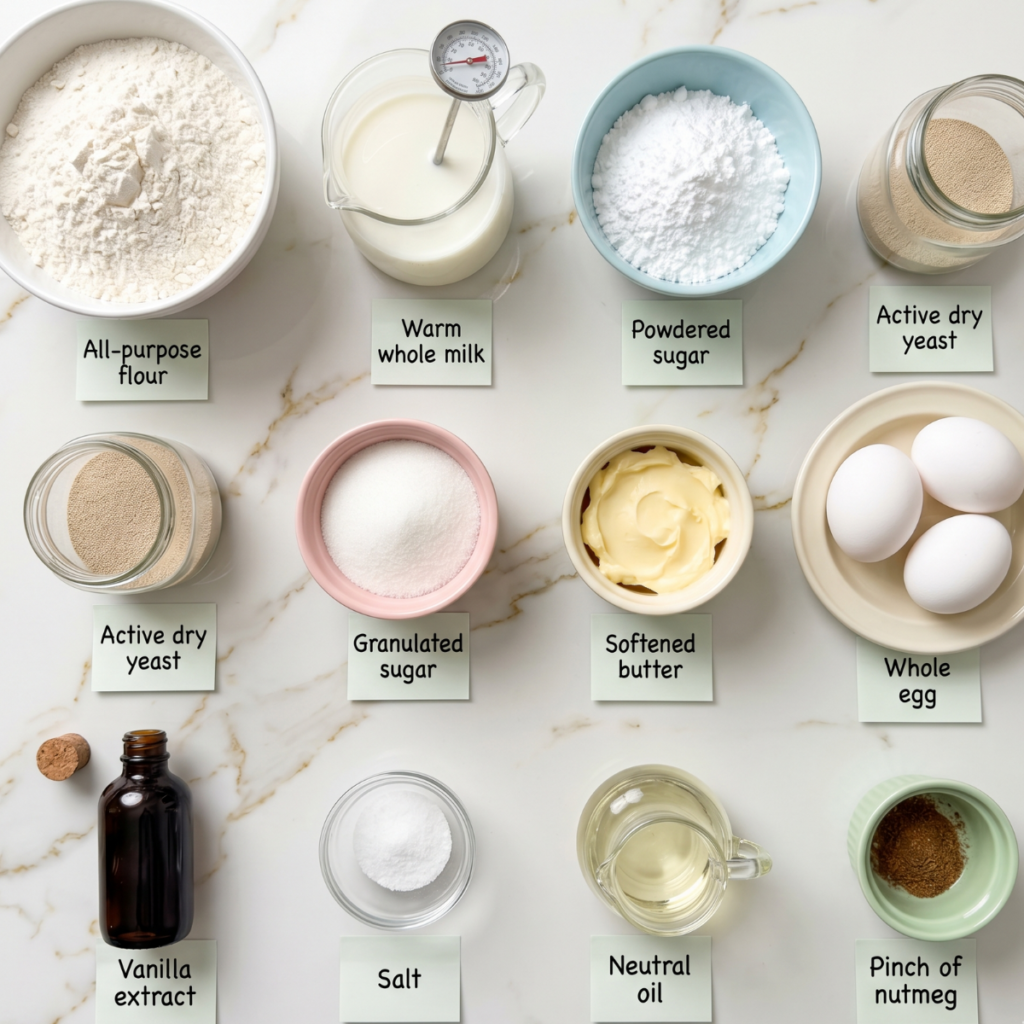
    • 2.5 cups all-purpose flour, plus extra for dusting – Spoon and level; the right flour amount gives the perfect soft but structured dough
    • 2.25 teaspoons active dry yeast (one standard packet) – Must be proofed in warm liquid first; this is not optional for a properly risen beignet
    • 3/4 cup warm whole milk (110 degrees F) – Activates the yeast; too hot kills it, too cold and it will not activate at all
    • 1/4 cup granulated sugar – Feeds the yeast and gives the dough its subtle sweetness
    • 2 tablespoons unsalted butter, softened – Adds richness and gives the beignets their tender, slightly glossy interior crumb
    • 1 large egg, room temperature – Gives structure and helps the dough hold together beautifully during frying
    • 2 teaspoons pure vanilla extract – The heart of this recipe; use good quality vanilla and do not reduce the amount
    • 1/4 teaspoon salt – Balances the sweetness and enhances the vanilla
    • Neutral oil for frying – Vegetable or canola oil; at least 3 inches deep in the pot for the beignets to float and fry evenly
    • 1 cup powdered sugar, for dusting – Applied generously and immediately while the beignets are still hot; this is non-negotiable
    Step-by-Step Instructions

    Step 1: Proof the Yeast and Make the Dough

    • Combine the warm milk (110 degrees F), sugar, and yeast in a large bowl and let it sit undisturbed for 5 to 10 minutes until the mixture is foamy and fragrant; if it does not foam, the yeast is dead and you need to start again with fresh yeast
    • Add the softened butter, egg, vanilla extract, and salt to the yeast mixture and stir until combined
    • Add the flour one cup at a time, stirring after each addition until a soft, slightly sticky dough forms that pulls away from the sides of the bowl
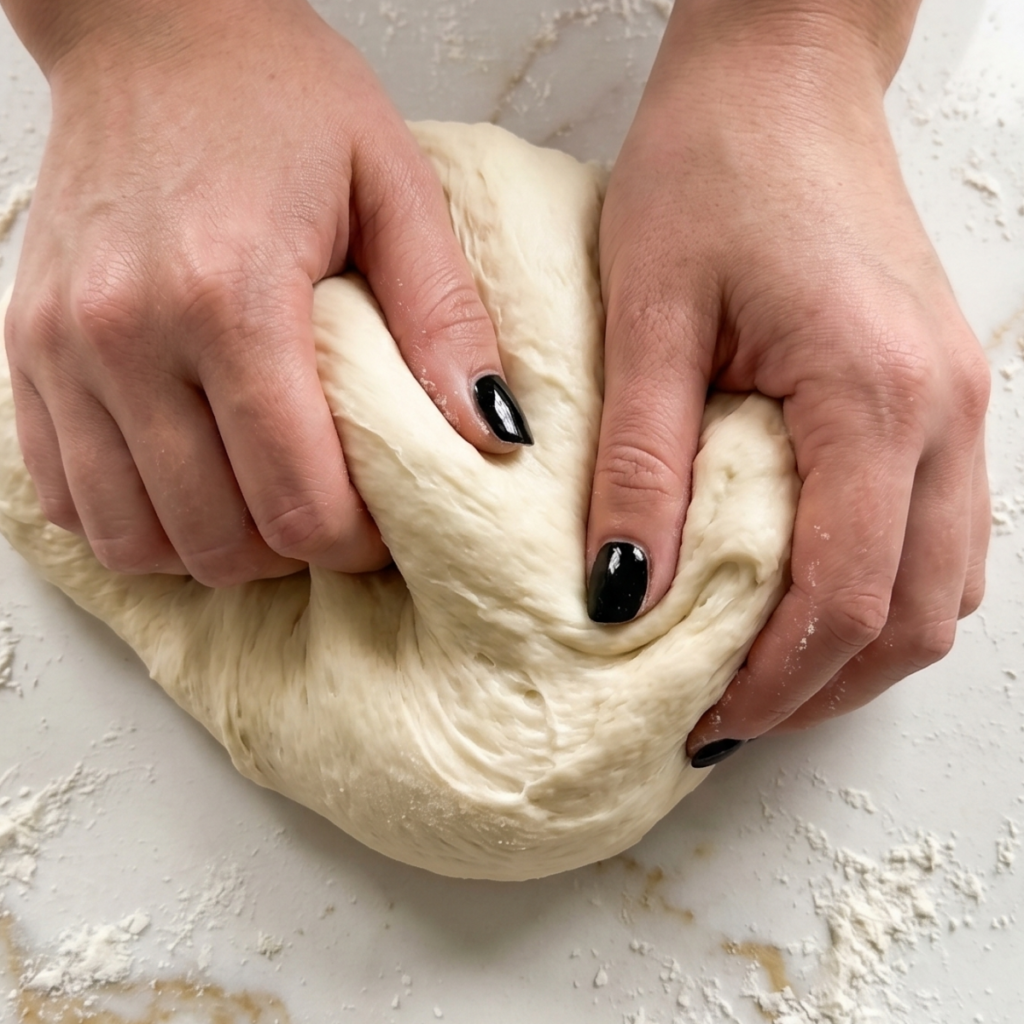
    • Turn the dough out onto a lightly floured surface and knead for 3 to 4 minutes until smooth and elastic; the dough should spring back slowly when you press it with your finger
    Step 2: Rest and Roll the Dough

    • Place the dough in a lightly oiled bowl, cover with a clean kitchen towel or plastic wrap, and let it rise in a warm spot for 1 to 1.5 hours until doubled in size
    • Punch the risen dough down gently to release the air, then turn it onto a lightly floured surface
    • Roll the dough out to about half an inch thickness and cut into squares or rounds roughly 2 to 3 inches across using a knife or biscuit cutter
    • Place the cut pieces on a lightly floured parchment-lined tray and cover loosely; let them rest for 15 minutes while the oil heats so they puff slightly before frying

    Step 3: Fry the Beignets

    • Heat at least 3 inches of neutral oil in a deep heavy-bottomed pot to exactly 350 to 360 degrees F using a kitchen thermometer; do not guess the temperature
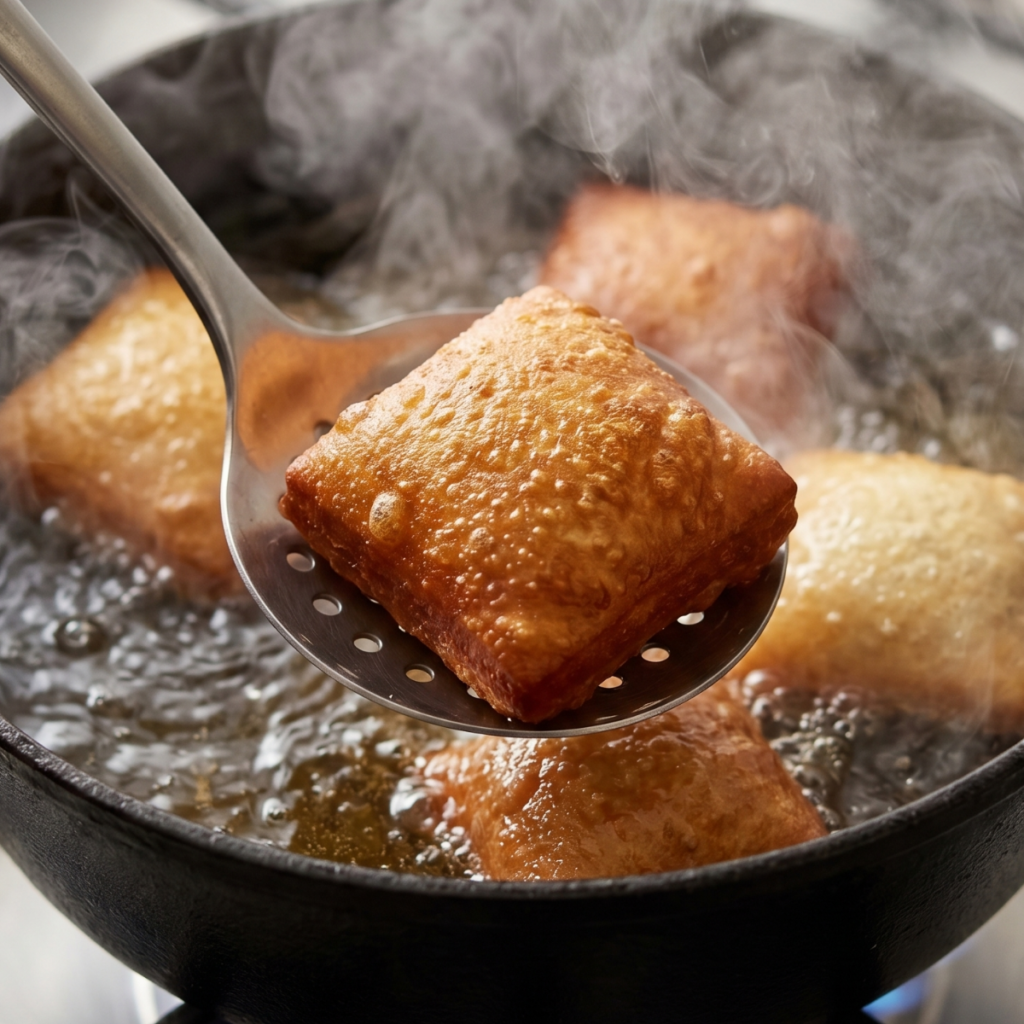
    • Fry 3 to 4 beignets at a time without crowding, lowering them gently into the oil with a slotted spoon; they will puff and float to the surface within about 30 seconds
    • Cook for 1 to 2 minutes per side until deep golden brown on both sides, turning once with a slotted spoon or tongs; the total fry time per beignet is about 3 minutes
    • Transfer to a paper towel-lined tray to drain for about 30 seconds and monitor the oil temperature between batches, adjusting the heat as needed to keep it in the correct range
    Step 4: Dust and Serve

    • While the beignets are still hot, transfer them to a serving plate and dust immediately and very generously with powdered sugar through a fine mesh strainer
    • Pile them on the plate and dust again from above so the powdered sugar settles into every crack and crevice; this is not a moment for restraint
    • Serve immediately while the inside is still soft and pillowy and the outside is at peak golden; beignets are a now-food, not a later-food
    • Set up a dipping station alongside if desired with vanilla custard, Nutella, jam, or honey so everyone can customize their experience

    Vanilla French Beignets Variations

    Mia’s “Nutella-Filled” Version

    Mia discovered that Nutella-filled beignets existed when she saw them on a baking video and immediately treated this as urgent news. She presented the information to me at breakfast the following morning with the energy of someone reporting a major development. For filled beignets, roll the dough slightly thinner, place a small teaspoon of Nutella in the center of each piece, fold the edges up, and pinch firmly to seal and fry sealed-side down first. The Nutella melts inside during frying into a warm, gooey center that Mia describes as “the whole point of beignets.” She is probably right.

    Ben’s “Cinnamon Sugar Instead” Version

    Ben has a position on powdered sugar, which is that cinnamon sugar is objectively better, and he is willing to discuss the topic at length. For his version, skip the powdered sugar entirely and toss the hot beignets immediately in a bowl of cinnamon sugar instead, two tablespoons of cinnamon mixed with half a cup of granulated sugar. The sugar sticks to the hot surface and creates a light caramelized coating that Ben calls “the superior finish.” He makes this argument every batch, and he has converted Mia to cinnamon sugar on at least three separate occasions.

    The Vanilla Custard Dipping Version

    This is the version I make when the table needs to feel genuinely special. Whisk together two egg yolks, two tablespoons of sugar, one tablespoon of cornstarch, and one cup of warm whole milk in a small saucepan over medium heat, stirring constantly until it thickens into a silky custard. Add a full teaspoon of vanilla and a small knob of butter at the end, let it cool slightly, and serve it warm in a small bowl alongside the beignet pile. Ben dips every single one with careful precision. Mia dunks hers completely and does not apologize for it.

    Substitutions

    Active dry yeast to instant yeast: Instant yeast can be added directly to the dry ingredients without proofing first. Use the same quantity. The rise time will be slightly shorter, about 45 minutes to 1 hour rather than the full hour and a half. Keep an eye on the dough and go by size rather than time; it should double regardless of which yeast you use.

    Whole milk to oat milk or almond milk: Non-dairy milks work for activating the yeast and making the dough, though the beignets will be very slightly less rich. Make sure whatever non-dairy milk you use is warmed to the same 110 degrees F range for the yeast to activate properly. Avoid milks with strong flavors that would compete with the vanilla.

    All-purpose flour to bread flour: Bread flour has slightly more protein, which gives the beignets a chewier, more structured interior. The dough will feel a little stiffer during kneading and may need a touch more milk to come together. The finished beignets are denser than the all-purpose version but have a beautiful pull when you tear them open.

    Frying oil to an air fryer: Spray each cut piece of dough generously with cooking spray and air fry at 350 degrees F for 6 to 8 minutes, flipping halfway through. The result is less golden and less puffy than the deep-fried version but significantly lighter. Dust with powdered sugar immediately out of the air fryer while still hot for the best result.

    Equipment

    • Large mixing bowl for the dough
    • Deep heavy-bottomed pot for frying (Dutch oven or large saucepan)
    • Kitchen thermometer (candy or deep-fry thermometer; the single most important piece of equipment for this recipe)
    • Slotted spoon or spider strainer for lowering dough into oil and removing beignets
    • Rolling pin for rolling the dough to even thickness
    • Sharp knife or biscuit cutter for cutting the pieces
    • Parchment-lined tray for resting the cut pieces before frying
    • Paper towel-lined tray for draining after frying
    • Fine mesh strainer for dusting the powdered sugar
    • Clean kitchen towel or plastic wrap for covering the dough during rising

    Storage Tips

    Make Ahead

    • Make the dough the night before, let it complete its first rise, then cover tightly and refrigerate overnight; bring to room temperature for 30 minutes before rolling and frying
    • The uncooked cut pieces can be placed on a parchment-lined tray, covered, and refrigerated for up to 4 hours before frying for same-day convenience
    • The powdered sugar and any dipping sauces can be prepared well ahead; only the frying needs to happen close to serving time

    Refrigerator

    • Beignets are genuinely best eaten fresh and warm; they are a serve-immediately kind of food that does not wait well at room temperature
    • Leftover cooked beignets can be stored loosely covered at room temperature for up to 1 day; they will lose their puffiness but still taste good
    • Store the raw dough wrapped tightly in the fridge for up to 2 days; this is much better than storing cooked beignets

    Freezing

    • Freeze-cut uncooked dough pieces on a lined tray until solid, then transfer to a freezer bag for up to 1 month
    • Thaw frozen dough pieces at room temperature for 30 to 45 minutes until slightly puffed before frying; do not fry from fully frozen
    • Cooked beignets do not freeze well, as the texture of the fried dough changes significantly when thawed

    Reheating

    • Reheat leftover beignets in a 325 degree F oven for 5 to 6 minutes until warmed through; they will not be as puffy as fresh but are still genuinely good
    • Air fryer reheating at 320 degrees F for 3 minutes works well and brings back some of the exterior texture
    • Dust with a fresh layer of powdered sugar after reheating since the original dusting will have absorbed into the surface during storage

    Family Secret Worth Sharing

    My mom always added a tiny pinch of nutmeg to her beignet dough, and I genuinely did not understand why until I made them without it and the whole flavor felt less warm, less rounded, and slightly flat. Nutmeg is one of those spices that you cannot identify when it is present but can absolutely detect when it is absent. She used just a small pinch, about an eighth of a teaspoon, whisked in with the flour. I added it to this recipe the second time I made the successful batch, told nobody, and waited. Mia ate two and then looked at the third one and said “these taste like they have a secret.” They do. That pinch of nutmeg is it. My mom would have been delighted to know a six-year-old figured it out.

    Troubleshooting FAQs

    My beignets are heavy and greasy instead of light and puffy. What went wrong?
    The oil was not hot enough. This is the single most common beignet problem and the one I know personally from my dough rock batch. Cold oil means the beignets absorb it before a crust can form on the outside. Make sure the oil reaches 350 to 360 degrees F before the first piece goes in and check the temperature between every batch. The thermometer is not optional; it is the whole recipe.

    The beignets are burning on the outside but raw in the middle. What happened?
    The oil is too hot, the dough pieces are too thick, or both. Keep the oil below 365 degrees F and roll the dough to a consistent half-inch thickness. If the outside is browning in under a minute per side, the oil is running too hot. Lower the heat slightly and let the temperature settle back into the correct range before continuing.

    My dough is not rising after an hour. What do I do?
    The yeast was not active. This can happen if the milk was too hot (above 115 degrees F kills yeast), too cold (below 105 degrees F will not activate it), or if the yeast itself was old and expired. Always proof the yeast first and wait for a genuinely foamy, fragrant result before adding flour. If the mixture looks flat and smells like nothing after ten minutes, start again with fresh yeast.

    The beignets are deflating as soon as they come out of the oil. What is happening?
    The dough was underproofed. The second rest after cutting, about 15 minutes on the tray before frying, is important for the gluten to relax and the pieces to puff slightly before they hit the oil. If you skip this rest or rush it, the beignets puff in the oil but collapse immediately once the heat source is removed. Give them the full rest and they will hold their shape beautifully.

    The Recipe That Made Sunday Afternoons Feel Like Paris

    There is powdered sugar on my ceiling from the first successful batch. I am not entirely sure how it got there, and I have decided not to investigate. Ben dusted so enthusiastically the whole kitchen went white for a moment, and Mia laughed so hard she nearly dropped her beignet. That is the kind of memory this recipe makes. These vanilla French beignets have become one of our most beloved special occasion baking recipes in the whole household, sitting right alongside our celebration dessert recipes that come out when something needs to feel genuinely festive. For the days when the whole house needs a treat that is a little extra, a little special, and completely impossible to eat without smiling, these beignets next to our easy homemade dessert recipes make the whole afternoon feel like somewhere worth being. Some recipes become moments, and this one always does.

  • 5-Ingredient Fluffy Apple Yogurt Pancakes

    5-Ingredient Fluffy Apple Yogurt Pancakes

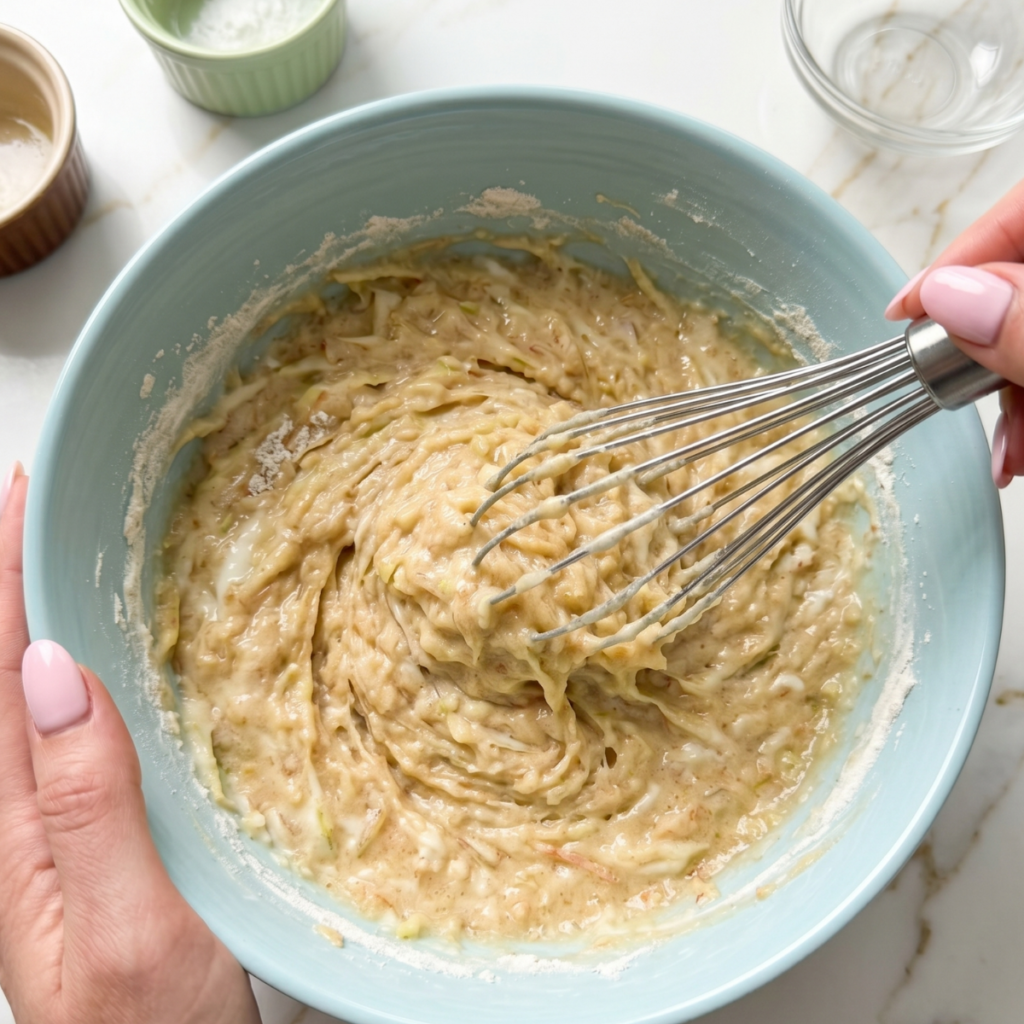
    I flipped them before the bubbles formed and ended up with a pan of pale, half-raw pancake puddles. Ben looked at the mess and said, “Are those supposed to fold?” Mia said they looked “like fallen leaves” and meant it as a compliment. That morning taught me the one rule that makes these apple yogurt pancakes turn out golden and perfect without a single casualty.

    Why This Recipe Is Special

    These pancakes are softer, more tender, and more flavorful than any regular pancake I have made, and the yogurt is the reason for all three of those things. It gives the batter a slight tang that makes the sweetness of the apple pop, keeps the inside almost custard-soft, and creates edges that get genuinely golden without going crispy or dry. The grated apple disappears into the batter during cooking, but you taste it in every single bite. Mia asked me once what makes these different from regular pancakes. I told her it was the yogurt and apple. She considered this and said, “Keep doing that.” I have.

    How To Make Apple Yogurt Pancakes

    The successful batch came on a Saturday morning when both kids were sitting at the counter watching me with the focused energy of people who had been promised pancakes and intended to hold me to that. Mia was in charge of grating the apple, which she did with tremendous seriousness and approximately one tablespoon of tasting along the way. Ben was whisking the dry ingredients and announcing each one like a sports commentator. When the first properly cooked pancake came out golden and puffed with those soft golden edges and the kitchen smelled like warm apple and vanilla, both of them went completely quiet. That is the review I was going for.

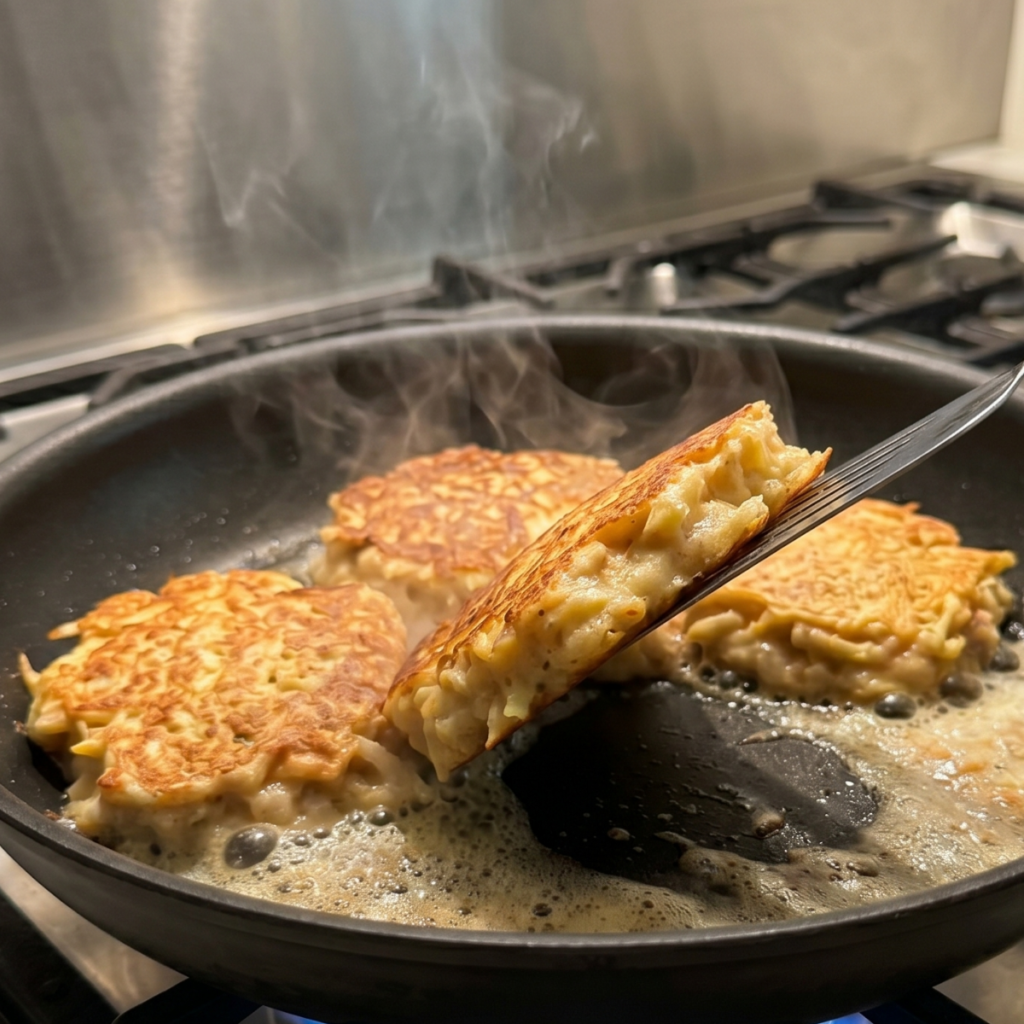
    The lesson that fixed my folded pancake disaster was patience and bubbles. You pour the batter and then you wait. You do not touch it; you do not nudge it; you do not check by lifting the edge too early. You wait until the surface is covered in small bubbles that have opened up and the edges look matte and set rather than shiny and wet. That is the only moment to flip. Ben now stands at the stove as the official bubble announcer, which mostly means he says “not yet, not yet, not yet, NOW” and then looks very satisfied when the pancake comes out perfectly golden underneath.

    Main Ingredients

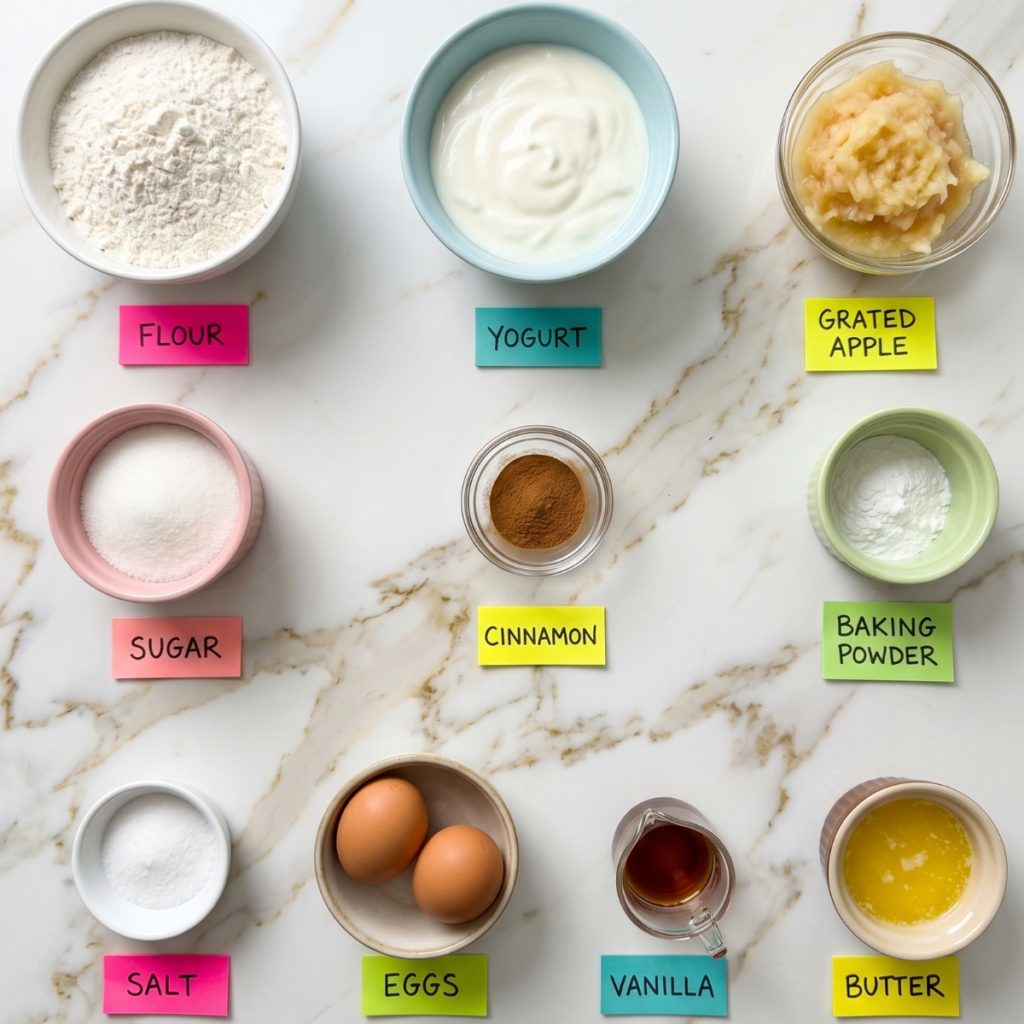
    • 1.5 cups all-purpose flour – Spoon and level; packed flour makes thick, dense pancakes that do not cook through properly
    • 1 cup plain whole milk yogurt – The ingredient that makes everything different; full-fat Greek yogurt also works and gives an even richer result
    • 1 large apple, peeled and grated – Grate on the fine side of a box grater; the finer the grate the more it melts into the batter during cooking
    • 2 large eggs – Room temperature eggs incorporate more smoothly into the yogurt batter
    • 2 tablespoons granulated sugar – Just enough to bring out the apple sweetness without making these dessert pancakes
    • 1 teaspoon baking powder – The lift that gives these their soft, fluffy interior
    • 1/2 teaspoon baking soda – Reacts with the yogurt acid for extra rise and that tender crumb
    • 1 teaspoon cinnamon – Warm spice that ties the apple and yogurt flavors together beautifully
    • 1/4 teaspoon salt – Enhances every other flavor; do not skip
    • 1 teaspoon vanilla extract – Rounds out the warmth of the cinnamon and the tang of the yogurt
    • 2 tablespoons melted butter, plus more for the pan – Goes into the batter for richness and helps create those golden edges
    • Powdered sugar for dusting – The finishing touch that makes every plate look like a Saturday morning should look

    Step-by-Step Instructions

    Step 1: Mix the Dry Ingredients

    • Whisk together the flour, sugar, baking powder, baking soda, cinnamon, and salt in a large bowl until completely combined
    • Make a well in the center of the dry ingredients to make it easier to incorporate the wet ingredients without overmixing
    • Peel the apple and grate it on the fine side of a box grater; gather the grated apple in a clean towel and squeeze out any excess juice so it does not make the batter too wet
    • Set the dry mixture and the grated apple aside while you prepare the wet ingredients

    Step 2: Mix the Wet Ingredients and Combine

    • Whisk together the yogurt, eggs, vanilla extract, and melted butter in a medium bowl until smooth and fully combined
    • Pour the wet ingredients into the well in the dry ingredients and stir gently with a spatula until just combined; the batter should still look slightly lumpy
    • Fold the grated apple into the batter with a few gentle strokes until evenly distributed; do not stir aggressively or the pancakes will be tough
    • Let the batter rest for 5 minutes before cooking; this allows the baking powder and soda to activate and the batter to thicken slightly to the perfect pourable consistency

    Step 3: Cook the Pancakes

    • Heat a non-stick skillet or griddle over medium-low heat and add a small knob of butter; let it melt and foam before adding any batter
    • Pour about a quarter cup of batter per pancake and cook without touching until the surface is covered in open bubbles and the edges look matte and set, about 2 to 3 minutes
    • Flip once, confidently, and cook for another 1 to 2 minutes until the second side is golden; do not press down or the soft interior will deflate
    • Transfer to a warm plate and cover loosely with foil while you cook the remaining batches; wiping the pan between batches with a paper towel keeps the butter from burning

    Step 4: Finish and Serve

    • Stack the finished pancakes on serving plates while still warm; they are best served immediately when the inside is still soft and the edges are at peak golden
    • Dust generously with powdered sugar through a fine-mesh strainer held high above the plate for an even, beautiful snow-like finish
    • Serve with maple syrup, a spoonful of plain yogurt on the side, fresh apple slices, or a drizzle of honey for a complete and genuinely lovely plate
    • Any leftover batter keeps covered in the fridge for up to 24 hours; give it a gentle stir before using, as the apple may settle slightly

    Apple Yogurt Pancakes Variations

    Mia’s “Cinnamon Sugar Every Bite” Version

    Mia has one position on cinnamon: more is always more. She asked if we could put cinnamon sugar inside the pancakes the way it is in a cinnamon roll, and honestly, I could not think of a reason not to. For her version, sprinkle a small pinch of cinnamon mixed with sugar directly onto each pancake immediately after pouring the batter, before it sets. It sinks slightly into the surface and caramelizes underneath during cooking into little pockets of cinnamon sweetness that make every bite taste like a warm bakery. She eats four without pausing and describes them as “the superior version.” She may be right.

    Ben’s “Apple Chunks Not Apple Mush” Version

    Ben objected to grating the apple on the grounds that he wanted to “actually see the apple in there.” He has opinions about texture that he holds firmly and expresses often. For his version, dice the peeled apple into very small pieces instead of grating, about a quarter inch, and fold them in at the same stage. The apple pieces hold their shape slightly during cooking and give each bite a soft, warm fruit texture that Ben describes as “like pie pancakes,” which is a completely accurate description and also the best one I have heard.

    The Yogurt Topping Stack Version

    This is the version I make when Sunday morning feels like it deserves something that looks as good as it tastes. Stack three pancakes on each plate with a generous spoonful of Greek yogurt between each layer, add a handful of thin apple slices alongside, drizzle with honey, and dust the whole tower with cinnamon and powdered sugar. It looks like something from a brunch menu and takes about three extra minutes. Ben called it “restaurant style” the first time I made it and now requests it specifically whenever we have a slow Sunday morning with nowhere to be.

    Substitutions

    Plain yogurt to Greek yogurt: Greek yogurt gives a thicker, richer batter and a slightly more pronounced tang that works beautifully with the cinnamon and apple. The pancakes will be a touch denser and more substantial. If using full-fat Greek yogurt, add a tablespoon of milk to loosen the batter slightly before cooking.

    All-purpose flour to whole wheat flour: Whole wheat flour works well here in a half-and-half ratio with all-purpose. Using all whole wheat produces a slightly nuttier, heartier pancake that still comes out soft and golden. Do not substitute entirely with almond or coconut flour, as the ratios and liquid absorption are completely different.

    Grated apple to unsweetened applesauce: Half a cup of unsweetened applesauce substitutes for one grated apple and adds even more moisture and sweetness to the batter. The texture of the finished pancake is slightly more tender, and the apple flavor is more evenly distributed throughout. No squeezing required, which saves a step on a rushed morning.

    Granulated sugar to maple syrup or honey: Two tablespoons of maple syrup or honey stirred into the wet ingredients in place of the sugar gives a more complex, natural sweetness that pairs beautifully with the apple and yogurt. The batter will be very slightly thinner, so reduce any additional milk by a tablespoon if the consistency feels too loose.

    Equipment

    • Large mixing bowl for dry ingredients
    • Medium mixing bowl for wet ingredients
    • Whisk for dry ingredients and wet ingredients
    • Rubber spatula for folding the batter
    • Box grater for the apple
    • Clean kitchen towel for squeezing excess apple juice
    • Non-stick skillet or griddle (10 to 12-inch)
    • Quarter-cup measure for portioning even pancakes
    • Thin spatula for flipping
    • Fine mesh strainer for the powdered sugar dusting
    • Warm plate or foil-covered plate for holding cooked pancakes

    Storage Tips

    Make Ahead

    • Mix the dry ingredients the night before and store covered at room temperature; combine with wet ingredients and apple fresh in the morning for a quicker start
    • The grated apple can be prepared the night before and stored in an airtight container in the fridge; give it a squeeze before adding to keep the batter from getting too wet
    • Cook a full batch, cool completely, and store for the week; these reheat beautifully and make one of the best quick breakfast options for school mornings

    Refrigerator

    • Store cooked pancakes in an airtight container or zip-lock bag in the fridge for up to 3 days
    • Stack with a small piece of parchment paper between each pancake to prevent them sticking together in the container
    • Raw batter keeps covered in the fridge for up to 24 hours; stir gently before using and expect slightly thicker pancakes from the rested batter

    Freezing

    • Freeze cooled pancakes in a single layer on a baking sheet until solid, then transfer to a freezer bag for up to 2 months
    • Separate each pancake with a small piece of parchment before freezing so they do not fuse together and can be taken out individually
    • Frozen pancakes go straight into the toaster from the freezer on the medium-high setting for a result almost identical to freshly made

    Reheating

    • Toaster reheating gives the best result; the edges get slightly crisp again and the inside warms through evenly in about 90 seconds
    • Microwave reheating works at 50 percent power for 30 seconds; cover with a damp paper towel to prevent drying out
    • Reheat in a dry non-stick pan over low heat for 1 minute per side if you want the closest result to freshly cooked without any drying

    Family Secret Worth Sharing

    My mom always added a pinch of cardamom to her apple pancake batter alongside the cinnamon, and I spent years thinking it was just her personal quirk until I made them without it one Saturday, and the whole flavor felt flatter. Cardamom has this floral, slightly citrusy warmth that you cannot quite identify when it is in there but miss immediately when it is gone. I add just a small pinch, maybe an eighth of a teaspoon, alongside the cinnamon every time. Ben has never noticed it. Mia noticed it immediately in the first batch I made with it and said, “These taste more like themselves today.” That is the most accurate description of what cardamom does to a recipe that I have ever heard from anyone, let alone a six-year-old. My mom would have agreed completely.

    Troubleshooting FAQs

    My pancakes are raw in the middle even though the outside looks done. What happened?
    The heat is too high. Yogurt pancakes need medium-low heat rather than medium-high because the yogurt and apple add moisture that needs time to cook through gently. If the outside is browning before the inside sets, reduce your heat by one notch and give each pancake a full 2 to 3 minutes on the first side before flipping. The surface bubbles are your best guide: wait until they have all opened before flipping.

    The batter is too thick to pour properly. How do I fix it?
    Add one tablespoon of milk at a time and stir gently until the batter pours from a spoon in a slow, thick ribbon rather than sitting in a lump. Different yogurt brands have very different thicknesses, so the batter may need adjusting depending on what you used. Greek yogurt in particular makes a thick batter that benefits from a small splash of milk to bring it to the right consistency.

    My pancakes are sticking to the pan even with butter. What do I do?
    The pan needs to be properly preheated before the butter goes in, and the butter needs to foam completely before the batter is added. A non-stick pan that has lost its coating will also cause sticking regardless of how much butter you use. Between batches, wipe the pan with a paper towel and add fresh butter each time; burnt butter residue from the previous batch is one of the most common causes of sticking.

    The pancakes are spreading too flat and not puffing up. What went wrong?
    Old baking powder or baking soda is the most common cause of flat pancakes. Test your baking powder by dropping a teaspoon into hot water; it should bubble immediately and vigorously. Also make sure the batter was not overmixed since aggressive stirring develops gluten, which prevents the pancakes from rising. A lumpy batter is a good batter for pancakes.

    The Saturday Morning Pancake That Fixed Everything

    There is something about a stack of warm pancakes dusted with powdered sugar on a Saturday morning that makes the whole week feel like it was worth it. Ben stations himself at the stove as a bubble monitor. Mia dusts the powdered sugar herself with tremendous ceremony. These apple yogurt pancakes have become one of our most beloved easy apple and fruit breakfast recipes in the whole household, sitting right alongside our wholesome weekend baking recipes that make a slow morning feel genuinely special. For the mornings when I want a full spread that covers everyone, these pancakes next to our fresh fruit and yogurt recipes give the whole table something to reach for, and nobody leaves hungry or unimpressed. Some recipes become the ones your kids remember, and I am quietly certain this one already has.

  • 3 Secrets to Perfect Spinach Egg Biscuits

    3 Secrets to Perfect Spinach Egg Biscuits

    I skipped the parchment paper on my first batch, and every single one cemented itself to the tray. Ben tried to scrape one off, and it came apart in pieces. Mia ate the pieces and said, “good even broken.” That accident taught me the one thing that makes these spinach egg biscuits work perfectly every time, and now they are our Sunday meal prep ritual.

    Why This Recipe Is Special

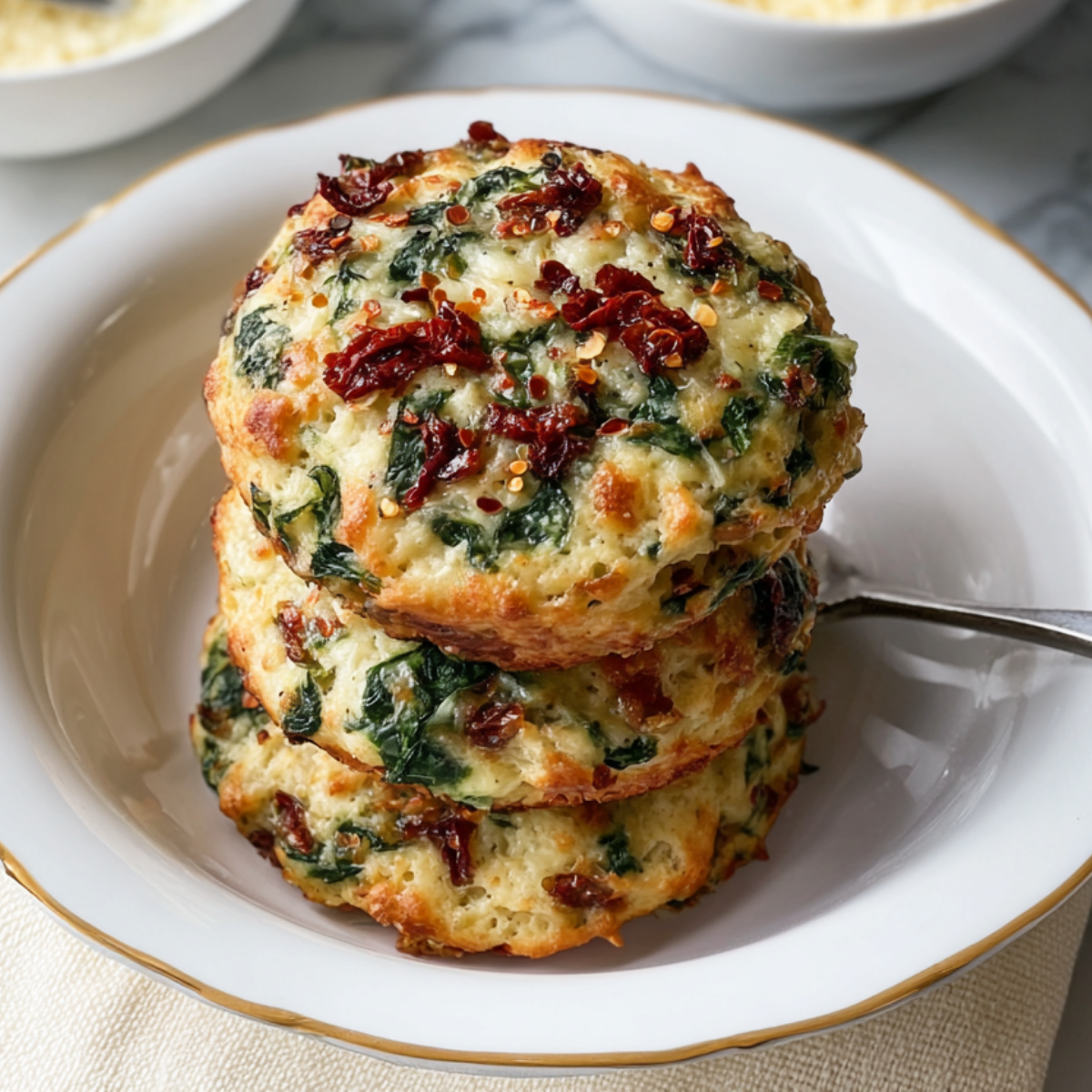
    These biscuits are the kind of thing you make once and immediately add to the permanent rotation. Keto, gluten-free, packed with protein, and golden and satisfying in a way that most low-carb breakfast food simply is not. The sun-dried tomatoes add a deep, slightly sweet, and tangy punch that makes every bite interesting, the spinach disappears into the egg base in the best possible way, and the cheese on top goes golden and blistered in the oven. Mia eats three before I can wrap the rest for the week. That is not a complaint.

    How To Make Spinach Egg Biscuits

    The successful batch came on the Sunday after the stuck-to-the-pan disaster, when I was determined to get it right. Mia had taken over chopping the sun-dried tomatoes with the small safety knife, which she uses with extreme concentration and a running commentary on how each piece looks. Ben was grating the cheese with what I can only describe as personal grievances, muttering at the grater every time a piece fell. When these came out of the oven properly golden with the cheese blistered on top and the whole kitchen smelling like a warm Italian cafe, both kids dropped what they were doing and came to stand directly next to the tray. I told them to wait five minutes. They waited approximately forty seconds.

    The thing that made the second batch perfect was parchment paper and giving the biscuits enough space on the tray. These need room to spread slightly and brown evenly rather than steaming against each other. I also learned that squeezing every last bit of moisture out of the spinach before it goes into the mixture is non-negotiable. Wet spinach makes wet biscuits that do not hold their shape, and Ben pointed this out during batch number three with the tone of someone who had clearly been waiting to say it for a while.

    Main Ingredients

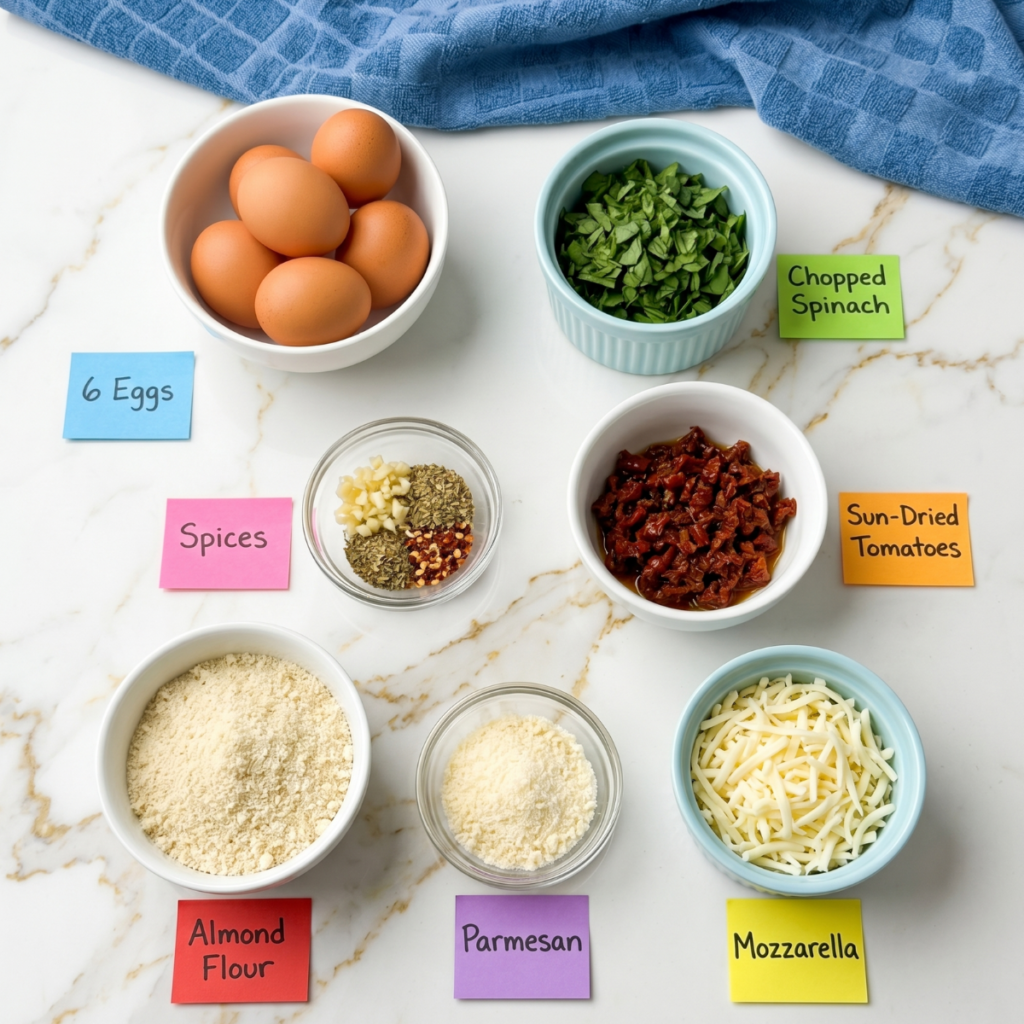
    • 6 large eggs – The base that holds everything together; large eggs give the best structure
    • 1 cup baby spinach, roughly chopped – Squeeze completely dry after chopping; excess moisture is the enemy of a firm biscuit
    • 1/3 cup sun-dried tomatoes, drained and finely chopped – Oil-packed sun-dried tomatoes are more flavorful than dried ones; drain them well and pat dry
    • 1 cup shredded mozzarella cheese, divided – Three quarters goes into the batter, the rest gets scattered on top for that golden blistered finish
    • 1/4 cup grated parmesan – Adds saltiness and a deeper savory flavor that mozzarella alone cannot deliver
    • 1/4 cup almond flour – Gives the biscuits just enough structure without carbs; do not skip or substitute with regular flour
    • 2 cloves garlic, minced – Savory backbone of the whole biscuit
    • 1/2 teaspoon dried oregano – Ties the Italian flavor profile of the sun-dried tomatoes together
    • 1/4 teaspoon red pepper flakes – Adds a subtle warmth that lifts the whole biscuit; optional but worth it
    • Salt and black pepper to taste – Season confidently since the eggs and almond flour need it
    • Cooking spray or olive oil for the tray – And parchment paper; this step is not optional and I learned that the hard way

    Step-by-Step Instructions

    Step 1: Prep the Ingredients

    • Preheat your oven to 375 degrees F and line a large baking sheet with parchment paper; do not skip this step
    • Roughly chop the baby spinach, then gather it in a clean kitchen towel or paper towels and squeeze out as much moisture as possible until no more liquid comes out
    • Drain the sun-dried tomatoes thoroughly, pat them dry with paper towels, and chop finely so they distribute evenly throughout every biscuit
    • Mince the garlic and have all your ingredients measured and ready before the mixing starts so the batter comes together quickly without the eggs sitting too long

    Step 2: Mix the Batter

    • Crack the eggs into a large bowl and whisk until the yolks and whites are fully combined and the mixture is uniform in color
    • Add the almond flour, garlic, oregano, red pepper flakes, salt, and pepper to the eggs and whisk again until completely smooth with no almond flour lumps remaining
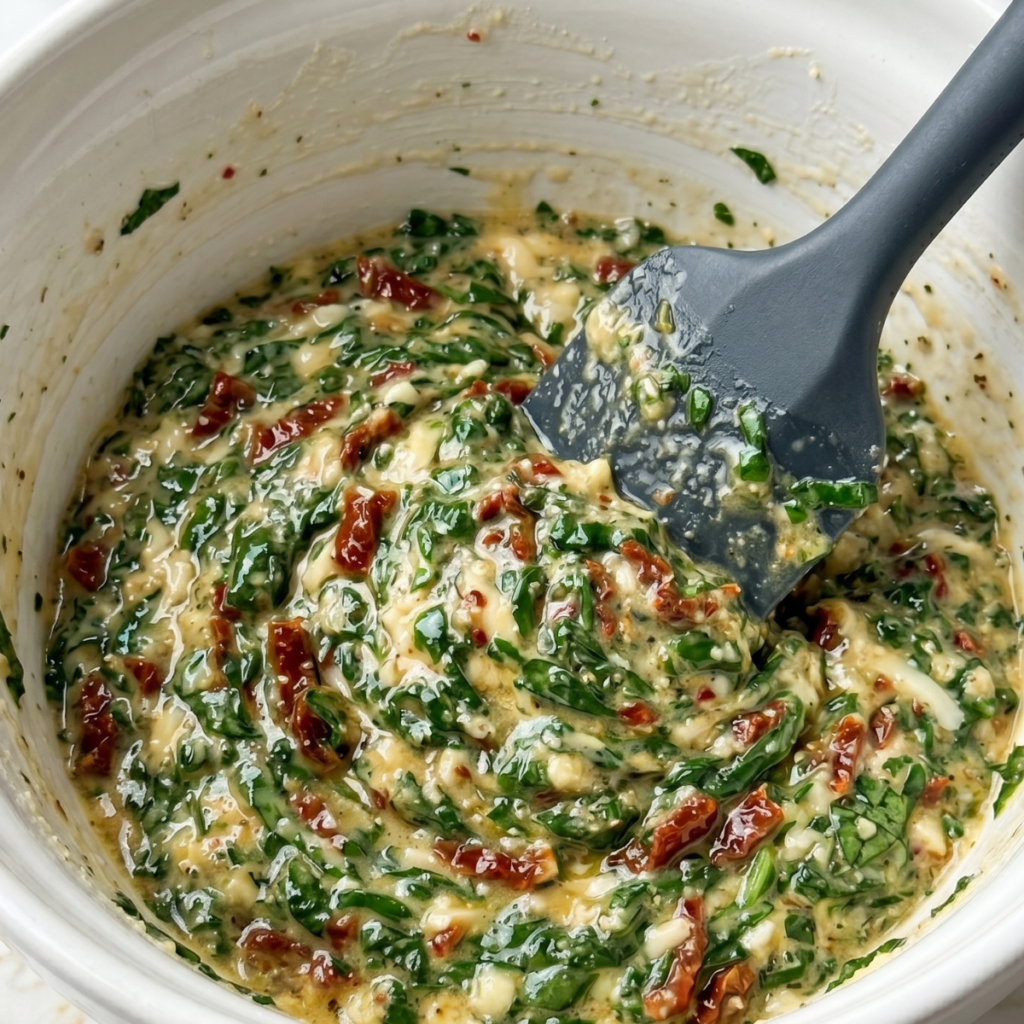
    • Fold in three quarters of the shredded mozzarella, all of the parmesan, the squeezed spinach, and the chopped sun-dried tomatoes until evenly distributed
    • The batter will be thick and slightly sticky, and should hold together when you scoop it; if it feels too wet, the spinach was not squeezed dry enough

    Step 3: Scoop and Top

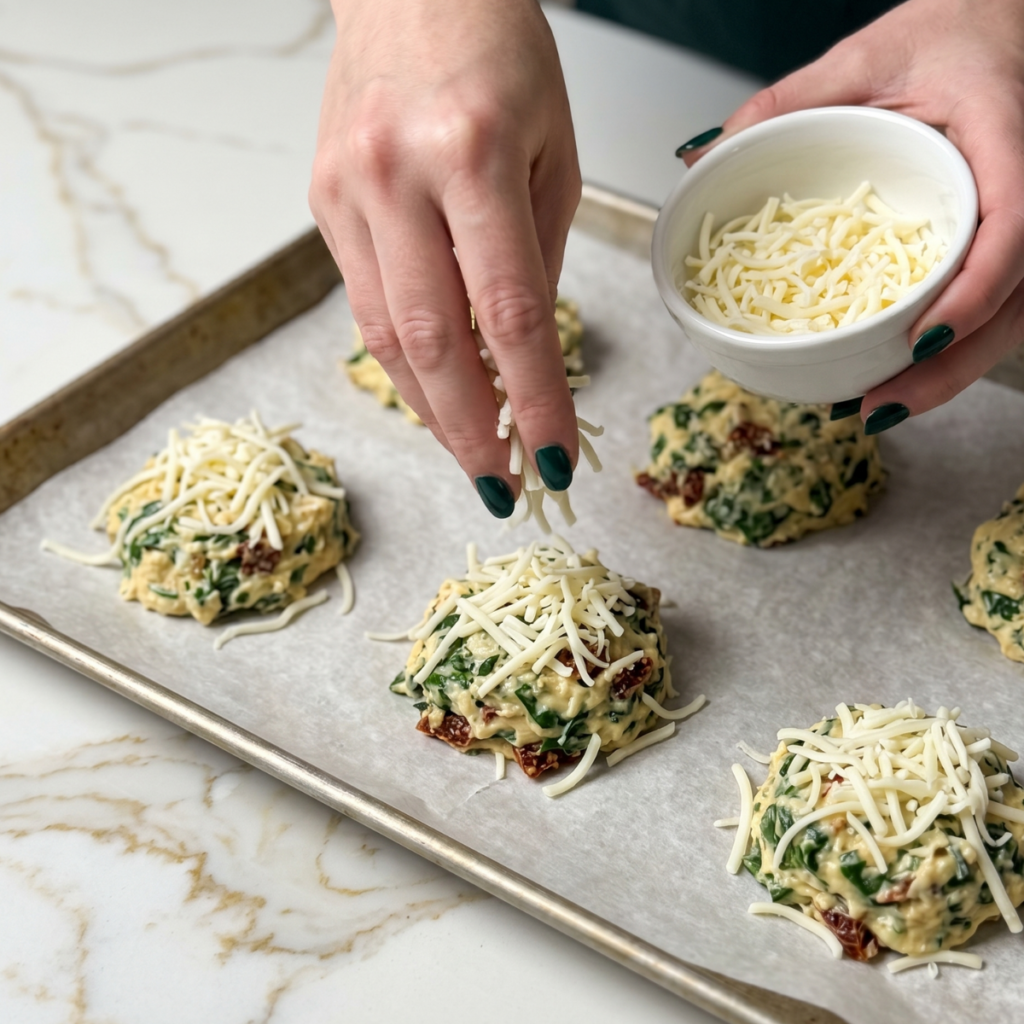
    • Use a large cookie scoop or two spoons to portion the batter onto the prepared parchment-lined baking sheet, making 8 to 9 even mounds spaced at least 2 inches apart
    • Gently press each mound down slightly with the back of the spoon to flatten them into thick disc shapes rather than tall domes
    • Scatter the remaining shredded mozzarella evenly over the top of each biscuit so it covers most of the surface and will blister and brown during baking
    • Add a small pinch of extra red pepper flakes and a crack of black pepper on top of each one if you want a little more heat on the surface

    Step 4: Bake and Cool

    • Bake at 375 degrees F for 18 to 22 minutes until the tops are deeply golden, the cheese is blistered in spots, and the edges look set and slightly crisp
    • Let the biscuits cool on the tray for 5 minutes before attempting to move them; they firm up significantly as they cool and will hold together much better once they have rested
    • Slide a thin spatula carefully underneath each biscuit and lift gently; they should release cleanly from the parchment with no sticking
    • Serve warm immediately or let cool completely before storing for meal prep; they reheat beautifully and taste almost identical to freshly baked

    Spinach Egg Biscuits Variations

    Mia’s “No Spicy Please” Version

    Mia has a formal relationship with red pepper flakes that is best described as hostile. She inspects every biscuit before eating it and removes visible flakes with the precision of someone performing a very small surgery. For her version, skip the red pepper flakes entirely in both the batter and the topping, and add an extra pinch of dried basil instead for a sweeter, more herby flavor. She eats four of these without pause and then asks if there are more, which is the closest thing to a standing ovation she is capable of giving a recipe.

    Ben’s “Double Cheese, Obviously” Version

    Ben’s position on cheese is consistent and unwavering: there is never enough of it. He lobbied for more cheese during the second batch, and his suggestion was not wrong. For Ben’s version, increase the mozzarella in the batter to a full cup and add an extra generous scatter on top before baking. The cheese melts throughout the biscuit and creates little pockets of molten mozzarella inside every bite alongside the golden crust on top. Ben calls it “the real version,” and I have stopped arguing.

    The Meal Prep Sunday Version

    This is the version I make in a double batch every Sunday without fail. Two trays, eighteen biscuits, the whole week sorted in forty minutes. I wrap them individually in paper towels, store them in a zip-lock bag in the fridge, and both kids can grab one before school without any morning chaos. Ben reheats his in the toaster oven for three minutes and says it is better than a breakfast sandwich. Mia eats hers cold out of the bag sometimes, which she describes as “fine.” Coming from Mia, “fine” is a full endorsement.

    Substitutions

    Almond flour to coconut flour: Coconut flour absorbs much more liquid than almond flour, so use only 2 tablespoons in place of the quarter cup. The texture will be slightly denser and less crumbly, but it still works well. Do not substitute regular all-purpose flour if you need this to stay keto and gluten-free.

    Sun-dried tomatoes to roasted red peppers: Finely chopped drained roasted red peppers give a sweeter, less intense flavor than sun-dried tomatoes but work beautifully in the same quantity. Pat them very dry before adding since they contain more moisture than sun-dried tomatoes and can affect the batter consistency.

    Mozzarella to cheddar or Gruyère: Sharp cheddar gives a more intense, slightly tangy flavor that pairs well with the sun-dried tomatoes and garlic. Gruyere adds a nutty richness that makes these feel genuinely fancy for a meal prep biscuit. Both melt and blister beautifully on top during baking.

    Fresh spinach to frozen spinach: Frozen spinach works perfectly here but must be completely thawed and squeezed so aggressively dry that you almost cannot squeeze anymore. Frozen spinach holds significantly more water than fresh, and if not completely dried, it will make the batter too loose to hold its shape on the tray.

    Equipment

    • Large baking sheet
    • Parchment paper (non-negotiable after my first batch disaster)
    • Large mixing bowl for the batter
    • Whisk for the eggs and dry ingredients
    • Rubber spatula or wooden spoon for folding
    • Large cookie scoop or two tablespoons for portioning
    • Clean kitchen towel or paper towels for squeezing the spinach
    • Sharp knife and cutting board for the sun-dried tomatoes and garlic
    • Box grater for the parmesan if not using pre-grated
    • Thin spatula for lifting the biscuits off the tray

    Storage Tips

    Make Ahead

    • The batter can be mixed up to 24 hours ahead, covered tightly, and stored in the fridge; give it a good stir before scooping since the almond flour settles slightly
    • Bake the full batch on Sunday and the whole week of breakfasts is done; these are genuinely one of the best zero-carb meal prep options. I have found
    • Double the recipe for two trays and bake them simultaneously on different oven racks, rotating halfway through for even browning

    Refrigerator

    • Store cooled biscuits in an airtight container or zip-lock bag in the fridge for up to 5 days
    • Wrap each biscuit individually in a paper towel before storing to absorb any residual moisture and keep the bottoms from going soggy
    • The flavor actually improves on days two and three as the sun-dried tomato and garlic notes deepen in the fridge

    Freezing

    • Freeze completely cooled biscuits in a single layer on a tray, then transfer to a freezer bag once solid, for up to 2 months
    • Thaw overnight in the fridge or reheat directly from frozen in a 350 degree F oven for 8 to 10 minutes
    • Do not microwave from frozen, as the egg base gets rubbery; oven reheating from frozen gives a result almost indistinguishable from freshly baked

    Reheating

    • Reheat in a toaster oven at 350 degrees F for 3 to 4 minutes for the best result; the cheese gets slightly melty again and the edges crisp back up
    • Microwave reheating works at 50 percent power for 30 to 45 seconds; cover with a damp paper towel to prevent the egg from drying out
    • These biscuits also taste excellent at room temperature after 15 minutes out of the fridge, which makes them genuinely grab-and-go for rushed school mornings

    Family Secret Worth Sharing

    My mom had a rule about any egg-based baked dish that I thought was fussy until I understood why: always let the batter rest for ten minutes before scooping. She said eggs need a little time to fully absorb any dry ingredients mixed into them, and the texture of everything baked with eggs is better for it. I tested this with and without the rest on these biscuits, and she was completely right. The batch that rested had a tighter, more cohesive structure and held together on the tray instead of spreading too flat. Ben watched me wait the ten minutes once and said “why aren’t we scooping yet?” I told him Grandma’s rule. He looked at the batter for a moment and then said, “Okay, but she better be right.” She was. She always was.

    Troubleshooting FAQs

    My biscuits are spreading too flat on the tray instead of holding their shape. What went wrong?
    Two things cause flat biscuits: wet spinach or batter that has not been rested. Squeeze the spinach until it seems like nothing more can come out and then squeeze it one more time. Also let the batter rest for ten minutes after mixing so the almond flour has time to absorb the egg and the mixture becomes slightly firmer and more scoopable. Chilling the batter for twenty minutes in the fridge before scooping also helps significantly.

    The biscuits stuck to the pan even with cooking spray. How do I fix it?
    Parchment paper is the only reliable solution for egg-based biscuits. Cooking spray alone is not enough because the egg proteins bond directly to any unlined metal surface during baking. Line the tray with parchment every single time; let the biscuits cool for the full five minutes before lifting; and use a thin, flexible spatula rather than a thick one to get cleanly underneath each one.

    The inside of my biscuits is still wet after the bake time. What happened?
    The biscuits were either too thick, the oven was not fully preheated, or the spinach added too much moisture to the batter. Flatten each mound slightly more before baking so they are no thicker than about three quarters of an inch. Make sure your oven has reached the full 375 degrees F before the tray goes in, and always squeeze the spinach completely dry before adding it.

    Can I make these dairy-free?
    Yes, with some adjustments. Replace the mozzarella with a meltable dairy-free shredded cheese and the parmesan with two tablespoons of nutritional yeast for that savory depth. The texture of the biscuit is slightly different without the real cheese structure, but they still hold together well, and the flavor from the sun-dried tomatoes, garlic, and oregano carries the whole thing beautifully.

    Sunday Prep, Five-Day Payoff

    Sunday afternoons in our kitchen smell like garlic and sun-dried tomatoes now, and Monday through Friday mornings are genuinely easier because of it. Ben grabs two from the fridge and reheats them in the toaster oven while making his lunch. Mia eats hers cold in the car and calls it efficient. These spinach egg biscuits have become one of our most depended-on keto breakfast and meal prep recipes in the whole weekly rotation, sitting right alongside the other healthy spinach and egg breakfast recipes I reach for when I want real food without a lot of weekday effort. For the mornings when we need something quick alongside a drink, these pair perfectly with our healthy carrot juice recipe for a complete low-carb start that actually keeps everyone going until lunch. Some recipes quietly become the ones your whole routine is built around, and this one did exactly that.

  • 5-Minute Fluffy Mushroom Spinach Scrambled Eggs

    5-Minute Fluffy Mushroom Spinach Scrambled Eggs

    I had the heat too high and stirred too fast and produced what Ben described as “yellow bouncy bits.” He was nine and he was completely correct. Mia flatly refused to eat them on principle. I stood there staring at the pan, made them again slowly, and absolutely everything changed. These mushroom spinach scrambled eggs are now the most requested breakfast in our entire house.

    Why This Recipe Is Special

    Most scrambled eggs are fine. These are genuinely good. The mushrooms get properly golden before anything else goes in, which gives the whole dish a deep savory base that plain scrambled eggs simply do not have. The spinach wilts into the eggs in the last thirty seconds and adds color and freshness without making things soggy. The eggs themselves, cooked low and slow, come out in those big, soft, glossy curds that feel like something a restaurant actually tried to make. Ben calls them “fancy eggs” and requests them on school mornings, which tells you everything.

    How To Make Mushroom Spinach Scrambled Eggs

    The version that worked happened on a quiet Saturday when I had more time and less coffee-fueled impatience than usual. Mia was sitting on the counter eating mushroom slices straight from the cutting board before I could stop her. Ben was cracking the eggs into the bowl with excessive confidence and getting shell in approximately thirty percent of them. When the mushrooms hit the hot pan and that deep buttery, earthy smell went through the kitchen, Mia stopped eating them raw and said “okay that smells better than eating them plain.” High bar. She cleared it.

    The lesson that changed everything was learning that scrambled eggs and mushrooms need to be cooked separately before they come together. If you throw the eggs in with uncooked mushrooms, the mushrooms release water, the eggs cook in that liquid, and you get watery, rubbery eggs every single time. Golden mushrooms, first completely done, are set aside; eggs are cooked alone on low heat, then everything comes together at the very end. Ben watched me do it this way once and said “oh, that is actually a different recipe.” It is the same recipe. It is just done right.

    Main Ingredients

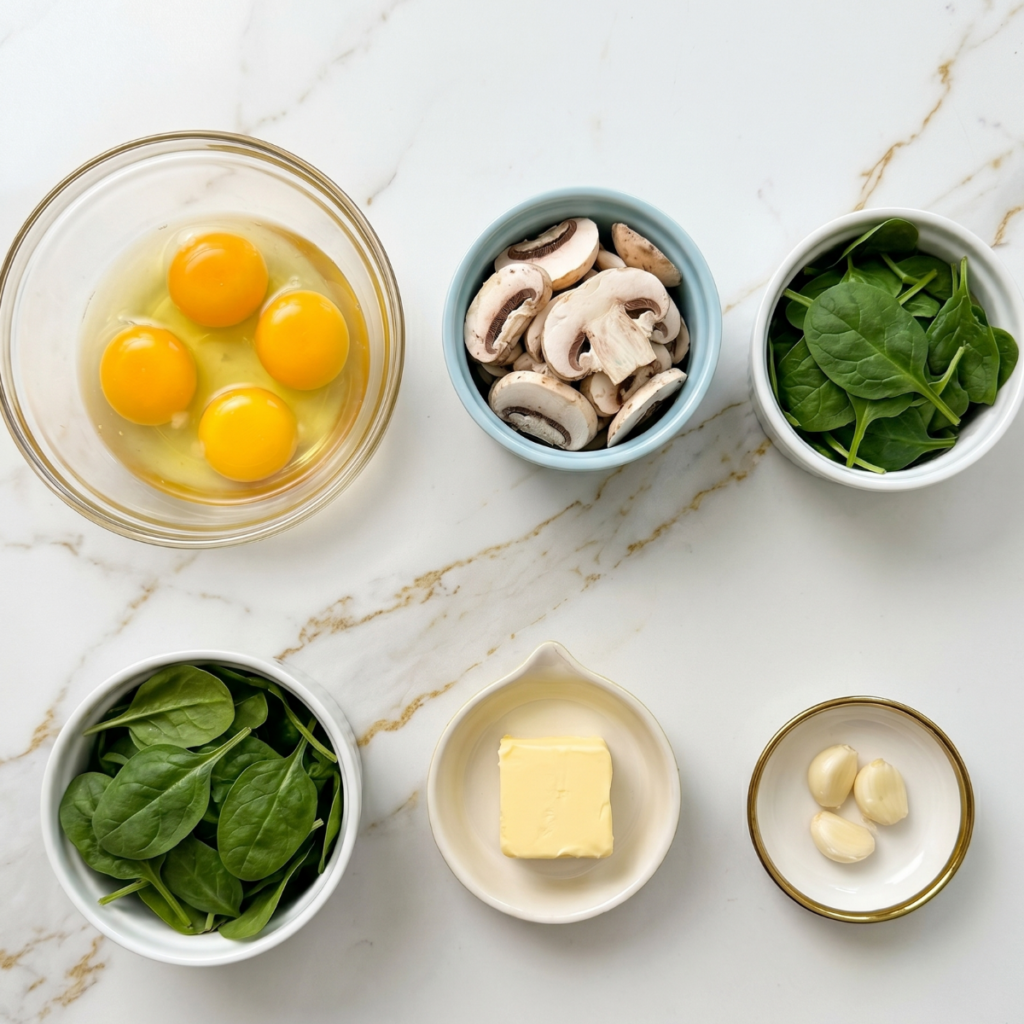
    • 4 large eggs – The base; crack them into a bowl and whisk well before they go anywhere near the pan
    • 1.5 cups cremini or button mushrooms, sliced – Cremini have a deeper flavor than white button; slice them evenly so they cook at the same rate
    • 2 cups fresh baby spinach – Goes in at the very end; it wilts down dramatically so use more than you think you need
    • 2 tablespoons unsalted butter, divided – One tablespoon for the mushrooms, one for the eggs; butter gives a richness that oil alone cannot match
    • 2 tablespoons whole milk or cream – Whisked into the eggs before cooking for the creamiest, softest curds
    • 2 cloves garlic, minced – Added to the mushrooms; gives the whole dish its savory backbone
    • Salt and black pepper to taste – Season the mushrooms as they cook and the eggs just before they set
    • 1/4 teaspoon red pepper flakes – Optional but adds a gentle warmth that lifts the whole dish; leave out for the kids’ version
    • Fresh chives or parsley, chopped – For garnish; adds a fresh finish that makes the whole plate look intentional

    Step-by-Step Instructions

    Step 1: Whisk the Eggs

    • Crack the eggs into a medium bowl and add the milk or cream, a pinch of salt, and a few cracks of black pepper
    • Whisk vigorously for about 60 seconds until the yolks and whites are completely combined and the mixture looks uniform in color with small bubbles on the surface
    • The more air you whisk in at this stage the fluffier and lighter the final curds will be, so do not rush this step
    • Set the whisked eggs aside at room temperature while you cook the mushrooms; do not add them to a cold pan straight from the fridge

    Step 2: Cook the Mushrooms

    • Heat one tablespoon of butter in a large non-stick skillet over medium-high heat until the butter foams and just starts to turn golden
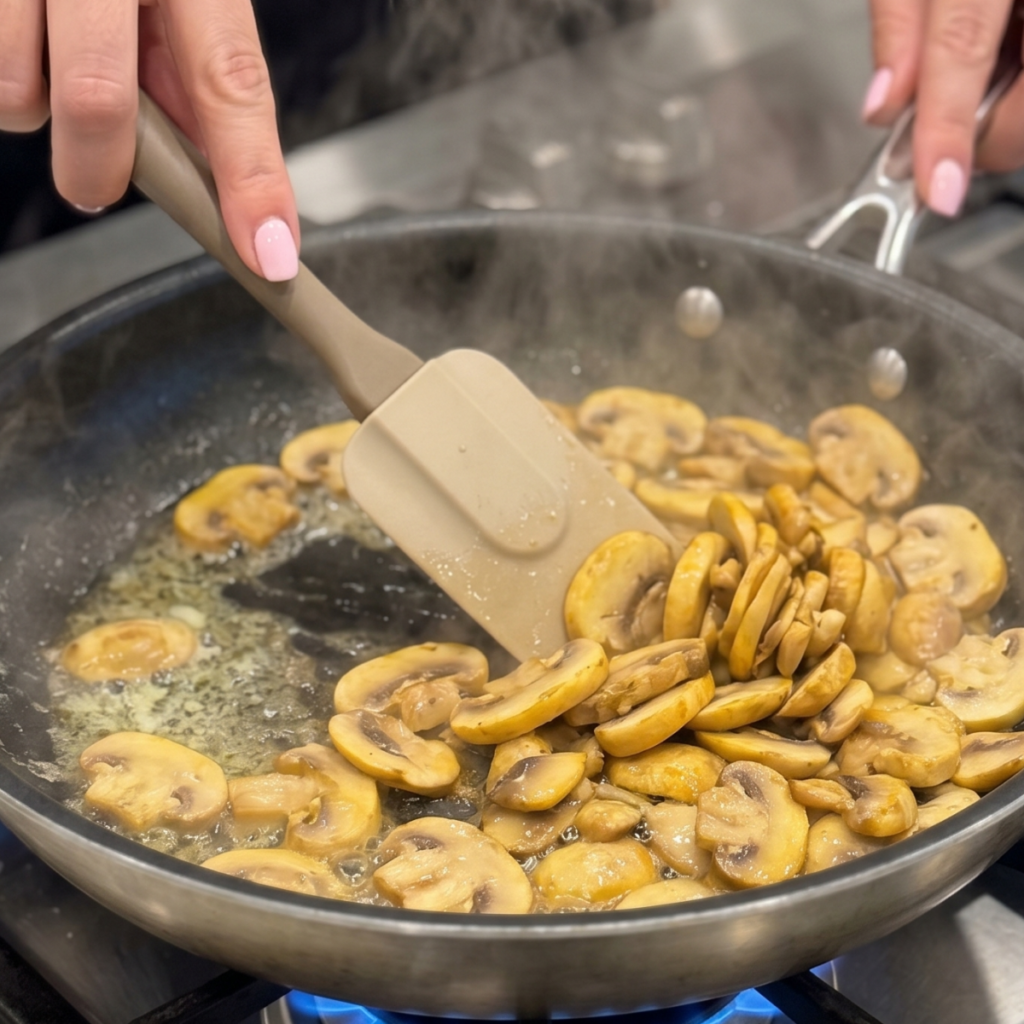
    • Add the sliced mushrooms in a single layer and cook without stirring for 2 to 3 minutes until the undersides are deeply golden and they have released most of their moisture
    • Stir once, add the minced garlic and red pepper flakes if using, and cook for another minute until the garlic is fragrant and the mushrooms are golden all over
    • Season generously with salt and pepper, then transfer the mushrooms to a plate and set aside while you cook the eggs in the same pan

    Step 3: Scramble the Eggs Low and Slow

    • Reduce the heat to low and add the remaining tablespoon of butter to the same skillet; let it melt gently without browning
    • Pour in the whisked eggs and let them sit undisturbed for about 20 seconds until just the edges begin to set
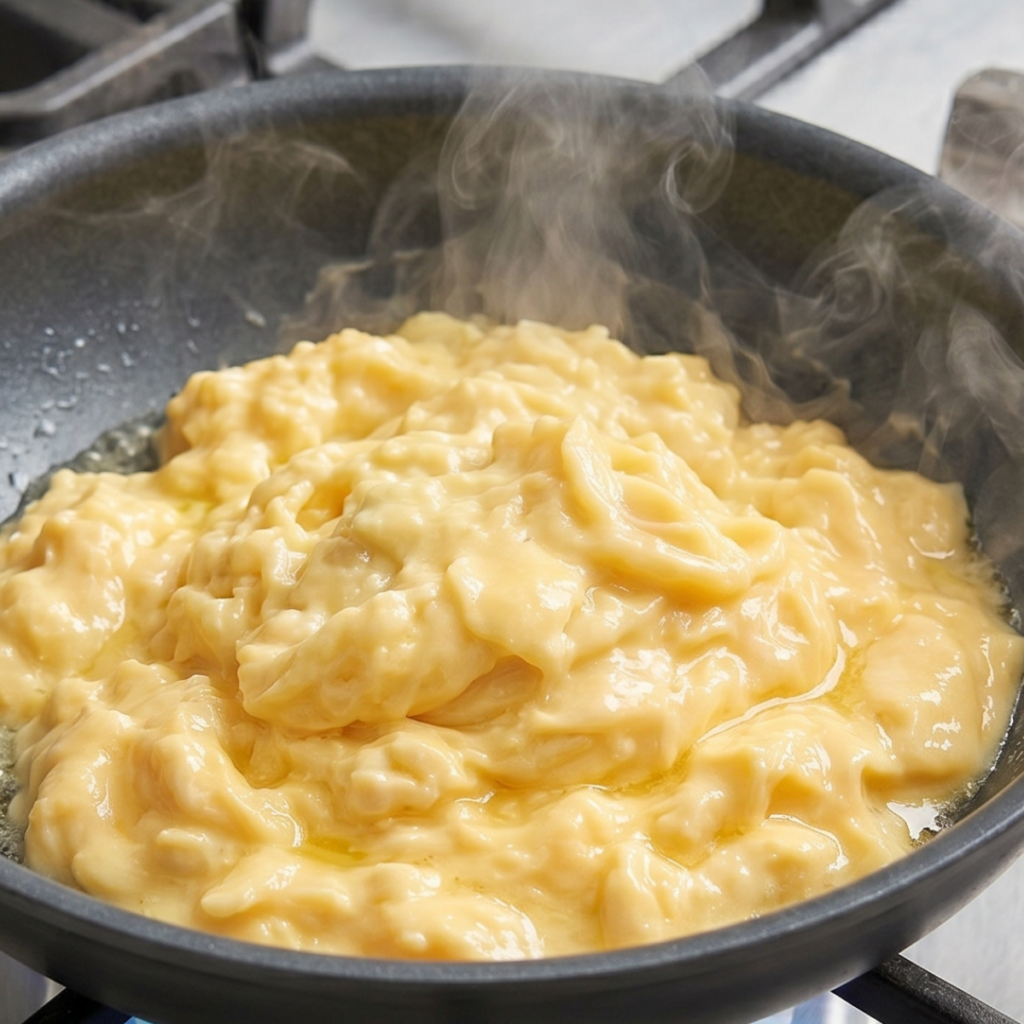
    • Using a rubber spatula, push the eggs slowly from the edges toward the center in large, gentle sweeping strokes; do not stir quickly or constantly
    • Continue the slow fold-and-push method for 2 to 3 minutes until the eggs are in large soft glossy curds and still look slightly underdone; they will finish cooking from residual heat

    Step 4: Add Spinach, Finish, and Serve

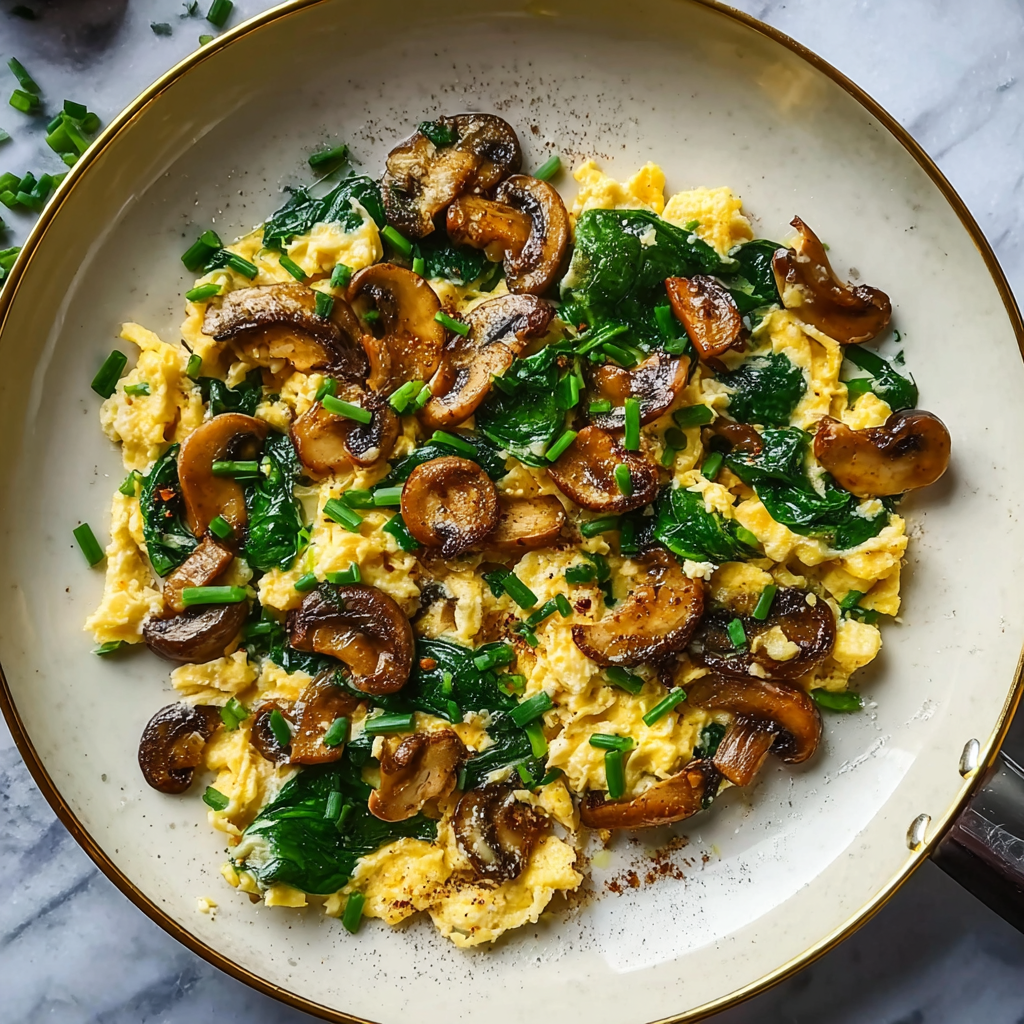
    • Add the fresh baby spinach directly to the eggs in the pan and fold it in gently; the residual heat will wilt it in about 30 seconds without overcooking the eggs
    • Return the golden mushrooms to the pan and fold everything together with one or two gentle turns so the mushrooms are distributed without breaking up the egg curds
    • Remove the pan from the heat immediately and season with a final pinch of salt and pepper; the eggs will continue to firm up slightly as they sit
    • Plate immediately, garnish with fresh chives or parsley, and serve with toast, crusty bread, or alongside whatever else makes the morning feel good

    Mushroom Spinach Scrambled Eggs Variations

    Ben’s “Add Cheese to Everything” Version

    Ben has a standing rule that any egg dish is improved by cheese and he has never once been wrong about this. For his version, fold two tablespoons of grated parmesan or sharp cheddar into the eggs during the last 30 seconds of cooking, right before the spinach goes in. The cheese melts into the curds and adds a slightly salty, savory richness that makes the whole plate feel more substantial. Ben describes this version as “the actual good one,” which I choose not to take personally since he eats two servings every time.

    Mia’s “No Mushrooms, Extra Spinach” Version

    Mia went through a phase of refusing mushrooms entirely based on their texture, which she described as “too wet and too loud.” I did not fully understand the loud part, but I respected the position. For her version, skip the mushrooms entirely and double the spinach, adding it in two batches so it wilts fully without releasing too much liquid at once. A tiny pinch of nutmeg in the eggs gives her version a subtle warmth that she cannot identify but always eats without complaint. She has never asked what it is, and I have never offered the information.

    The High-Protein Meal Prep Version

    On the Sundays when I want the whole week’s breakfasts sorted in twenty minutes, I make a triple batch of the mushroom and spinach mixture, store it in the fridge, and just cook fresh eggs each morning with a scoop of the pre-cooked filling. The vegetables hold beautifully for four days, and fresh eggs take two minutes. This is one of the best prep meal ideas I have come across for busy weekday mornings when the kids need a real breakfast before school and nobody has time to cook something properly from scratch.

    Substitutions

    Cremini mushrooms to portobello or shiitake: Portobello mushrooms have a meatier texture and stronger flavor that makes the dish feel even more substantial. Shiitake adds an earthy, almost smoky quality that pairs beautifully with the eggs. Both need a slightly longer cook time than cremini, so give them an extra minute in the pan before adding the garlic.

    Fresh spinach to frozen spinach: Frozen spinach works in a time crunch but must be completely thawed and squeezed very dry before it goes into the pan. Excess moisture from frozen spinach will make the eggs watery in exactly the same way that undercooked mushrooms do. When properly drained, it tastes nearly identical to fresh and is a perfectly good weekday shortcut.

    Butter to olive oil or ghee: Olive oil gives a slightly more savory, less rich result that works well for anyone avoiding dairy. Ghee has an even higher smoke point than butter and adds a slightly nutty quality that is genuinely lovely with the mushrooms. Or substitutes in the exact same quantity with almost no change to the final dish.

    Whole milk to oat milk or no liquid at all: A small splash of oat milk works as a dairy-free swap and gives a similar creamy texture to the eggs. Leaving the liquid out entirely is also a perfectly valid option; the eggs will be slightly less fluffy and a little firmer but still delicious. Some people prefer their scrambled eggs without any liquid, and this recipe works both ways.

    Equipment

    • Large non-stick skillet (10 to 12-inch; non-stick is important for low-heat scrambling without sticking)
    • Medium mixing bowl for whisking the eggs
    • Whisk or fork for combining the eggs and milk
    • Rubber spatula (not a metal spoon or wooden spoon; rubber gives the gentlest fold)
    • Sharp knife and cutting board for the mushrooms and garlic
    • Plate for resting the cooked mushrooms while the eggs cook
    • Measuring spoons for the butter and seasoning

    Storage Tips

    Make Ahead

    • Cook the mushroom and spinach mixture up to 4 days ahead and store in a sealed container in the fridge; reheat briefly in the pan while the fresh eggs cook
    • Whisk the egg mixture (eggs plus milk and seasoning) up to 24 hours ahead and store covered in the fridge; give it a quick re-whisk before using
    • This is one of the best quick-to-go breakfast ideas for weekday mornings when prep has been done the night or weekend before

    Refrigerator

    • Store leftover cooked scrambled eggs in an airtight container in the fridge for up to 2 days; scrambled eggs do not hold as well as other dishes but are still perfectly good reheated
    • Store the mushroom and spinach filling separately from the eggs if possible for the best texture when reheating
    • Do not press the eggs flat in the container; leave them loosely packed so the curds do not compress and turn dense

    Freezing

    • The cooked mushroom and spinach mixture freezes well for up to 1 month; freeze in individual portions for easy single-serve breakfasts
    • Cooked scrambled eggs can be frozen but the texture changes noticeably; they become slightly watery and grainy on thawing, which most people find acceptable for a quick weekday breakfast
    • Thaw frozen portions overnight in the fridge and reheat gently in a skillet rather than the microwave for the best texture recovery

    Reheating

    • Reheat leftover scrambled eggs in a non-stick pan over the lowest possible heat, stirring gently, just until warmed through; high heat will make them rubbery
    • Microwave reheating at 50 percent power in 20-second bursts works in a pinch; stir between each burst and stop the moment the eggs are just warm
    • A tiny extra knob of butter added to the pan when reheating refreshes the richness and brings the eggs back closer to their original texture

    Family Secret Worth Sharing

    My mom had one rule about scrambled eggs that she repeated every single time anyone made them in her kitchen: take them off the heat before you think they are ready. She said eggs keep cooking for thirty seconds after the pan is off the stove, and the people who make rubbery eggs are always the ones who wait too long. She was right about this in the same way she was right about most things in the kitchen. I pull mine when the curds are still slightly glossy and just a touch underdone, and they are perfect by the time they hit the plate. Ben watched me do this once and asked why I was stopping early. I told him Grandma’s rule. He nodded, took a bite, and said, “Grandma understood eggs.” She really did.

    Troubleshooting FAQs

    My scrambled eggs keep coming out rubbery and dry. What am I doing wrong?
    Two things cause rubbery eggs every single time: too high a heat and cooking them too long. Scrambled eggs need low heat and patient, slow folding. The moment you feel tempted to turn up the heat because it is taking too long, resist it. Pull the eggs off the heat when they still look slightly underdone and let residual heat finish the job. The thirty-second rule from the family secret section is the most important thing in this whole recipe.

    The mushrooms are releasing a lot of water and going soggy instead of golden. How do I fix it?
    Do not crowd the pan and do not stir too early. Mushrooms need space and undisturbed contact with a hot surface to develop color. If you pack them in too tightly, they steam in each other’s moisture and go grey and soft. Cook them in a single layer, leave them alone for the first 2 to 3 minutes, and only stir once they have a visible golden color on the bottom. If your pan is not large enough, cook them in two batches.

    The spinach made my eggs watery. What went wrong?
    The spinach went in too early or the heat was too high when it was added. Fresh baby spinach wilts extremely quickly from residual heat alone and does not need any additional cooking time. Add it to the eggs after the pan comes off the heat, fold it in, and serve immediately. If spinach sits in a hot pan for more than 30 to 40 seconds, it releases liquid that makes the whole dish wet.

    Can I make this recipe with just egg whites?
    Yes, with one small adjustment. Egg whites cook faster than whole eggs and have less fat to slow the cooking process, so they set more quickly and go rubbery more easily. Use a slightly lower heat than you would for whole eggs and remove them from the heat even earlier. Two tablespoons of cream or a small knob of cream cheese folded in helps compensate for the missing richness from the yolks.

    The Breakfast That Finally Made Mornings Worth Getting Up For

    There is something about a pan of properly made scrambled eggs that makes a Tuesday morning feel like it was planned with intention rather than survived on autopilot. Ben eats his with toast and a level of focused satisfaction that he usually reserves for video games. Mia eats hers slowly, which is how you know she is genuinely enjoying something. These mushroom spinach scrambled eggs sit naturally right alongside our healthy high-protein breakfast ideas as one of the most filling and genuinely nourishing starts to the day, and on the mornings when I want something equally easy but with a completely different flavor, our healthy carrot juice recipe alongside these eggs makes the whole morning feel properly taken care of. For the weeks when I am meal prepping seriously and want everything sorted in one go, this recipe alongside our keto chicken broccoli recipe covers breakfast and dinner in one prep session, and the whole week runs smoother. Some mornings are just better than others, and this recipe is a good reason why.

  • 4-Layer Irresistible Strawberry Cheesecake Dump Cake

    4-Layer Irresistible Strawberry Cheesecake Dump Cake

    I misread the recipe and used a full cup of butter instead of half. It came out bubbling and slightly translucent, and Ben said “is it supposed to glow?” It was. But Mia took a bite and declared it the best thing I had ever made. That buttery disaster is how I discovered that a great strawberry cheesecake dump cake is incredibly hard to ruin.

    Why This Recipe Is Special

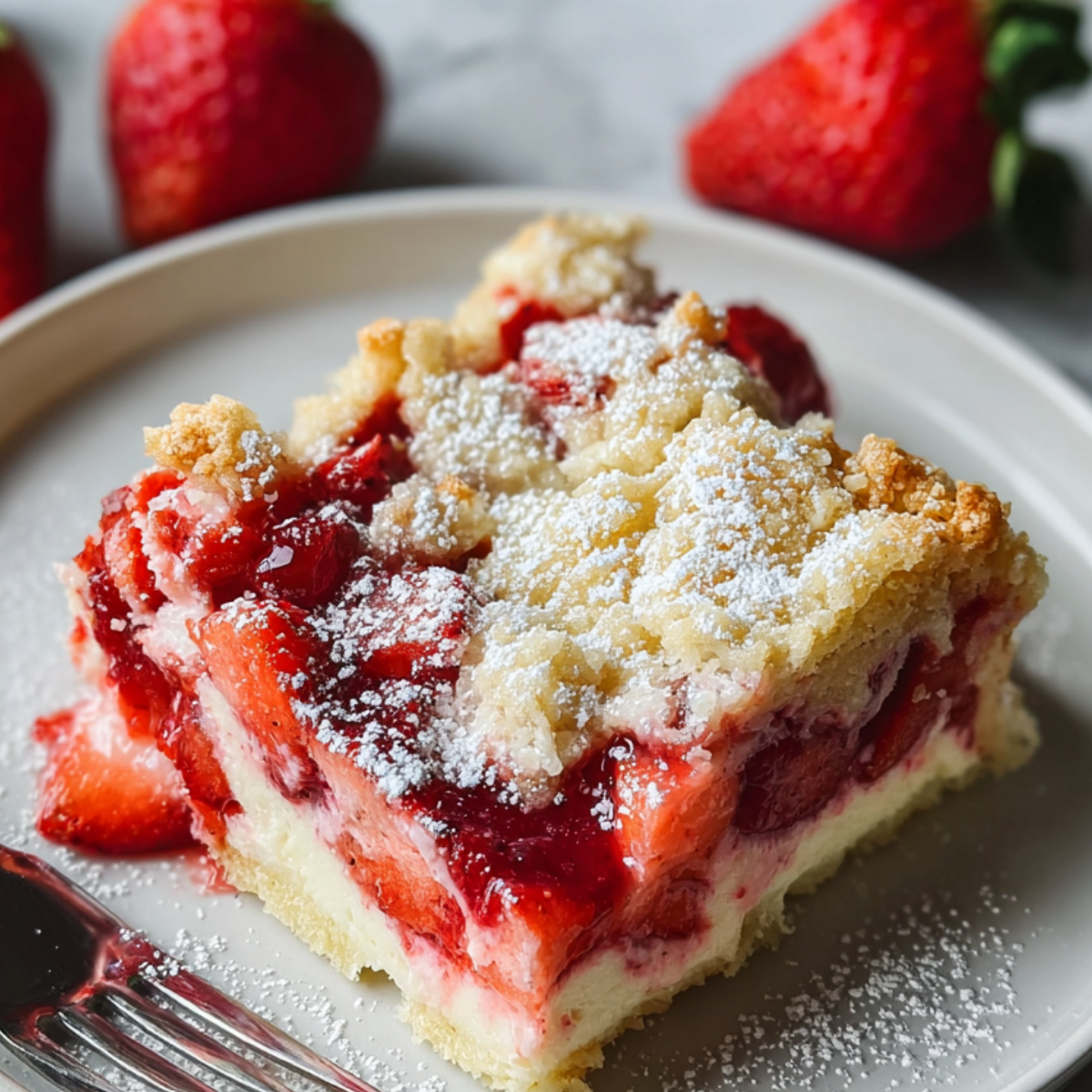
    A dump cake is exactly what it sounds like: you layer everything into a pan, dump butter on top, and let the oven do all the work. But this version has a cream cheese layer tucked between the strawberries and the cake topping that turns the whole thing into something that tastes genuinely special, like a strawberry cheesecake decided to become a cobbler and nobody tried to stop it. There are no mixers, no creaming, no complicated steps, and the whole pan comes together in about ten minutes. Mia calls it “the lazy cake,” and she means it as the highest possible compliment.

    How To Make Strawberry Cheesecake Dump Cake

    The version that actually worked came together on a Saturday afternoon when both kids had declared themselves bored with everything and needed a project. Mia was in charge of spreading the cream cheese layer and took this responsibility so seriously she smoothed it four times with the back of a spoon until she was satisfied with the evenness. Ben was opening the cake mix box and immediately reading the back of it to me at full volume like I had never made a cake before. When the pan went into the oven and the butter started melting down through the cake mix and that warm vanilla-strawberry smell filled the kitchen, both of them planted themselves in front of the oven window and watched it bake like it was something worth watching. It was.

    The thing that makes this recipe work every time is the order of the layers and the patience to not stir anything. The strawberries go in first, the cream cheese goes in the middle, the dry cake mix goes on top completely undisturbed, and the butter gets poured slowly and evenly over everything last. If you mix or stir at any point, the whole texture changes. Ben learned this when he gave the top layer “a little mix” because he thought it looked uneven. It was not uneven. It was on purpose. The subsequent conversation about following recipes was one of the more educational moments we have had in this kitchen.

    Main Ingredients

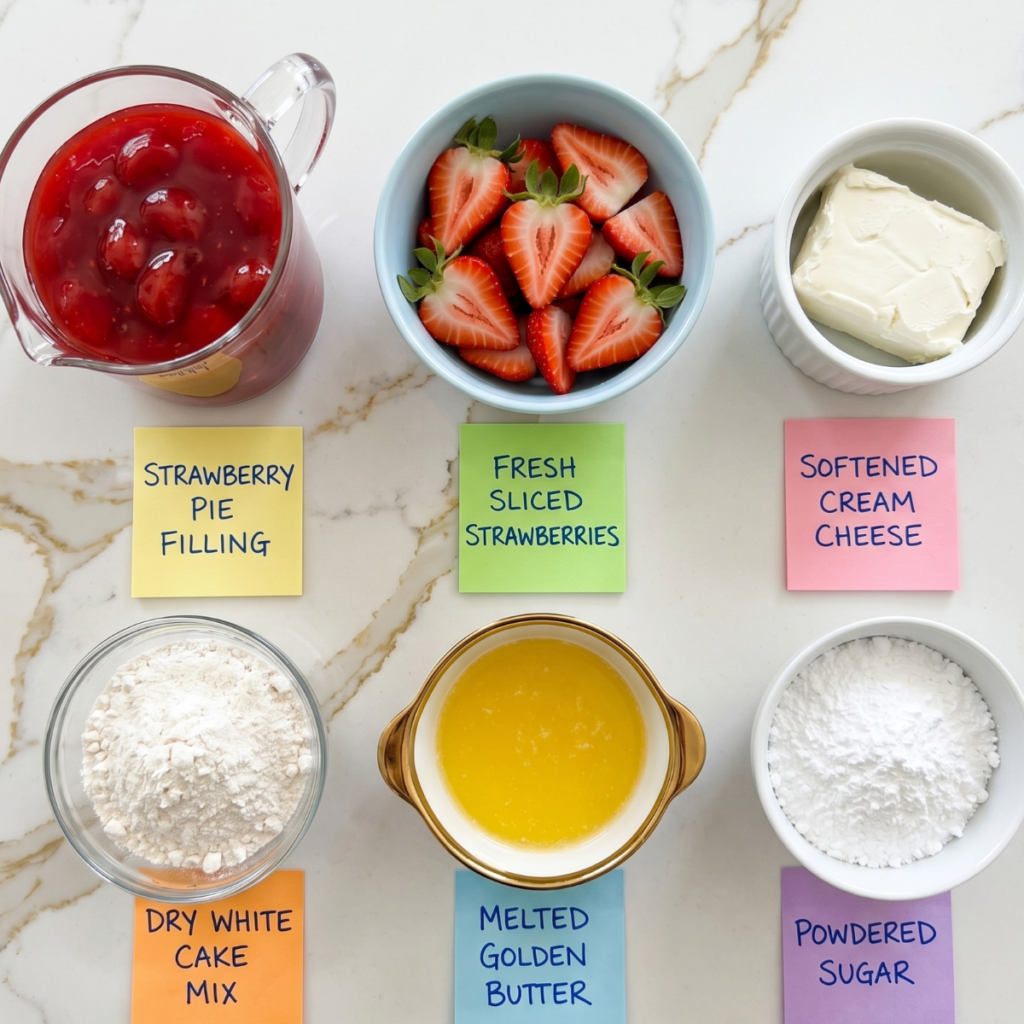
    • 2 cans (21 oz each) strawberry pie filling – The base of everything; the sweetness and body of the strawberry layer comes from here
    • 1 cup fresh strawberries, sliced – Added on top of the pie filling for extra fresh flavor and texture; frozen works too if thawed and drained first
    • 8 oz full-fat block cream cheese, softened – Block only; creates that cheesecake layer in the middle that makes this so much more than a regular dump cake
    • 1/3 cup powdered sugar – Sweetens the cream cheese layer just enough without making it cloying
    • 1 teaspoon vanilla extract – Goes into the cream cheese layer; rounds out the whole cheesecake flavor
    • 1 box (15.25 oz) white or yellow cake mix, dry – Poured straight from the box completely dry; do not add eggs or oil
    • 1/2 cup unsalted butter, melted – Poured slowly and evenly over the dry cake mix; this is what creates the golden cobbler-like topping
    • Powdered sugar for dusting – Optional but makes the finished cake look beautiful and adds a delicate sweetness on top

    Step-by-Step Instructions

    Step 1: Prepare the Pan and Strawberry Layer

    • Preheat your oven to 350 degrees F and lightly grease a 9×13 inch baking dish with butter or cooking spray
    • Pour both cans of strawberry pie filling into the prepared dish and spread evenly across the entire base
    • Scatter the sliced fresh strawberries over the pie filling in an even layer; frozen strawberries must be thawed and thoroughly drained first or the bottom layer will be watery
    • Do not stir the layers together; each layer needs to stay separate so the textures develop correctly during baking

    Step 2: Make and Add the Cream Cheese Layer

    • Beat the softened block cream cheese with the powdered sugar and vanilla extract in a medium bowl until completely smooth, creamy, and lump-free
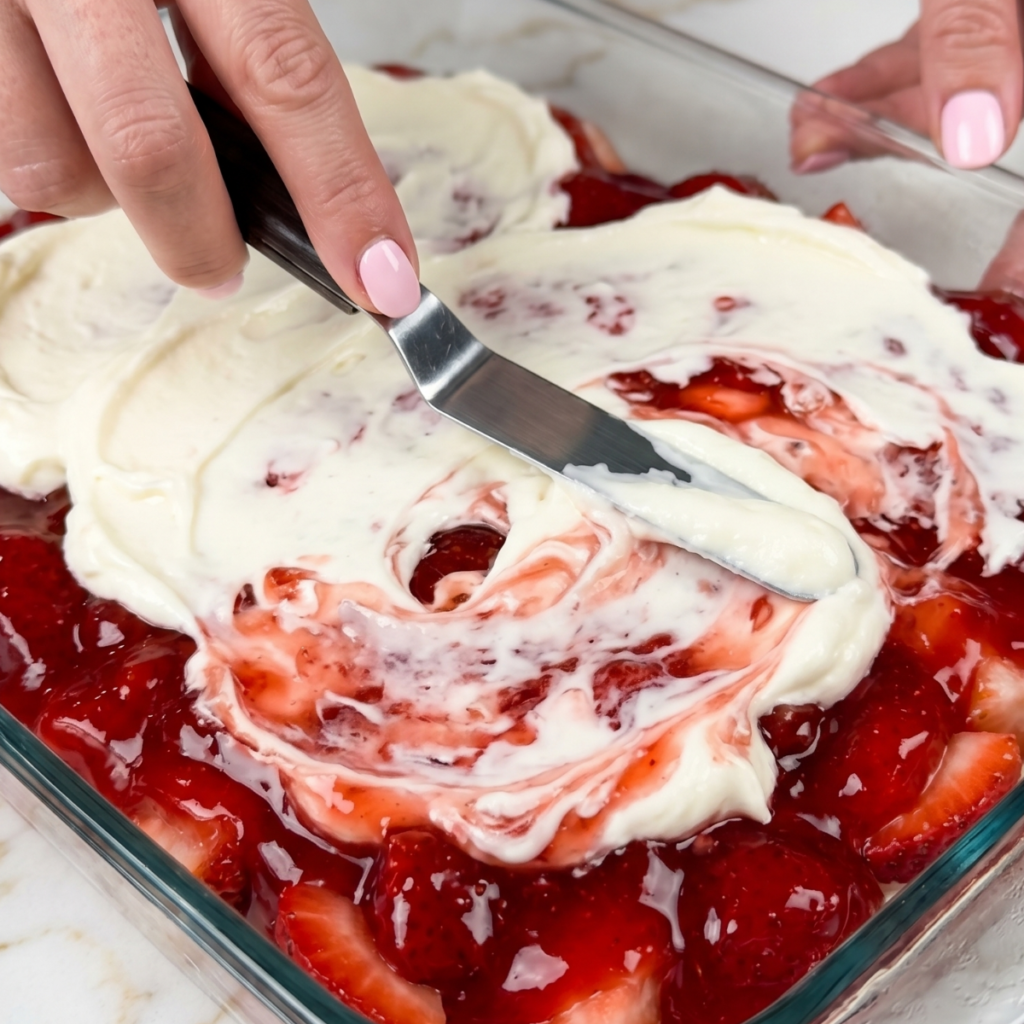
    • Drop spoonfuls of the cream cheese mixture evenly across the top of the strawberry layer, spacing them so every slice will get some of the cheesecake layer
    • Use the back of a spoon or a small offset spatula to gently spread the cream cheese into a rough layer without pressing down into the strawberries
    • The cream cheese layer does not need to be perfectly even; rustic is fine and it will spread further during baking as the heat softens everything

    Step 3: Add the Cake Mix and Butter

    • Open the cake mix box and pour the dry mix evenly over the entire surface of the cream cheese layer; do not level it perfectly; some variation in thickness is fine
    • Do not mix, stir, or disturb the layers at any point; the dry cake mix sits on top exactly as it is
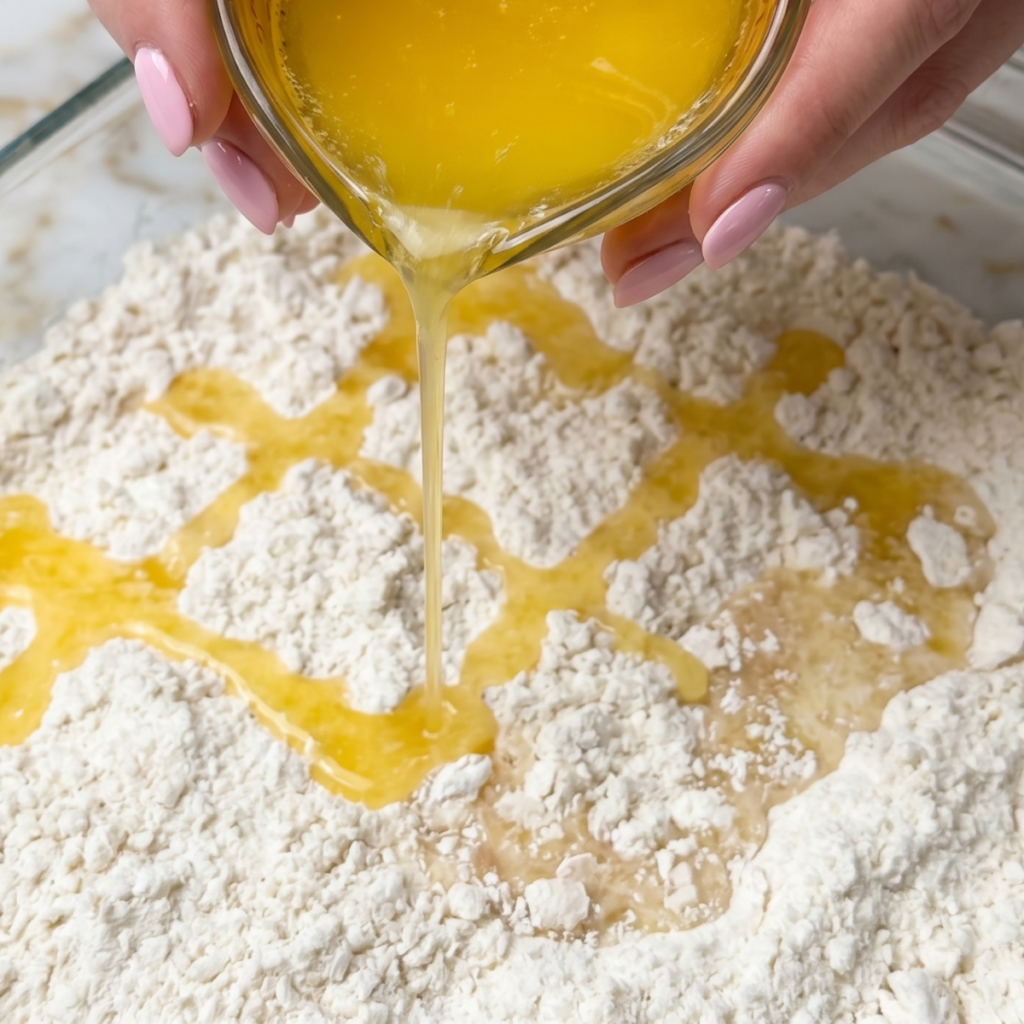
    • Pour the melted butter in a slow, steady stream over as much of the dry cake mix as possible, working in a grid pattern to cover the surface as evenly as you can
    • Some dry cake mix patches will remain visible and that is completely correct; they will absorb moisture from the steam during baking and create a crumbly golden topping

    Step 4: Bake and Serve

    • Bake uncovered at 350 degrees F for 45 to 50 minutes until the top is deep golden brown, the edges are bubbling vigorously, and the center looks set rather than soupy
    • Let the cake rest in the pan for at least 15 minutes before serving; it needs this time to settle and the layers to firm up slightly for the best scoopable texture
    • Dust generously with powdered sugar right before serving while the cake is still slightly warm for the most beautiful presentation
    • Scoop and serve directly from the pan into bowls; this cake is rustic and homey by nature and does not need to be cut into neat squares

    Strawberry Cheesecake Dump Cake Variations

    Mia’s “Extra Strawberries Everywhere” Version

    Mia staged a formal protest the first time I made this because she felt the strawberry-to-cake ratio was unfair to the strawberries. She is six, she has very strong positions, and she was not entirely wrong. For her version, add a third can of strawberry pie filling to the base layer and double the fresh strawberry slices on top. The result is fruitier, saucier, and even more vibrant, and Mia describes it as “the correct amount of strawberry.” She eats hers out of the biggest bowl we own, and I let her because the cake always earns it.

    Ben’s “Lemon Cake Mix Upgrade” Version

    Ben made a discovery that changed our whole household approach to this recipe when he swapped the yellow cake mix for lemon cake mix because that was what we had left in the pantry. The lemon notes against the sweet strawberry filling and the tangy cream cheese layer turned out to be genuinely exceptional. Ben announced after the first bite that it was “actually better” with the same calm certainty he brings to all his food opinions. He was right. We now keep lemon cake mix specifically for this recipe, and it has become the version we make for company.

    The Frozen Strawberry Year-Round Version

    This is the version I make from November through March when fresh strawberries cost more than a small mortgage. Use two 16-ounce bags of frozen strawberries instead of the fresh sliced layer on top. Thaw them completely, drain off all the liquid very thoroughly, and toss with two tablespoons of sugar before layering. The frozen version tastes nearly identical to the fresh version and makes this one of the best dump cake recipes for any time of year, not just strawberry season. Both kids cannot tell the difference, and I have not mentioned it.

    Substitutions

    Strawberry pie filling to cherry or blueberry pie filling: Any canned fruit pie filling works in this recipe with zero changes to the method or timing. Cherry gives a more tart, jewel-toned result. Blueberry is sweeter and more jammy. Mixed berry is a personal favorite for summer gatherings. The cream cheese layer plays beautifully with all of them.

    White cake mix to vanilla or butter cake mix: Any plain or lightly flavored boxed cake mix works here. Butter cake mix gives a richer, more golden topping. Vanilla gives a slightly more delicate result. Lemon cake mix (Ben’s discovery) is the version most likely to make your guests ask for the recipe immediately. Avoid strongly flavored mixes like chocolate, which will compete with the strawberry.

    Full-fat block cream cheese to Neufchatel cheese: Neufchatel is lower in fat than full-fat cream cheese but behaves almost identically when softened and beaten. The texture of the cream cheese layer will be very slightly less rich, but it will still be completely delicious and still melt into that signature cheesecake-like pocket in the finished cake.

    Melted butter to melted coconut oil: Refined coconut oil works as a dairy-free substitute in exactly the same quantity. The topping will still go golden and slightly crumbly during baking and the finished cake tastes almost identical. Unrefined coconut oil adds a subtle coconut note that actually works surprisingly well with the strawberry layer.

    Equipment

    • 9×13 inch baking dish (glass or ceramic preferred for even heating)
    • Medium mixing bowl for the cream cheese layer
    • Hand mixer or stand mixer for beating the cream cheese smooth
    • Spoon or small offset spatula for spreading the cream cheese layer
    • Liquid measuring cup for the melted butter
    • Fine mesh strainer or sifter for the powdered sugar dusting
    • Large spoon or serving scoop for dishing out the finished cake
    • Oven mitts because the dish will be very hot and the bubbling filling can splatter

    Storage Tips

    Make Ahead

    • Assemble the full dish up to 24 hours ahead, cover tightly with plastic wrap, and refrigerate unbaked; bake straight from the fridge, adding 5 to 10 extra minutes to the bake time
    • The cream cheese mixture can be made up to 2 days ahead and stored covered in the fridge; bring it to room temperature for 20 minutes before spreading for the easiest application
    • This cake is also one of the best party desserts to bake the morning of and serve at room temperature later in the day; the texture is excellent at both warm and room temperature

    Refrigerator

    • Store leftovers covered in the fridge for up to 4 days; the topping softens slightly overnight but the flavor deepens in a very good way
    • Cover the dish with plastic wrap or transfer to an airtight container; the cream cheese layer makes refrigeration non-negotiable after the first day
    • Cold leftover dump cake eaten directly from the fridge with a spoon at midnight is a legitimate life choice and I will not apologize for endorsing it

    Freezing

    • Freeze individual portions in airtight freezer-safe containers for up to 2 months; the texture changes slightly but is still very good when reheated
    • Do not freeze the full assembled unbaked dish, as the cream cheese layer does not freeze well in raw form
    • Thaw frozen portions overnight in the fridge before reheating; do not microwave from fully frozen, as the strawberry layer will heat unevenly

    Reheating

    • Reheat individual portions in the microwave for 60 to 90 seconds until warmed through; the topping softens but the strawberry layer becomes saucy and warm in the best possible way
    • Reheat the full dish in a 325 degree F oven covered loosely with foil for 15 to 20 minutes for the closest result to freshly baked
    • Serve reheated portions with a small scoop of vanilla ice cream and the whole thing tastes like it just came out of the oven regardless of when it was actually made

    Family Secret Worth Sharing

    My mom made dump cakes for every potluck and family gathering from as far back as I can remember, and people asked her for the recipe every single time. Her secret was something she told me years later in the most casual way, like it was obvious: she always stirred a tablespoon of cream cheese into the fruit filling before it went into the pan. Not a lot, just a spoonful, enough to give the fruit layer a faint richness that people could never quite identify. When I started adding the full cream cheese layer on top of that, the whole thing became something genuinely special. Ben tasted it once and said “this one tastes like it was made by someone who really tried. “That is the highest compliment he knows how to give a dessert, and I think my mom would have loved hearing it.

    Troubleshooting FAQs

    The top of my dump cake is dry and powdery instead of golden and crumbly. What happened?
    The butter did not cover enough of the cake mix surface. Next time, pour the butter slowly in a back-and-forth grid pattern to reach as much of the dry mix as possible. You can also melt an extra two tablespoons of butter and add it specifically to any obviously dry patches right before the pan goes in the oven. Some dry spots are normal and will steam-bake to a crumbly texture, but large dry patches stay floury and unpleasant.

    The middle of my cake is still liquid after the full bake time. What do I do?
    Put it back in the oven. A liquid center usually means the dish is too deep, the oven temperature is slightly off, or the fruit filling was very cold when it went in. Cover the edges loosely with foil if they are getting too dark and give the center another 10 to 15 minutes. The cake is done when the center is bubbling actively and a spoon pressed into the topping meets some resistance rather than sinking straight through.

    The cream cheese layer disappeared into the strawberry filling during baking. What went wrong?
    The cream cheese was too warm or too thinly spread. Make sure the cream cheese is properly softened but not melted before you beat it, and drop it in generous spoonfuls rather than spreading it too thin. A thicker application holds its shape better during the bake and creates more distinct pockets of cheesecake flavor in the finished cake.

    Can I make this cake in a slow cooker?
    Yes, and it is genuinely excellent. Layer everything in the slow cooker in the same order, cook on high for 2 to 2.5 hours until the top is set and the edges are bubbling, and then prop the lid open slightly for the last 30 minutes to let steam escape and the top dry out. You will not get the same golden topping as the oven version, but the filling is even richer, and the cream cheese layer melts beautifully into the fruit.

    The Lazy Cake That Became Everyone’s Favorite Request

    There is something deeply satisfying about a recipe that asks almost nothing of you and delivers something that feels genuinely homemade and genuinely special. Ben takes seconds every time without saying anything because the food is doing the talking for him. Mia saves her powdered sugar bite for last like it is the reward at the end of the bowl. This strawberry cheesecake dump cake has quietly become one of our most beloved strawberry dessert recipes in the whole household, sitting right alongside our easy baked fruit desserts that we reach for whenever something needs to feel celebratory without a lot of effort. For the days when the whole dessert table needs to feel like it was made with love and very little stress, this cake next to our mini pineapple cakes covers every craving in the room and leaves absolutely nothing behind. Some recipes become traditions because of how good they taste, and some become traditions because of how easy they are, and every now and then you get one that is both.

  • Best Carrot Cake Cream Cheese Bars

    Best Carrot Cake Cream Cheese Bars

    I flipped the pan to unmold them, and they landed upside down on the counter instead of the cutting board. Ben stared. Mia said “that still looks good,” before I could process what happened. She was right. I flipped them back, called it rustic, and cut them anyway. That accident is how I learned that great carrot cake cream cheese bars are impossible to ruin.

    Why This Recipe Is Special

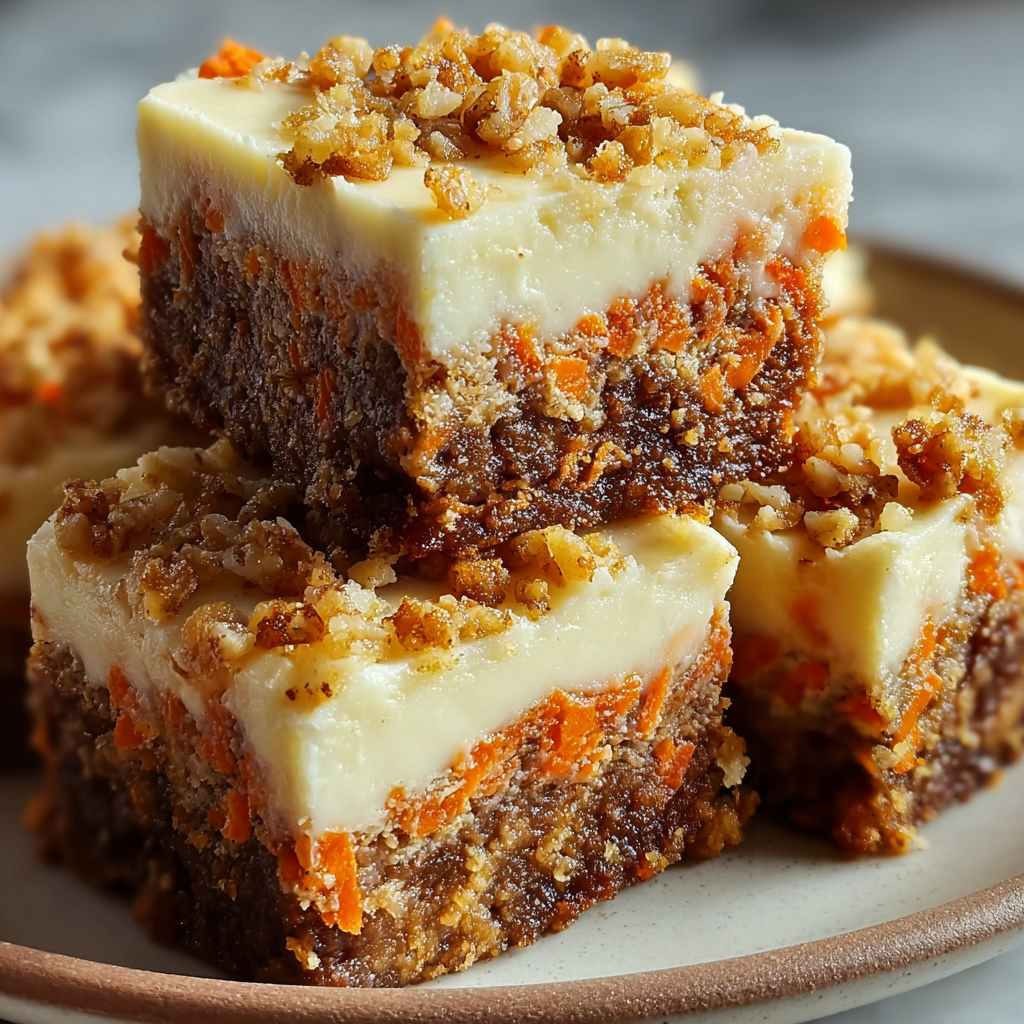
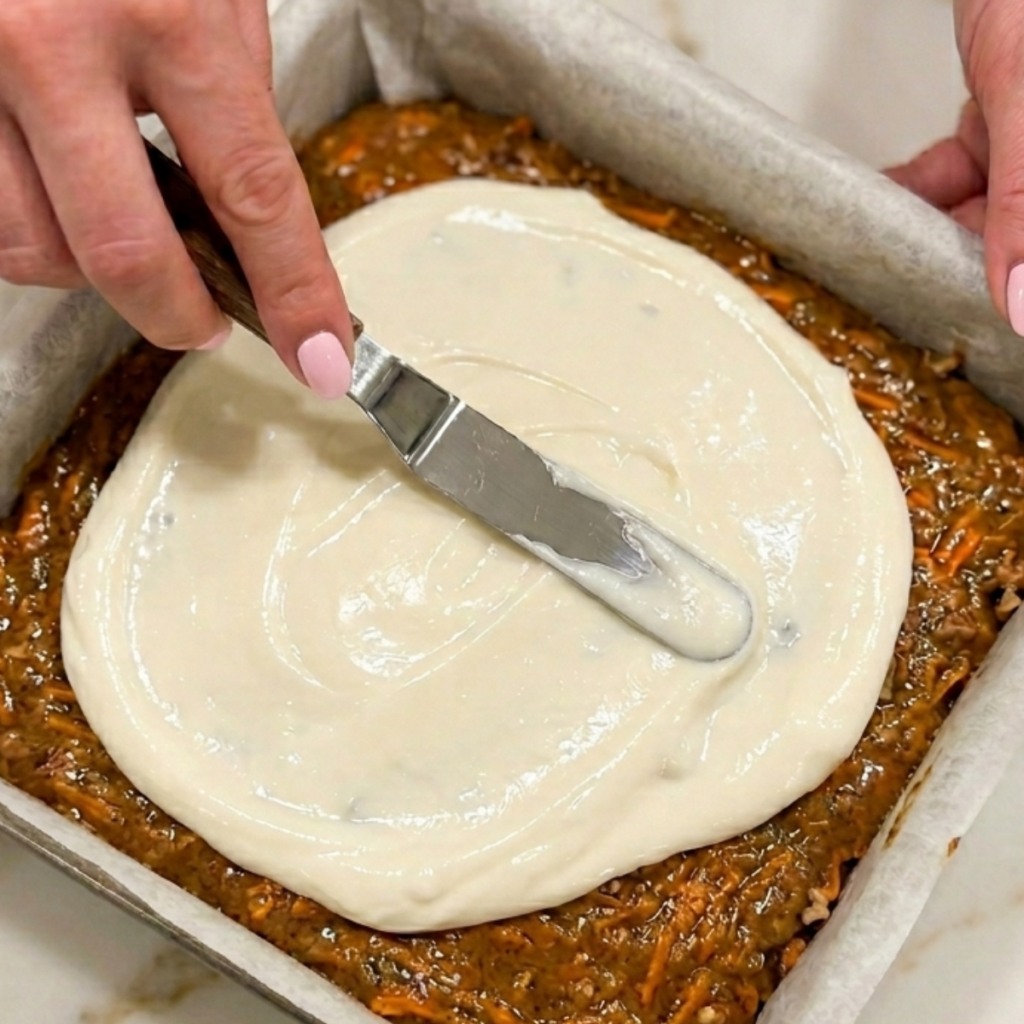
    These bars have everything a carrot cake should have: warm spice, tender crumb, sweet shredded carrot, and the kind of cream cheese layer that makes you close your eyes for a second after the first bite. But they are cut into bars instead of sliced as a cake, which means they are easier to serve, easier to transport, and significantly easier to grab off the counter when you walk past. Mia calls them “carrot squares” and Ben calls them “basically cake,” and both of them are correct.

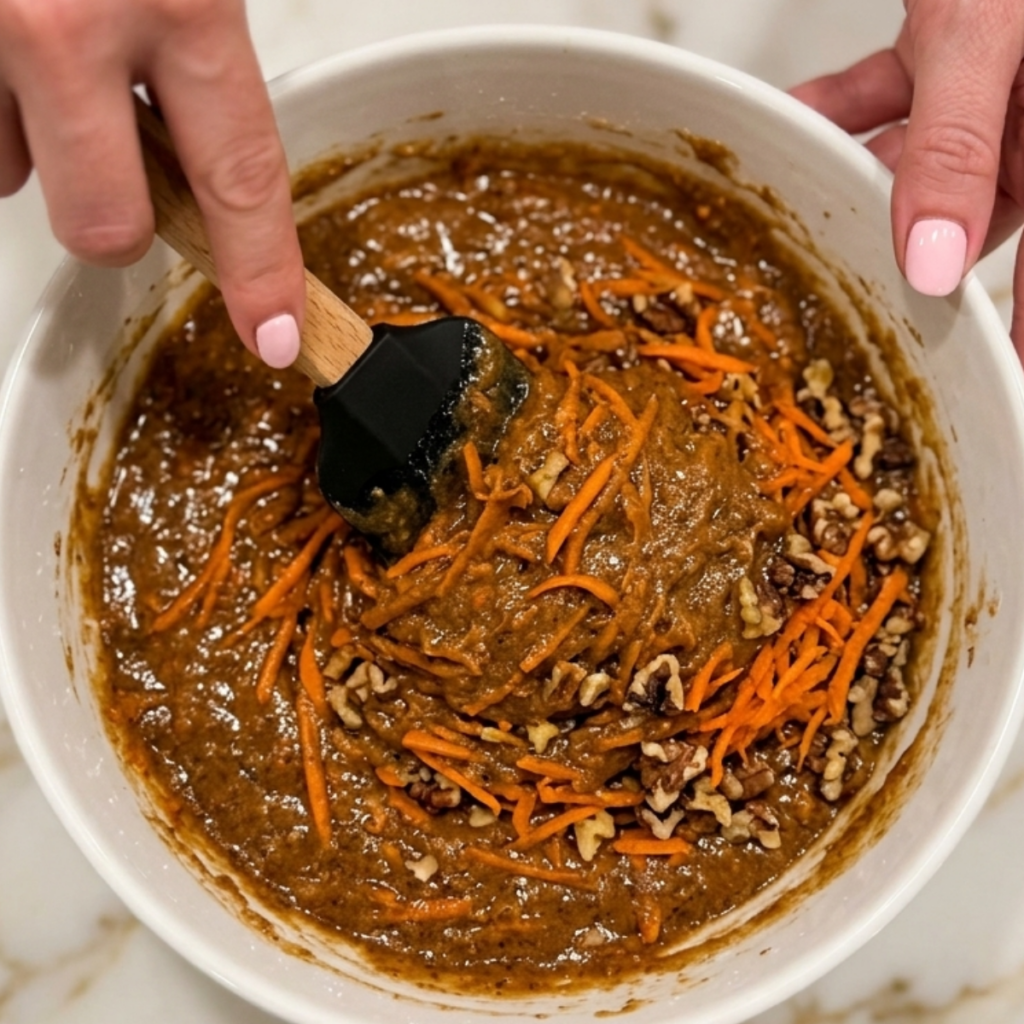
    How To Make Carrot Cake Cream Cheese Bars

    The successful batch happened on a Sunday afternoon when Mia had appointed herself official carrot grater, which she took so seriously she grated her knuckle on the third carrot and then bravely continued with a bandage and tremendous dignity. Ben was mixing the dry ingredients and announcing each spice as he added it like a very small cooking show host. When the batter came together and the cinnamon smell hit the kitchen, both of them stopped what they were doing and just stood there inhaling. I know exactly how they felt.

    The cream cheese layer is where this recipe separates itself from every other carrot cake situation. It goes on top of the batter before baking, which means it bakes into the top of the bar rather than sitting separately as a frosting. The result is a slightly dense, cheesecake-like surface that sets into something between frosting and filling and is frankly the best part of every single bar. Ben said after the first bite that it tasted like “the bakery but at home,” and I wrote that down because it is exactly right.

    Main Ingredients

    For the Carrot Cake Base

    • 2 cups all-purpose flour – Spoon and level; packed flour makes dense, dry bars
    • 1.5 cups granulated sugar – Sweetness and moisture in the crumb
    • 1 teaspoon baking soda – Gives the bars their lift; make sure yours is fresh
    • 1 teaspoon baking powder – Works alongside the baking soda for an even, tender crumb
    • 1.5 teaspoons cinnamon – The signature warm spice of every good carrot cake
    • 1/2 teaspoon nutmeg – Adds depth alongside the cinnamon; do not skip it
    • 1/4 teaspoon ginger – A small but important layer of warmth in the spice blend
    • 1/2 teaspoon salt – Enhances every other flavor; non-negotiable
    • 3 large eggs, room temperature – Room temperature eggs incorporate more evenly into the batter
    • 3/4 cup neutral oil – Keeps the bars moist for days; vegetable or avocado both work
    • 1 teaspoon vanilla extract – Rounds out all the warm spice notes
    • 1 tablespoon orange zest – The family secret; brightens the spices and lifts the sweetness of the carrots
    • 2 cups freshly grated carrots – Grate fresh from whole carrots; pre-shredded bagged carrots are too dry
    • 1/2 cup chopped walnuts or pecans – Optional but adds a wonderful crunch against the tender crumb

    For the Cream Cheese Layer

    • 8 oz full-fat block cream cheese, room temperature – Block only; spreadable tub cream cheese does not bake properly
    • 1/3 cup granulated sugar – Sweetens the cream cheese layer without making it cloying
    • 1 large egg – Helps the cream cheese layer set into that perfect cheesecake-like texture
    • 1 teaspoon vanilla extract – Essential in the cream cheese layer; brings the whole thing together

    Step-by-Step Instructions

    Step 1: Prepare the Pan and Mix the Dry Ingredients

    • Preheat your oven to 350 degrees F and line a 9×13 inch baking pan with parchment paper, leaving an overhang on the sides to lift the bars out cleanly after baking
    • Whisk together the flour, sugar, baking soda, baking powder, cinnamon, nutmeg, ginger, and salt in a large bowl until completely combined and no lumps remain
    • In a separate bowl, whisk together the eggs, oil, vanilla, and orange zest until smooth and slightly thickened, about 1 minute
    • Pour the wet ingredients into the dry ingredients and stir until just combined, then fold in the freshly grated carrots and chopped walnuts until evenly distributed

    Step 2: Make the Cream Cheese Layer

    • Beat the room-temperature block cream cheese in a medium bowl with a hand mixer for 2 minutes until completely smooth with absolutely no lumps
    • Add the sugar and beat for another minute until fully incorporated and the mixture looks light and creamy
    • Add the egg and vanilla extract and beat until just combined; do not overbeat at this stage or the cream cheese layer will develop cracks during baking
    • The finished cream cheese mixture should be smooth, pourable, and just thick enough to spread without it sinking into the carrot batter

    Step 3: Layer and Bake

    • Spread the carrot cake batter evenly into the prepared pan, smoothing it all the way to the edges and corners with an offset spatula
    • Pour the cream cheese mixture gently over the top of the carrot batter and spread it carefully into an even layer using the back of a spoon
    • For a swirled finish, drag a skewer or toothpick through the surface in slow figure-eight motions to marble the two layers slightly before baking
    • Bake for 30 to 35 minutes until the edges are set, the center has just a slight jiggle, and a toothpick inserted in the carrot cake portion comes out with just a few moist crumbs

    Step 4: Cool, Chill, and Cut

    • Let the bars cool completely in the pan at room temperature for at least one hour before transferring to the fridge
    • Refrigerate for at least 2 hours until the cream cheese layer is fully set and firm enough to cut cleanly; overnight chilling gives the best, sharpest slices
    • Lift the chilled slab out of the pan using the parchment overhang and place it on a cutting board
    • Cut into bars using a hot, clean knife wiped dry between each cut for clean, professional-looking edges that do not drag the cream cheese layer

    Carrot Cake Cream Cheese Bars Variations

    Mia’s “Extra Crumble On Top” Version

    After the upside-down counter incident, Mia decided that the bottom of the bars actually looked better than the top and that we should add something crunchy on the cream cheese side to make it more interesting. She was not wrong. For her version, mix together two tablespoons of brown sugar, two tablespoons of finely chopped walnuts, and a pinch of cinnamon, then scatter it over the cream cheese layer right before the pan goes into the oven. It bakes into a little caramelized crumble on the surface that makes every bar look and taste exactly like it came from a bakery case. Mia takes full credit for this and I let her have it completely.

    Ben’s “Raisin Included” Version

    Ben has very strong pro-raisin opinions that Mia finds deeply offensive. He asks for raisins in every carrot cake situation with the calm confidence of someone who knows they are right. For his version, fold half a cup of golden raisins into the carrot batter alongside the walnuts. The raisins plump up during baking and add little pockets of sweetness that Ben describes as “the best part.” Mia picks every single one out of her bar with surgical precision and puts them on Ben’s plate, and he eats them without comment. This is their arrangement.

    The Easter Celebration Version

    Every Easter these bars appear on our table decorated with a little extra love. Press mini candy-coated eggs or small decorative sugar carrots into the cream cheese layer right before it goes in the oven, and dust the finished chilled bars with a small amount of powdered sugar. Cut into smaller squares rather than large bars for a party platter presentation. They travel beautifully in a container layered between parchment, they hold up well at room temperature for a couple of hours, and they disappear from the table faster than anything else I bring.

    Substitutions

    All-purpose flour to a 1:1 gluten-free baking flour: A good quality 1:1 gluten-free baking blend works well here since the carrots and oil keep the bars moist regardless of the flour type. The texture will be very slightly denser, but the flavor is identical. Bob’s Red Mill 1:1 is the one I have tested, and it holds together cleanly when cut.

    Neutral oil to melted coconut oil: Refined coconut oil (the kind without a strong coconut flavor) substitutes in the same quantity with almost no difference in the finished bar. Unrefined coconut oil adds a subtle tropical note that actually works surprisingly well alongside the warm spices in the batter.

    Granulated sugar to brown sugar: Replacing the granulated sugar with brown sugar in the carrot base gives a deeper, more molasses-forward flavor and a slightly denser, moister crumb. The bars will be a shade darker in color and the spice flavors will be richer and more pronounced. This is my personal preference when I have the choice.

    Walnuts to raisins, pecans, or shredded coconut: Any mix-in works in the carrot base. Pecans are buttery and slightly sweeter than walnuts. Shredded sweetened coconut adds chewiness and tropical sweetness. Golden raisins add pockets of fruit sweetness throughout. Use whatever combination your family loves or leave the mix-ins out entirely for a cleaner bar.

    Equipment

    • 9×13 inch baking pan
    • Parchment paper with overhang on both sides for easy lifting
    • Large mixing bowl for the carrot batter
    • Medium mixing bowl for the cream cheese layer
    • Hand mixer or stand mixer for the cream cheese
    • Box grater for the fresh carrots
    • Offset spatula for spreading both layers evenly
    • Skewer or toothpick for the optional marble swirl
    • Whisk for the dry ingredients and the wet ingredients
    • Hot clean knife for slicing; wipe dry between every cut
    • Wire cooling rack for cooling the pan before refrigerating

    Storage Tips

    Make Ahead

    • These bars are genuinely better the next day once the cream cheese layer has fully set and the spices in the carrot base have had time to deepen overnight
    • Bake the day before serving, cool completely, refrigerate overnight uncut, and slice fresh the morning you plan to serve for the cleanest presentation
    • The grated carrots can be prepared a day ahead and stored in a sealed container in the fridge to save time on baking day

    Refrigerator

    • Store cut bars in an airtight container in the fridge for up to 5 days; the cream cheese layer makes refrigeration non-negotiable
    • Layer the bars between sheets of parchment paper to prevent the cream cheese tops from sticking together
    • Let bars sit at room temperature for 10 to 15 minutes before serving; the texture of both the cake layer and the cream cheese improves significantly at room temperature

    Freezing

    • Freeze individual cut bars wrapped tightly in plastic wrap and then place them in a freezer bag for up to 2 months
    • Thaw overnight in the fridge still wrapped; unwrap before serving so condensation does not collect on the cream cheese surface
    • Do not freeze the uncut slab, as the cream cheese layer can develop a slightly grainy texture when thawed in a large mass

    Reheating

    • These bars are served at room temperature or cold and do not need reheating
    • Remove from the fridge 15 minutes before serving for the best texture; cold cream cheese is firmer and the bar flavors open up beautifully at room temperature
    • A lightly chilled bar with a cup of tea on a Tuesday afternoon is one of the genuinely best things about having made a full batch of these

    Family Secret Worth Sharing

    My mom always added a tablespoon of orange zest to her carrot cake batter and I spent years thinking it was an optional flourish until I left it out one Easter and the whole family immediately noticed something was off. Nobody could name what was missing but everyone agreed something was. The orange zest does not make the bars taste like orange; it makes them taste more like themselves. It brightens the spices, lifts the sweetness of the carrots, and gives the whole thing a quality that is hard to describe but instantly recognizable when it is there. I add it every time now and I added it to this recipe without writing it in the main ingredients list because I wanted to tell you about it here instead, the way my mom would have told me. Add it. A whole tablespoon. You will know exactly what I mean after the first bite.

    Troubleshooting FAQs

    The cream cheese layer cracked during baking. What went wrong?
    Cracking in a baked cream cheese layer almost always comes from overmixing after the egg is added or from too high an oven temperature. Once the egg goes into the cream cheese mixture, mix only until just combined. Also make sure your oven is actually at 350 degrees F and not running hotter; an oven thermometer is worth having for any cream cheese baking. Small hairline cracks are normal and will not affect the flavor or texture at all.

    My bars are sinking in the middle after baking. What happened?
    A sunken center usually means the bars were underbaked or the oven door was opened too early. Do not open the oven until at least 25 minutes have passed. The cream cheese layer jiggles more than the carrot base when done, which can look alarming, but check the carrot portion with a toothpick rather than judging by the cream cheese. Let the bars cool completely before refrigerating; cutting into a warm or lukewarm bar will always look underdone in the center.

    The bars are crumbling when I try to cut them. How do I fix it?
    Two things cause crumbly bars: not chilling long enough before cutting and using a cold knife. The cream cheese layer needs to be completely firm before you make the first cut, which means at least 2 hours in the fridge and ideally overnight. Run your knife under hot water, wipe it completely dry, and cut with one clean downward press without sawing back and forth. Wipe and reheat the knife between every single cut.

    Can I use pre-shredded carrots from the bag?
    The short answer is technically yes but really no. Bagged pre-shredded carrots are much drier than freshly grated carrots and will make the bars noticeably denser and less moist. They are also cut thicker than a box grater produces, which means they do not soften as fully during baking. Freshly grated carrots take about three minutes and make a meaningful difference in the final texture. It is worth it.

    The Bars That Survived the Counter and Became a Family Tradition

    The upside-down counter incident is now a story we tell every time I make these, usually while Ben is reaching for his second bar and Mia is already planning which corner piece she wants. These carrot cake cream cheese bars have become one of our most beloved easy baked dessert recipes in the whole repertoire, sitting comfortably alongside our strawberry chocolate cake as a celebration dessert that feels genuinely special without being genuinely complicated. For the weeks when the dessert spread needs to cover every kind of craving, these bars next to our healthy brownie recipe give you something for everyone at the table with almost no overlap and absolutely no complaints. Some recipes arrive as accidents and stay as traditions, and this one has been both from the very first upside-down batch.

  • 3 Secrets to Perfect Crispy Ground Beef Tacos

    3 Secrets to Perfect Crispy Ground Beef Tacos

    I got the pan too hot, walked away for ninety seconds, and came back to one side completely charred. Mia took a bite of the burnt side and said, “Still good.” Ben had already eaten two before I could plate them. That first burnt batch is what taught me the technique, and these crispy ground beef tacos have been our Friday night staple ever since.

    Why This Recipe Is Special

    These are not the soft taco Tuesday situations most people picture. These are pan-fried, golden, and shatteringly crispy on the outside, with seasoned ground beef and melted cheese sealed inside so every single bite has that crunch and that pull at the same time. They come together in under 30 minutes with ingredients most people already have, and they make the whole kitchen smell like the kind of Mexican restaurant you drive across town for. Mia calls them “crunch tacos” and refuses to call them anything else.

    How To Make Crispy Ground Beef Tacos

    The version that actually worked was a Saturday lunch situation where both kids were home and extremely invested in the process. Mia had taken it upon herself to be the cheese distributor, which mostly meant she was eating handfuls of shredded cheese directly from the bowl between each taco. Ben was standing at the stove watching the first taco fry with the focused intensity of someone expecting something to go wrong. When that first one came out golden and blistered and perfect, he said, “That sounds right,” referring to the crunch when I pressed it down. He was absolutely right.

    The lesson from the burnt batch was about heat management. You want the pan hot enough to get that immediate sizzle when the tortilla hits the oil, but medium rather than high so the cheese has time to melt completely before the outside burns. The combination of pre-cooking the beef, loading the taco, and folding it before it hits the pan is what creates that sealed, crispy pocket with no steam escaping and no filling falling out. Ben now monitors the heat with a dedication that would impress a professional cook.

    Main Ingredients

    • 1 lb ground beef (80/20) – The fat content gives the beef flavor and keeps it juicy inside the crispy taco shell
    • 8 small flour tortillas – Small flour tortillas fry up crispier and more evenly than large ones; corn tortillas also work beautifully
    • 1.5 cups shredded Monterey Jack or mozzarella cheese – Melts fast and creates that irresistible cheese pull; cheddar works too but melts slightly slower
    • 1 teaspoon cumin – The warm earthy backbone of the taco seasoning
    • 1 teaspoon chili powder – Depth and color in the beef; reduce to half for the kids’ version
    • 1 teaspoon smoked paprika – Adds a subtle smokiness that makes the filling taste deeply seasoned
    • 1/2 teaspoon garlic powder – Layered savory flavor throughout the beef
    • 1/2 teaspoon onion powder – Sweetness and depth without having to dice an onion
    • Salt and black pepper to taste – Season the beef generously while it cooks
    • 2 to 3 tablespoons neutral oil – For pan-frying; vegetable or avocado oil both work well
    • Fresh cilantro or parsley, chopped – For garnish; adds brightness against the rich golden crust
    • Lime wedges for serving – A squeeze of lime over the finished tacos is genuinely transformative
    • Avocado green sauce or salsa for dipping – The creamy dipping sauce in the image is what takes these to another level entirely

    Step-by-Step Instructions

    Step 1: Cook the Ground Beef

    • Heat a large skillet over medium-high heat, add the ground beef, and cook undisturbed for 2 minutes before breaking it up so it gets some browning instead of just steaming
    • Break the beef into small crumbles and cook until deeply browned with no pink remaining, about 5 to 6 minutes total
    • Drain any excess fat from the pan, leaving about one tablespoon behind, then add the cumin, chili powder, smoked paprika, garlic powder, onion powder, salt, and pepper
    • Stir the spices into the beef for 1 minute over medium heat until everything is deeply coated and fragrant, then remove from heat and set aside

    Step 2: Assemble the Tacos

    • Lay the flour tortillas flat on a clean surface and place a generous spoonful of seasoned beef on one half of each tortilla, leaving a small border at the edge
    • Scatter a good pinch of shredded cheese over the beef on each tortilla; the cheese goes between the beef and the fold so it melts directly against the hot filling
    • Fold each tortilla in half firmly, pressing down gently so the filling is compact and the taco holds its shape without splitting open during frying
    • Work quickly once you start assembling so the tortillas do not have time to absorb moisture from the filling and go soft before they hit the pan

    Step 3: Fry Until Crispy

    • Heat the neutral oil in a large skillet over medium heat until shimmering; the oil should sizzle immediately when the taco edge touches it
    • Place 2 to 3 assembled tacos in the pan at a time without crowding; work in batches so the temperature stays consistent
    • Cook for 2 to 3 minutes on the first side without moving until deep golden and blistered, then flip carefully with tongs and cook for another 2 minutes on the second side
    • Press down gently on each taco with a spatula during the last 30 seconds of cooking to maximize the contact between the tortilla and the hot oil for an even, all-over crunch

    Step 4: Drain, Garnish, and Serve

    • Transfer the fried tacos to a wire rack or a plate lined with paper towels to drain for about 60 seconds; a rack keeps the underside crispy while a paper towel can make it steam
    • Sprinkle freshly chopped cilantro or parsley over the top of each taco immediately while the surface is still slightly oily so the herbs stick
    • Serve right away with lime wedges on the side and a bowl of creamy avocado green sauce or your favorite salsa for dipping
    • These tacos are at their absolute best in the first five minutes out of the pan; the crunch is loudest and the cheese is at peak meltiness right from the start

    Crispy Ground Beef Tacos Variations

    Mia’s “Extra Cheese Inside” Version

    Mia has never once in her life felt that any dish contained enough cheese. She conducted a formal inspection of the first assembled taco, looked at me very seriously, and said there was not enough cheese. There was plenty of cheese. For her version, double the cheese inside each taco and add a small extra pinch right at the fold line so it melts into a crispy cheese crust right at the edge of the tortilla. That little seam of blistered cheese that forms is so good I now do it for everyone and just call it Mia’s method.

    Ben’s “Spicy Crunch” Version

    Ben went through a spicy food phase that is now apparently permanent. He adds a thin swipe of chipotle hot sauce directly onto the tortilla before the beef goes on, which creates a little heat layer that builds slowly under all that crispy golden shell. He also requests extra smoked paprika in the beef seasoning and finishes his plate with a very aggressive squeeze of lime. The result is genuinely one of the best versions of these tacos, and I have started making it this way for myself on the nights the kids are not watching.

    The Sheet Pan Oven Version

    On the nights when I have eight or more tacos to make and standing over the stove in batches sounds exhausting, I do the whole thing in the oven. Brush both sides of the assembled tacos lightly with oil, place them on a lined baking sheet, and bake at 425 degrees F for 12 to 14 minutes, flipping once at the halfway point. They come out golden, crispy, and remarkably close to the stovetop version. The whole batch is done at once, cleanup is minimal, and Ben calls it “the lazy version,” which he means as a compliment.

    Substitutions

    Ground beef to ground turkey or chicken: Ground turkey or chicken works well here and keeps things slightly leaner. Since both are lower in fat than 80/20 beef, add an extra half tablespoon of oil to the pan when cooking the meat and season a little more generously since leaner meat holds seasoning slightly differently than beef.

    Flour tortillas to corn tortillas: Corn tortillas give a more traditional flavor and a slightly different crunch that is thinner and crispier than flour. Warm them briefly in a dry skillet before assembling so they are pliable enough to fold without cracking. They are also naturally gluten-free, which makes this recipe work for more people at the table.

    Monterey Jack to pepper jack: Pepper jack adds a subtle heat from the jalapeño pieces inside the cheese and melts just as beautifully as Monterey Jack. It is Ben’s preferred cheese for obvious reasons, and it pairs incredibly well with the smoked paprika in the beef seasoning. A half-and-half mix of Monterey Jack and pepper jack is the version I make most often now.

    Fresh lime to bottled lime juice: Fresh lime is genuinely worth squeezing here because the brightness and the aroma from the zest do something that bottled lime juice simply cannot replicate. If fresh is not available, a small splash of bottled works and is still better than nothing, but if you have fresh limes on hand, this is one of those recipes where it really makes a difference at the end.

    Equipment

    • Large skillet for cooking the ground beef
    • Separate large skillet or the same skillet wiped clean for frying the tacos
    • Tongs for flipping the tacos safely without breaking them
    • Wide spatula for pressing down during frying
    • Wire rack or paper towel-lined plate for draining
    • Sharp knife and cutting board for the cilantro and lime
    • Small bowl for the dipping sauce
    • Measuring spoons for the spice blend
    • Paper towels for patting the beef dry if needed and for draining the fried tacos

    Storage Tips

    Make Ahead

    • The seasoned ground beef can be cooked up to 3 days ahead and stored in an airtight container in the fridge; reheat in a skillet before assembling and frying the tacos
    • Assemble the tacos up to 30 minutes before frying and keep them covered at room temperature; do not assemble too far ahead or the tortilla will absorb moisture and go soft
    • The spice blend can be mixed in a small jar and stored for up to 3 months so taco night is even faster next time

    Refrigerator

    • Store leftover cooked tacos in an airtight container in the fridge for up to 3 days; they will lose their crunch but the flavor is still excellent
    • Store the cooked beef and the fried tortilla shells separately if possible for the best texture when reheating
    • Keep any leftover dipping sauce in a sealed jar in the fridge for up to 2 days; stir well before serving

    Freezing

    • The cooked and seasoned ground beef freezes well for up to 2 months; thaw overnight in the fridge and reheat in a skillet before assembling
    • Do not freeze assembled or fried tacos, as the tortilla texture changes completely after thawing
    • Freeze the beef in individual portion bags so you can pull out exactly what you need for a quick weeknight taco night without thawing the whole batch

    Reheating

    • Reheat leftover fried tacos in a dry skillet over medium heat for 2 to 3 minutes per side to restore as much crunch as possible; avoid the microwave, which makes them soggy
    • The oven at 375 degrees F for 8 to 10 minutes on a wire rack also works well and brings back a good amount of the original crispiness
    • A splash of fresh lime juice and a sprinkle of fresh cilantro after reheating makes leftovers taste almost as good as the original batch

    Family Secret Worth Sharing

    My mom always added a tiny splash of Worcestershire sauce to her ground beef while it was cooking, and I spent years thinking it was unnecessary until I tried leaving it out one night and immediately noticed the difference. It adds this deep, slightly savory, almost caramelized quality to the meat that is impossible to pin down but remarkably to miss when it is gone. I add it immediately after the spices are added, using just a small splash, perhaps a teaspoon. Ben caught me doing it once and asked what it was. I told him it was my mom’s secret. He stirred it in himself the next time without saying anything. That is precisely how recipes pass between people.

    Troubleshooting FAQs

    My tacos are burning on the outside, but the cheese is not melting inside. What went wrong?
    The pan is too hot. This is exactly what happened to my first batch. Medium heat gives the cheese enough time to melt completely before the outside gets too dark. If the cheese is still not melting fast enough, cover the pan with a lid for the first minute of frying on each side; the trapped steam melts the cheese without adding moisture to the outside of the tortilla.

    The tortilla keeps splitting open when I try to fold it. How do I fix it?
    Cold or dry tortillas crack instead of fold. Warm each tortilla for 20 to 30 seconds in a dry skillet or in the microwave under a damp paper towel before assembling. This makes them pliable enough to fold cleanly without any cracking. Flour tortillas are more forgiving than corn for this reason, but both work well once they are properly warmed.

    My tacos are greasy and soggy instead of crispy. What happened?
    Too much oil in the pan or the oil was not hot enough before the taco went in. The oil should shimmer, and the taco edge should sizzle immediately on contact. Drain the tacos on a wire rack rather than paper towels for the first minute; a rack lets air circulate underneath and prevents the bottom from steaming against a flat surface. Also make sure not to overcrowd the pan.

    Can I make these without frying in oil?
    Yes. A dry non-stick skillet over medium heat works if you want a lighter result. The tortilla will still crisp up from the dry heat and the cheese will still melt, but the color will be paler and more toasted than golden and the texture will be slightly drier than the oil-fried version. Brushing the outside of the assembled taco with a very light coat of oil spray before it goes into the dry pan is a good middle ground that many people prefer.

    Friday Night Just Got a Whole Lot Crunchier

    Friday nights in our house used to mean whatever was easiest. Now they mean tacos, the sound of that first crunch coming from the pan, Mia stationed at the cheese bowl, and Ben standing at the stove with a timer and more opinions than I was ready for. These crispy ground beef tacos have quietly become one of our most beloved easy weeknight dinner recipes in the whole rotation, right there alongside the other ground beef dinner recipes I reach for when I need something fast and genuinely satisfying. For the weeks when the whole table needs to feel like taco night done properly, these pair perfectly with our healthy chicken enchiladas for a spread that covers every craving and leaves absolutely nothing on the table. Some dinners just become the ones your family builds a whole evening around, and this one did exactly that for us.

  • 3 Secrets to the Best Biscoff Cheesecake

    3 Secrets to the Best Biscoff Cheesecake

    I forgot to chill it long enough and served what was essentially Biscoff soup in a crust. Ben poked it with his spoon, and it rippled. Mia said, “I think it is still alive.” I put it back in the fridge, waited four more hours, and sliced it again. That second attempt is what taught me that a perfect biscoff cheesecake is entirely about patience.

    Why This Recipe Is Special

    No baking. No water bath. No oven anxiety. This no-bake biscoff cheesecake has a buttery Lotus Biscoff crumb base, a silky cream cheese filling swirled with Biscoff spread, and a glossy caramelized cookie butter layer on top that makes every single slice look like it came from a bakery. It is the dessert I bring to every gathering and the one people ask me for every time. Mia calls it “the brown one” and requests it for her birthday every year. I have stopped suggesting alternatives.

    How To Make Biscoff Cheesecake

    The version that finally worked happened on a Friday night when both kids were supposed to be in bed and were absolutely not in bed. Mia was sitting on the counter crushing Biscoff biscuits in a zip-lock bag with the enthusiasm of someone who had been waiting for this their whole life. Ben was reading the Biscoff spread jar like it was a novel, announcing the ingredients out loud in a very serious voice. When I pressed the base into the tin and the whole kitchen smelled like caramelized spiced cookies, both of them immediately asked if they could lick the spatula. There were two spatulas. I had planned ahead.

    The lesson that fixed everything was about the cream cheese. It has to be full-fat block cream cheese, completely at room temperature, beaten until smooth before anything else goes in. Cold or low-fat cream cheese never sets properly in a no-bake cheesecake. It stays soft, grainy, or wobbly no matter how long you chill it. Ben learned these lessons the hard way when he helped me with batch number two and accidentally used spreadable cream cheese from the tub. We waited six hours for that one to firm up. It did not. Full-fat block only, every single time.

    Main Ingredients

    For the Biscoff Base

    • 250g Lotus Biscoff biscuits (about 40 biscuits) – Crushed to fine crumbs; a zip-lock bag and a rolling pin work perfectly, and the kids love this job
    • 80g unsalted butter, melted – Binds the crumbs into a firm, sliceable base; salted butter works fine if that is what you have

    For the Cheesecake Filling

    • 600g full-fat block cream cheese, room temperature – Block cream cheese only; spreadable tub cream cheese will not set properly in a no-bake recipe
    • 100g icing sugar, sifted – Sweetens the filling and helps with structure; sift it to avoid lumps in the final texture
    • 300ml double cream, cold – Whipped into the filling for volume and stability; must be cold to whip properly
    • 150g Biscoff spread, room temperature – Folded into the filling for that signature caramelized cookie flavor throughout every bite
    • 1 teaspoon vanilla extract – Rounds out the filling flavor and complements the Biscoff beautifully
    • 1 tablespoon lemon juice – A small amount cuts through the richness and brightens the whole filling without tasting lemony

    For the Biscoff Topping

    • 150g Biscoff spread, warmed slightly – Poured over the set cheesecake for a smooth, glossy caramel-like topping that firms up in the fridge
    • 50g Biscoff biscuits, roughly crushed – Scattered over the top for texture and that beautiful golden crumb finish visible in every slice

    Step-by-Step Instructions

    Step 1: Make the Biscoff Base

    • Crush the Biscoff biscuits into fine crumbs using a food processor or a zip-lock bag and rolling pin until no large pieces remain
    • Pour the melted butter over the crumbs and mix thoroughly until every crumb is coated and the mixture holds together when pressed between your fingers
    • Press the mixture firmly and evenly into the base of a lined 8-inch springform pan using the back of a spoon or the bottom of a glass
    • Refrigerate the base for at least 30 minutes while you prepare the filling so it is firm enough to hold the weight of the cheesecake

    Step 2: Make the Cheesecake Filling

    • Beat the room-temperature cream cheese with the sifted icing sugar and vanilla extract in a large bowl until completely smooth and lump-free, about 2 to 3 minutes
    • Add the lemon juice and the Biscoff spread and beat again until fully combined and the mixture is glossy and uniform in color
    • In a separate chilled bowl, whip the cold double cream to soft peaks, then gently fold it into the cream cheese mixture using a spatula in slow strokes until just combined
    • Do not overmix once the cream is folded in; stop as soon as no white streaks remain or the filling will lose its light, mousse-like texture

    Step 3: Assemble and Chill

    • Spoon the cheesecake filling over the chilled base and spread it evenly with an offset spatula, smoothing the top as flat as possible
    • Tap the tin gently on the counter two or three times to release any air bubbles trapped in the filling
    • Cover the tin loosely with plastic wrap and refrigerate for a minimum of 6 hours, but overnight is strongly preferred for a perfectly set, cleanly sliceable cheesecake
    • Do not rush this step; the cheesecake will look set on the edges before the center is ready, and cutting too early is exactly how you end up with Biscoff soup

    Step 4: Add the Topping and Serve

    • Warm the Biscoff spread in the microwave for 20 to 30 seconds until just pourable but not hot, then pour it slowly and evenly over the fully set cheesecake
    • Use the back of a spoon or a small offset spatula to gently spread the Biscoff topping to the edges, letting it drip slightly over the sides if desired
    • Scatter the roughly crushed Biscoff biscuits generously over the top while the spread is still slightly warm so they stick in place
    • Refrigerate for another 20 minutes until the topping is set, then carefully release the springform tin, slice with a hot clean knife, and serve

    Biscoff Cheesecake Variations

    Mia’s “Extra Crumble on Everything” Version

    Mia’s relationship with the Biscoff crumble topping is deeply personal. She inspects every slice before anyone is served and redistributes the crumbs with a spoon if she feels the coverage is uneven. For her version, double the crushed biscuit topping to 100g and press half of it into the sides of the cheesecake filling before it sets, then scatter the rest on top after the Biscoff spread goes on. The result is a fully encrusted cheesecake that Mia describes as “how it is supposed to look,” and I have no arguments.

    Ben’s “Drizzle Version” Version

    Ben discovered that warming the Biscoff spread and drizzling it in lines over a slice looks exactly like what he sees on baking videos online. He now requests this specific presentation every single time. Instead of spreading the topping flat, warm the Biscoff spread slightly more so it is very pourable, then load it into a piping bag or a zip-lock bag with the corner snipped and pipe it in tight back-and-forth lines over each slice right before serving. Ben stands back, tilts his head slightly, and says “perfect” every time. It takes about forty-five seconds and makes him genuinely happy.

    The Biscoff Cheesecake Bars Version

    On the weekends when I want something easier to serve at a kids’ party or pack into a lunchbox, I make this as bars instead of a round cake. Press the base into a lined 9×13-inch baking dish, spread the filling evenly, chill for six hours, add the Biscoff topping, and slice into neat rectangles. They hold their shape beautifully, travel well, and the kids can pick them up without a plate. Ben called them “portable cheesecake,” and I thought that was a genuinely good product name.

    Substitutions

    Lotus Biscoff biscuits to digestive biscuits: Digestive biscuits make a more neutral, slightly less sweet base that still works beautifully with the Biscoff filling. The flavor will be less intensely spiced but the texture of the base is almost identical. Add a tablespoon of brown sugar to the crumb mixture to bring a little extra sweetness if you go this route.

    Double cream to whipping cream: Whipping cream at 35 percent fat or above whips to the same volume as double cream and sets just as well in a no-bake cheesecake. Heavy whipping cream commonly found in the US works perfectly in place of UK double cream in exactly the same quantity.

    Full-fat block cream cheese to mascarpone: Mascarpone gives a slightly richer, silkier texture and a more subtly sweet flavor that pairs beautifully with the Biscoff spread. Use the same quantity and treat it exactly the same way. The cheesecake will be a little denser and richer but absolutely delicious and still sets firmly overnight.

    Biscoff spread to peanut butter: Smooth peanut butter in place of Biscoff spread makes a completely different but equally incredible no-bake cheesecake with a salty-sweet filling and peanut butter drizzle. It is not a biscoff cheesecake anymore, but it is genuinely one of the best accidents that can happen in this recipe.

    Equipment

    • 8-inch springform tin
    • Parchment paper for lining the base and sides
    • Food processor or zip-lock bag and rolling pin for the crumbs
    • Large mixing bowl for the cream cheese filling
    • Separate chilled bowl for whipping the double cream
    • Hand mixer or stand mixer with whisk attachment
    • Rubber spatula for folding
    • Offset spatula for smoothing the filling and spreading the topping
    • Microwave-safe bowl for warming the Biscoff spread
    • Piping bag or zip-lock bag with corner snipped for the drizzle topping
    • Hot clean knife for slicing; run it under hot water and wipe dry between each cut

    Storage Tips

    Make Ahead

    • This cheesecake is ideal for making ahead; assemble the whole thing the night before, chill overnight, and add the Biscoff topping the morning of serving for the freshest finish
    • The base can be made up to 2 days ahead and kept covered in the fridge so assembly day is even faster
    • Make the filling up to 24 hours ahead and store it covered in the fridge before spreading over the base if you want to split the work across two days

    Refrigerator

    • Store the finished cheesecake covered in the fridge for up to 4 days; the texture actually improves on day two as everything firms up even further
    • Cover any cut edges with plastic wrap pressed directly against the exposed filling to prevent the surface from drying out or absorbing fridge odors
    • Keep the cheesecake in the springform tin until you are ready to serve the final slices for the best structural support

    Freezing

    • The cheesecake freezes beautifully for up to 2 months without the Biscoff topping; add the topping fresh after thawing for the best result
    • Freeze individual slices on a lined tray until solid, then wrap each one in plastic wrap and store in a freezer bag for easy single-serve portions
    • Thaw overnight in the fridge rather than at room temperature; slow thawing preserves the texture and prevents the filling from weeping

    Reheating

    • This cheesecake is served cold and does not need reheating; serve straight from the fridge for the firmest, cleanest slices
    • Let slices sit at room temperature for 10 minutes before eating if you prefer a slightly softer, creamier texture
    • If the Biscoff topping has hardened too much in the fridge, let the whole cheesecake sit at room temperature for 15 minutes and it will soften back to a glossy, pourable consistency

    Family Secret Worth Sharing

    The tip that nobody tells you about no-bake cheesecakes is that the knife you use to slice it matters almost as much as the recipe itself. My mom taught me to run the knife under very hot water, wipe it completely dry, and then make one clean, confident cut without sawing back and forth. Do this between every single slice, and the cheesecake comes out looking like the pictures every time. I showed Ben this technique once, and he watched with the concentration of someone learning a magic trick. He sliced the next piece himself, and it was genuinely perfect. He looked at it for a second and then said, “The hot knife is the secret. “It is. It really is.

    Troubleshooting FAQs

    My cheesecake is not setting and stays wobbly after chilling. What went wrong?
    Almost always the culprit is the type of cream cheese. Spreadable cream cheese from a tub contains more water and stabilizers than block cream cheese and will never set firmly in a no-bake recipe. Make sure you used full-fat block cream cheese at room temperature. If it is still not setting after 8 hours, the filling may have been overmixed after the cream was added, which can break down the structure. Give it a full overnight chill and serve it cold.

    The base is crumbling when I slice the cheesecake. How do I fix it?
    A crumbly base usually means not enough butter or the base was not pressed firmly enough. The crumb mixture should feel like wet sand and hold together cleanly when you press a handful in your palm. If it is too dry, add an extra 10g of melted butter. Pressing it firmly with the flat bottom of a glass rather than a spoon gives a much more compact, sliceable base.

    There are lumps in my filling. How do I avoid them?
    Lumps come from cold cream cheese or cream cheese that was not beaten long enough before the other ingredients were added. The cream cheese must be genuinely room temperature, which means out of the fridge for at least an hour. Beat it alone for a full two minutes until it is completely smooth before adding anything else. Any lump in the cream cheese at that stage will still be a lump in the finished cheesecake.

    The Biscoff topping is too thick to pour and tears the cheesecake surface. What do I do?
    The spread needs to be a little warmer than you might think. Microwave it in 15-second bursts, stirring between each, until it is pourable and moves freely when you tip the bowl. It should be the consistency of warm honey. If it is still tearing the surface, let the cheesecake chill for another hour before adding the topping so the filling underneath is completely firm and can support the weight.

    The Dessert That Made Everyone Go Quiet

    There is a very specific kind of quiet that happens at a table when a dessert is genuinely good. This cheesecake creates that quiet every single time I serve it. Forks go in, eyes go wide, and nobody says anything for about thirty seconds. Ben eventually breaks it by asking if there is more. Mia is already checking the crumble ratio on her slice. This no-bake biscoff cheesecake sits beautifully alongside our brown butter brookies as one of the most requested things I make when someone needs a dessert that genuinely impresses, and the creamy no-bake format puts it right in the same league as our strawberry chocolate cake for showstopping celebration desserts that are secretly not that hard. For the weeks when the dessert table needs a full spread, this cheesecake next to our healthy brownie recipe covers every single craving in the room without a single complaint from anyone. Some recipes become part of your family’s story quietly and completely, and this one did exactly that for us.

  • 5-Minute Creamy Banana Chamomile Tea Smoothie

    5-Minute Creamy Banana Chamomile Tea Smoothie

    I steeped four tea bags instead of one because I misread my own handwriting, and both kids were asleep on the couch by six. Ben did not even finish his. Mia said it tasted “like a hug from a flower” right before her eyes closed. Once I dialed back the chamomile, this banana chamomile tea smoothie became the calmest, creamiest afternoon drink in our house.

    Why This Recipe Is Special

    Most smoothies are about energy. This one is about the opposite. Chamomile is naturally calming, banana adds a creamy sweetness that makes the whole drink feel like dessert, and a little honey pulls everything together into something that feels genuinely special rather than just healthy. It is the smoothie I make on school pickup days when the afternoon is loud and everyone needs ten minutes of quiet. Mia now calls it the “flower smoothie” and asks for it specifically when she has had a big-feelings kind of day.

    How To Make Banana Chamomile Tea Smoothie

    The version that worked was a Thursday afternoon situation that started with me trying to use up two very ripe bananas before they turned into banana bread, whether I wanted them to or not. Mia was drawing at the kitchen table, and Ben was doing that thing where he lies on the floor for no reason and stares at the ceiling. When I started brewing the chamomile and that soft floral smell filled the kitchen, Mia looked up from her drawing and said, “Are we having tea?” I told her we were having a smoothie. She considered this for a moment and then said, “That is better than tea.” High praise from a six-year-old.

    The thing that changed this from good to something genuinely special was brewing the tea strong but not bitter and then chilling it completely before it went into the blender. Warm liquid in a smoothie makes everything go thin and watery almost immediately. Cold-brewed chamomile keeps the texture thick, creamy, and properly cold all the way through. Ben figured this out when he made a batch himself one afternoon and used the tea still hot. He handed it to me, watched me take a sip, and before I could say anything, he said, “I know. It needs to be cold.” He was right. He always knows.

    Main Ingredients

    • 2 ripe bananas, frozen – Frozen bananas are the key to a thick, creamy texture without needing ice cream; peel them before freezing
    • 1 cup brewed chamomile tea, chilled – Brew with 1 to 2 tea bags in 1 cup of hot water for 5 minutes, then cool completely before using
    • 1/2 cup whole milk or oat milk – Whole milk gives a richer, creamier result; oat milk adds a subtle sweetness that works beautifully with the chamomile
    • 2 tablespoons honey – Raw honey adds warmth and depth; adjust to your preferred sweetness level
    • 1/2 teaspoon vanilla extract – Rounds out the floral chamomile notes and adds a warm bakery quality to the whole drink
    • 1/4 teaspoon cinnamon – Just a pinch; adds warmth without competing with the chamomile
    • 1/2 cup plain Greek yogurt – Optional but adds creaminess, protein, and a slight tang that balances the sweetness
    • Pinch of salt – A tiny pinch enhances every other flavor in the smoothie; do not skip it
    • Dried chamomile flowers for garnish – Optional but makes the whole glass look beautiful and tells everyone exactly what they are about to drink

    Step-by-Step Instructions

    Step 1: Brew and Chill the Chamomile Tea

    • Bring 1 cup of water to just below boiling, around 200 degrees F, and steep 1 to 2 chamomile tea bags for exactly 5 minutes
    • Remove the tea bags without squeezing them to avoid any bitterness and stir in the honey while the tea is still warm so it dissolves completely
    • Let the tea cool to room temperature, then transfer it to the fridge for at least 30 minutes until fully cold before using
    • For a faster chill, pour the brewed tea over a small bowl of ice and stir for about 2 minutes until cold; do not add this ice to the blender as it will water down the smoothie

    Step 2: Prep the Bananas

    • If your bananas are not already frozen, peel them, break into chunks, place on a lined tray, and freeze for at least 2 hours before blending
    • Ripe bananas with plenty of brown spots give the best flavor and sweetness; under-ripe bananas make the smoothie taste starchy and flat
    • Frozen bananas straight from the freezer give the thickest, coldest, most ice-cream-like texture; do not thaw them before they go into the blender
    • If you do not have frozen bananas, add 4 to 5 ice cubes to the blender alongside fresh bananas, but the texture will be slightly thinner

    Step 3: Blend Until Smooth

    • Add the frozen banana chunks, chilled chamomile tea, milk, vanilla, cinnamon, Greek yogurt if using, and the pinch of salt to the blender
    • Blend on high speed for 45 to 60 seconds until completely smooth with no banana chunks remaining; scrape down the sides once if needed
    • Taste the smoothie and adjust with a little more honey if you want it sweeter or a splash more milk if it is too thick to pour easily
    • Blend for another 10 seconds after any additions to make sure everything is fully incorporated before pouring

    Step 4: Pour, Garnish, and Serve

    • Pour the smoothie immediately into chilled glasses for the best temperature and thickest texture right from the start
    • Top with a small pinch of dried chamomile flowers if you have them; even a tiny amount makes the presentation feel intentional and lovely
    • Serve right away while the smoothie is at its thickest and coldest; it will thin slightly as it sits at room temperature
    • For a creamier, more dessert-like version, pour into a bowl and top with sliced fresh banana, a drizzle of honey, and a light dusting of cinnamon

    Banana Chamomile Tea Smoothie Variations

    Mia’s “Flower Smoothie Bowl” Version

    Mia discovered smoothie bowls when she was five and has never fully recovered from the experience. The flower smoothie in bowl form is her current greatest joy. Use one extra frozen banana to make the blended mixture thick enough to hold toppings, pour it into her favorite bowl, and let her arrange the garnishes herself. She places the dried chamomile flowers with the concentration of someone decorating a cake, adds a drizzle of honey in a very specific pattern, and then stands back and says “perfect” before picking up her spoon. I take a picture every time.

    Ben’s “Protein Power” Version

    Ben went through a phase of asking whether everything we ate had enough protein in it after his class did a nutrition unit at school. He brings this up approximately once a week. For his version, add a scoop of vanilla protein powder alongside the Greek yogurt and blend as usual. The chamomile and banana flavors hold up beautifully against the vanilla protein, the texture stays thick and smooth, and Ben feels very satisfied with his nutritional choices. He also adds an extra drizzle of honey and calls it “the good one.”

    The Lavender Chamomile Version

    This one is for the afternoons when I want something that feels genuinely spa-like and the kids are at their dad’s and I have exactly fifteen quiet minutes to myself. Add one quarter teaspoon of culinary dried lavender to the chamomile tea while it steeps, then remove it along with the tea bags before chilling. The lavender adds a subtle floral layer that makes the whole smoothie taste like something you would order at a very calm and beautiful cafe. It is my personal favorite version, and I do not share it.

    Substitutions

    Chamomile tea bags to loose-leaf chamomile: Use one tablespoon of loose-leaf chamomile flowers steeped in a tea infuser or fine-mesh strainer for the same 5 minutes. Loose leaf chamomile is often more fragrant and flavorful than bagged tea and gives the smoothie a slightly more intense floral quality that is genuinely lovely.

    Honey to maple syrup or dates: Maple syrup is a seamless swap in equal amounts and gives a slightly earthier sweetness that works well with the banana. Two pitted Medjool dates blended directly into the smoothie add natural sweetness and extra creaminess and make the whole drink more filling without any added sugar.

    Whole milk to coconut milk: Full-fat canned coconut milk makes this smoothie incredibly rich and creamy with a subtle tropical note that pairs surprisingly well with the chamomile. Use half the amount since canned coconut milk is much thicker than regular milk and add the rest as needed to reach your preferred consistency.

    Greek yogurt to silken tofu: Silken tofu is a great dairy-free swap that adds the same creamy protein boost without any dairy flavor. Use the same quantity as the yogurt, add it straight from the fridge, and blend thoroughly. The tofu is completely undetectable in the finished smoothie, and both kids have never once noticed it.

    Equipment

    • High-powered blender (a standard blender works but a high-powered one gives a silkier texture)
    • Small saucepan or kettle for heating the water
    • Mug or heatproof cup for steeping the tea
    • Fine mesh strainer if using loose-leaf chamomile
    • Freezer-safe tray or plate for pre-freezing banana chunks
    • Measuring spoons
    • Tall glasses for serving
    • Small bowl of ice for rapid tea chilling if needed

    Storage Tips

    Make Ahead

    • Brew the chamomile tea up to 3 days ahead and store it in a sealed jar in the fridge so it is always ready when you want a smoothie quickly
    • Pre-freeze peeled banana chunks in a zip-lock bag so they are always ready to blend without any extra prep on busy afternoons
    • Measure and freeze individual smoothie packs: one bag with two banana chunks plus a pre-measured amount of frozen Greek yogurt so the whole smoothie comes together in under two minutes

    Refrigerator

    • Blended smoothie can be stored in a sealed jar or bottle in the fridge for up to 24 hours; shake or stir well before drinking as it will separate slightly
    • The texture will be thinner after refrigerating; re-blend with a small handful of ice for 15 seconds to restore the creamy thickness
    • Brewed chamomile tea keeps in the fridge for up to 3 days sealed; do not store it with the honey already mixed in as it can ferment slightly

    Freezing

    • Pour the blended smoothie into ice cube trays, freeze completely, then pop the cubes into a bag for up to 1 month
    • Blend the frozen smoothie cubes straight from the freezer with a splash of milk for a quick, thick version any time
    • Do not freeze the finished smoothie in a jar or sealed container, as it expands when frozen and can crack or overflow

    Reheating

    • This smoothie is served cold and does not need reheating; if it has warmed up too much, just give it a quick re-blend with a few ice cubes
    • For a warm version on cold evenings, blend all ingredients without the frozen banana, warm gently on the stovetop until just steaming, and serve as a chamomile banana tea latte instead
    • The warm latte version with a little extra honey and a pinch of nutmeg is one of the coziest things I make in the winter and both kids love it equally

    Family Secret Worth Sharing

    My mom used to make chamomile tea for me every time I could not sleep or had a hard day at school. She would sit at the kitchen table with me while I drank it and not say very much, just be there. I think about that every time I brew chamomile now. There is something about the smell of it that immediately makes me feel like things are going to settle down. I started making this smoothie on the hardest afternoons specifically because of that. Mia does not know any of this backstory. She just knows it is the flower smoothie and that it appears when she has had a big-feelings kind of day, and that is enough. Ben asked me once why I always smile when I make it. I told him it reminded me of Grandma. He nodded, took a long sip, and said, “Grandma had good ideas.” She really did.

    Troubleshooting FAQs

    My smoothie is too thin and watery. What went wrong?
    Almost always the tea was not cold enough when it went into the blender, or the bananas were not frozen solid. Both add warmth and liquid that thin the smoothie out quickly. Make sure the tea is fully chilled and the bananas are completely frozen before blending. If the smoothie is already too thin, add another half-frozen banana and blend again to bring the thickness back.

    The chamomile flavor is too strong and almost bitter. How do I fix it?
    Two things cause bitter chamomile tea: steeping too long or squeezing the tea bags when you remove them. Stick to exactly 5 minutes and lift the bags out gently without pressing. If the tea is already bitter, add an extra drizzle of honey and a splash more milk to the smoothie before blending. The sweetness and fat in the milk balance out the bitterness beautifully.

    I cannot taste the chamomile at all in the finished smoothie. What happened?
    Banana is a strong flavor and can easily dominate the drink if the tea is too diluted. Try brewing with 2 tea bags instead of 1 in the same amount of water for a more concentrated flavor. You can also reduce the amount of banana slightly to one and a half frozen bananas, and the chamomile will come through much more clearly.

    Can I make this smoothie without a high-powered blender?
    Yes, with one small adjustment. Let the frozen banana chunks sit at room temperature for 5 minutes before blending so they are slightly softened and easier for a standard blender to process. Blend in short pulses rather than one long run and scrape down the sides frequently. The result will be slightly less perfectly smooth but still very delicious and completely worth making.

    The Smoothie That Made Everyone Calm Down

    There is a specific kind of afternoon in our house where everyone is tired and a little bit loud and nobody can quite explain why. This smoothie is what I make on those days. Two glasses on the counter, the chamomile smell filling the kitchen, and within about ten minutes, everyone is sitting quietly, and the day feels manageable again. It sits right alongside our healthy carrot juice recipe as one of the most reach-for drinks in our afternoon routine, and on the days I want something warming instead of cold, our beet juice recipe is right there next to it as another one that makes me feel like I am genuinely taking care of everyone. And for the mornings when we need something sweet and comforting that doubles as breakfast, this smoothie pairs beautifully with a slice of our banana bread recipe that uses up the rest of those ripe bananas in the most satisfying way. Some recipes are just quietly good for you in every possible sense, and this one is exactly that.

    Don’t forget to snap a picture of your banana-chamomile tea smoothie before that… (trust me, it will disappear quickly!), and leave a rating below. We’d love to hear how this banana chamomile tea smoothie becomes part of your family afternoon story.

  • Perfect Healthy Chicken Enchiladas

    Perfect Healthy Chicken Enchiladas

    I overfilled every single one. They burst open in the oven like little cheese volcanoes, and the whole dish looked like a complete disaster. Ben said it looked “exploded.” Mia asked if we could eat it anyway. We absolutely did. But once I figured out the rolling technique, these healthy chicken enchiladas became the cheesy, high-protein weeknight dinner our whole family actually looks forward to.

    Why This Recipe Is Special

    Most enchilada recipes feel heavy and leave you regretting the second helping. These do not. Lean shredded chicken, a light but deeply flavorful homemade enchilada sauce, and just enough cheese to make the whole dish feel genuinely indulgent without going overboard. Each serving packs over 35 grams of protein, which means even Ben stops asking for a snack an hour after dinner. That alone is worth every minute in the kitchen. Mia calls them “the fancy burritos,” and I have decided not to correct her.

    How To Make Healthy Chicken Enchiladas

    The version that finally worked came together on a Wednesday when I had leftover rotisserie chicken, a can of tomatoes, and two children who kept sneaking shredded cheese from the bowl. Mia had cheese on her chin before a single enchilada had been rolled. Ben was attempting to fold a tortilla using what he described as “the burrito method” and absolutely refused to switch techniques even when I showed him mine. When the pan came out of the oven with that golden, bubbling cheese on top and the whole kitchen smelling like cumin and garlic and something warm and good, both of them went very still. That kind of quiet is the best review a recipe can get.

    The thing that transformed this recipe was warming the tortillas before rolling. Cold tortillas crack and split the second you try to bend them, which is exactly what caused my first cheese volcano situation. Thirty seconds per tortilla in a dry skillet makes them pliable, cooperative, and completely rollable without drama. Ben now handles this step entirely and takes it extremely seriously, timing each one with the kitchen timer and announcing “ready” before handing it to me. It is the most efficient we have ever been as a kitchen team.

    Main Ingredients

    • 3 cups cooked shredded chicken breast – Rotisserie chicken saves significant time; about 2 large breasts shredded gives the right amount
    • 8 medium whole wheat tortillas – Whole wheat adds fiber and holds up better in the oven than regular flour tortillas
    • 1 can (15 oz) crushed tomatoes – The base of the enchilada sauce; fire-roasted crushed tomatoes add extra depth
    • 1 cup low-sodium chicken broth – Thins the sauce to the right consistency without adding unnecessary sodium
    • 2 tablespoons olive oil – For sauteing the aromatics and building the sauce base
    • 3 cloves garlic, minced – Essential flavor base for the sauce; do not reduce this
    • 1 small onion, finely diced – Adds sweetness and body to the enchilada sauce
    • 2 teaspoons cumin – The warm, earthy backbone of the whole dish
    • 1 teaspoon smoked paprika – Adds subtle smokiness that makes the sauce taste slow-cooked
    • 1 teaspoon chili powder – Warmth and depth; reduce to half a teaspoon for the kids’ version
    • 1/2 teaspoon oregano – A small but important layer of savory flavor in the sauce
    • Salt and black pepper to taste – Season at every stage for the best result
    • 1 cup plain Greek yogurt – Stirred into the chicken filling for creaminess and a serious protein boost
    • 1.5 cups shredded mozzarella or Monterey Jack – Half goes in the filling, half goes on top for that golden bubbly finish
    • Fresh parsley or cilantro, chopped – For garnish; adds freshness and color against the golden cheese

    Step-by-Step Instructions

    Step 1: Make the Enchilada Sauce

    • Heat the olive oil in a medium saucepan over medium heat, add the diced onion, and cook for 4 to 5 minutes until softened and translucent
    • Add the minced garlic, cumin, smoked paprika, chili powder, and oregano and stir for 30 seconds until the spices bloom and the kitchen smells incredible
    • Pour in the crushed tomatoes and chicken broth, stir to combine, and let the sauce simmer uncovered for 10 to 12 minutes until slightly thickened
    • Season with salt and pepper, taste, and adjust the spices to your preference; the sauce should be bold, slightly smoky, and deeply savory

    Step 2: Prepare the Chicken Filling

    • Combine the shredded chicken, Greek yogurt, half the shredded cheese, and 3 to 4 tablespoons of the enchilada sauce in a large bowl and mix until everything is well coated
    • Taste the filling and adjust salt and pepper; it should be creamy, well seasoned, and packed with flavor before it ever touches the tortilla
    • Warm each tortilla in a dry skillet over medium heat for about 30 seconds per side until pliable and soft; this step prevents cracking and splitting during rolling
    • Spoon about 3 tablespoons of filling down the center of each tortilla, leaving a one-inch border at each end, then roll firmly but not too tightly and place seam-side down in a baking dish

    Step 3: Assemble and Bake

    • Preheat your oven to 375 degrees F and spread a thin layer of enchilada sauce across the bottom of a 9×13 inch baking dish before placing the rolled enchiladas inside
    • Pour the remaining enchilada sauce evenly over the top of all the rolled enchiladas, making sure every tortilla is well coated so nothing dries out in the oven
    • Scatter the remaining shredded cheese generously over the top and cover the dish loosely with foil
    • Bake covered for 20 minutes, then remove the foil and bake for another 10 minutes until the cheese is golden and bubbling and the edges are slightly crisp

    Step 4: Rest and Serve

    • Let the enchiladas rest in the pan for 5 minutes after coming out of the oven so the filling firms up slightly and they are easier to lift and serve cleanly
    • Use a wide spatula to lift each enchilada carefully onto serving plates, keeping them seam-side down so they hold their shape
    • Garnish with freshly chopped parsley or cilantro and serve with a dollop of Greek yogurt on the side in place of sour cream for extra protein
    • Serve immediately while the cheese is still melty and the sauce is warm and glossy on top

    Healthy Chicken Enchiladas Variations

    Ben’s “Extra Cheese on Top” Version

    Ben has a deeply held belief that the cheese-to-everything-else ratio on baked dishes is always improvable. He inspects the pan before it goes in the oven and adds a second handful of cheese every single time with the calm authority of someone who has thought about this a lot. For the extra cheese version that makes this feel like a full comfort food moment without losing the protein punch, increase the topping cheese to 2 full cups and add it in two layers: half before the foil goes on and half after the foil comes off in the last ten minutes. The result is a deeply golden, extra melty top that Ben considers correct.

    Mia’s “No Spicy” Version

    Mia operates a strict no-heat policy that has been in effect since she was approximately three years old and accidentally ate a pepperoncini. For her version, omit the chili powder entirely and reduce the cumin to one teaspoon. Add a pinch of garlic powder to the filling to make up for the depth, and stir a tablespoon of honey into the sauce for a slightly sweeter, more mild flavor that she actually describes as “better.” It is not better. But it is genuinely delicious, and she eats the whole thing without negotiation, which is its own kind of win.

    The Meal Prep Double Batch Version

    This is the version I make every other Sunday when I want four days of easy lunches handled in one shot. Double the entire recipe, fill two 9×13 dishes, bake one for dinner that night, and assemble the second one without baking it. Cover the unbaked dish tightly with foil and refrigerate for up to two days or freeze for up to one month. When you are ready to eat it, bake it straight from the fridge at 375 degrees F for 30 minutes covered, then uncover it for 10 more minutes. It comes out just as good as freshly made, and Wednesday-night dinner practically handles itself.

    Substitutions

    Shredded chicken breast to canned chicken: Canned chicken works well here in a time crunch, and the filling still tastes great once it is mixed with the sauce and Greek yogurt. Drain it very well and break up any large chunks before mixing. The texture is slightly softer than freshly cooked chicken, but once it is baked inside the enchilada, nobody notices.

    Greek yogurt to light cream cheese: If Greek yogurt is not something you keep on hand, softened light cream cheese mixed with a tablespoon of milk gives a similar creamy texture to the filling. The protein count will be slightly lower, but the flavor is rich and smooth and holds together beautifully in the oven.

    Whole wheat tortillas to corn tortillas: Corn tortillas are the more traditional choice and make this recipe naturally gluten-free. They are smaller and more delicate, so warm them especially well before rolling and use two if needed to prevent splitting. The flavor is earthier and pairs beautifully with the smoky enchilada sauce.

    Mozzarella to reduced-fat cheddar: Reduced-fat cheddar gives a sharper, more classic enchilada flavor and melts just as well as mozzarella. Sharp cheddar specifically brings a boldness to the top layer that makes the dish taste more traditionally enchilada-style for anyone who finds mozzarella a little mild.

    Equipment

    • 9×13 inch baking dish
    • Medium saucepan for the enchilada sauce
    • Large mixing bowl for the chicken filling
    • Small skillet for warming the tortillas
    • Wide spatula for serving
    • Ladle or large spoon for pouring the sauce
    • Sharp knife and cutting board for the onion and garlic
    • Two forks for shredding the chicken if not using rotisserie
    • Aluminum foil for covering the dish during the first bake
    • Measuring spoons for the spices

    Storage Tips

    Make Ahead

    • Assemble the full dish up to 2 days ahead, cover tightly with foil, and refrigerate unbaked until you are ready to cook
    • The enchilada sauce can be made up to 4 days ahead and stored in a sealed jar in the fridge; it actually deepens in flavor as it sits
    • Shred and season the chicken filling up to 2 days ahead and keep it covered in the fridge so assembly on dinner night takes under 10 minutes

    Refrigerator

    • Store leftover baked enchiladas in an airtight container in the fridge for up to 4 days
    • Keep the enchiladas whole rather than cutting them before storing so the filling stays moist and does not dry out
    • Store any extra enchilada sauce separately and spoon it over the enchiladas when reheating to refresh the moisture

    Freezing

    • Freeze the assembled but unbaked dish tightly wrapped for up to 1 month for the best texture result
    • Baked enchiladas can also be frozen individually wrapped for up to 2 months; thaw overnight in the fridge before reheating
    • Do not freeze with Greek yogurt-based filling that has not been baked as the yogurt can separate when thawed; always freeze after assembling with the sauce on top

    Reheating

    • Reheat covered in a 350 degree F oven for 15 to 20 minutes until warmed through and the cheese is melty again; add a splash of broth over the top before covering to prevent drying
    • Microwave individual enchiladas on 70 percent power for 90 seconds, covered with a damp paper towel, then check and add 30 seconds if needed
    • A splash of extra enchilada sauce over the top before reheating makes leftovers taste almost identical to the freshly baked version

    Family Secret Worth Sharing

    My mom made enchiladas every time someone in the family had a hard week. It was her version of a hug on a plate. She always stirred a small spoonful of honey into her enchilada sauce right at the end, just before it came off the heat. Not enough to make it sweet, just enough to round off the edge of the acidity and make the whole sauce taste warmer and more settled. I do the same thing now, but I can’t tell you the exact amount because she never measured it. She just kept adding it until it tasted like something you wanted more of. That is still the instruction I follow. Ben caught me doing it once and asked what I was adding. I told him it was the secret. He nodded like that was a completely satisfying answer and went back to taming the tortillas.

    Troubleshooting FAQs

    My enchiladas keep bursting open during baking. How do I stop that?
    Two things cause this almost every time: overfilling and cold tortillas. Use no more than 3 tablespoons of filling per tortilla and leave a one-inch border at each end before rolling. Warm each tortilla in a dry skillet for 30 seconds per side before filling so it is pliable enough to roll without cracking. Place them seam-side down immediately in the sauced dish so they are held closed from the moment they go in.

    The sauce tastes too acidic and sharp. How do I fix it?
    A small spoonful of honey stirred in at the end is the quickest fix and the one my mom swore by. A pinch of sugar works too. If the acidity is very strong, add a little more chicken broth to dilute it and let the sauce simmer for another five minutes uncovered so the flavors have time to come together properly.

    My filling is watery, and the tortillas are going soggy. What went wrong?
    The most common cause is chicken that was not drained well enough, especially if using canned or poached chicken. Pat the shredded chicken dry with paper towels before mixing the filling. Also make sure the Greek yogurt is full-fat or at least 2 percent; lower-fat yogurt releases more liquid when heated and makes the filling wet. A thin layer of sauce on the bottom of the dish rather than a thick pool also helps the bases stay firm.

    Can I make this recipe dairy-free?
    Yes. Replace the Greek yogurt with a plain unsweetened coconut yogurt or a dairy-free cream cheese alternative, and use a dairy-free shredded cheese on top. The texture of the filling will be slightly different, but the flavor is still very good. Make sure whatever dairy-free cheese you use is labeled as “meltable” since some brands do not melt well in the oven.

    The Dinner That Ended the Snack-After-Dinner Habit

    Wednesday nights used to be the hardest dinner night in our house. The week was tiring, the kids were tired, and I was very tired. Now Wednesday means enchiladas, tortilla-warming duty for Ben, cheese quality control for Mia, and a kitchen that smells warm and good before anyone even sits down. These have become one of our most reliable easy weeknight chicken dinners in the whole rotation, right alongside the other healthy high-protein chicken recipes I come back to when I want something that fills everyone up without the post-dinner slump. And for the weeks when I want a full spread of comfort food that covers every craving, these enchiladas sit beautifully next to our garlic parmesan chicken meatloaf as two of the most requested things I make. Some dinners just quietly become the ones your family asks for by name, and this one did exactly that for us.

    Don’t forget to snap a picture of your healthy chicken enchiladas before they… (trust me, they will disappear quickly!), and leave a rating below. We’d love to hear how this healthy chicken enchiladas recipe becomes part of your family dinner story.