Blog

  • 5-Minute Perfect Avocado Toast

    5-Minute Perfect Avocado Toast

    I put salt, pepper, and nothing else and then wondered why it tasted flat and forgettable. Ben tried it and said, “It needs something.” Mia said “it needs more.” They were both right; neither could tell me what. That under-seasoned slice sent me on a proper seasoning mission, and now this avocado toast is the most requested breakfast in our house by a significant margin.

    Why This Recipe Is Special

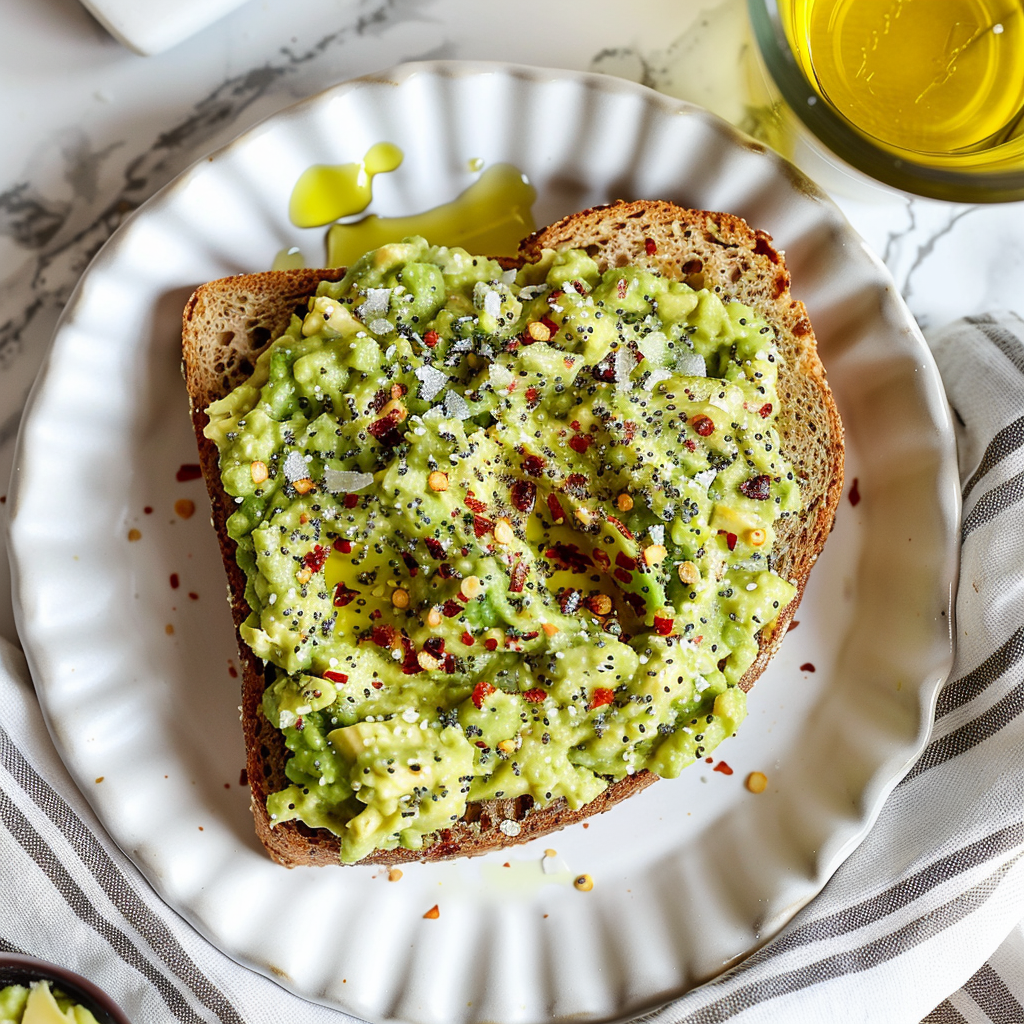
    This is not just mashed avocado on bread. The avocado gets seasoned with lemon juice, flaky salt, red pepper flakes, and everything bagel seasoning before it goes anywhere near the toast, and that layering of flavors is what turns a simple ingredient into something genuinely worth making every morning. The bread gets toasted properly golden and slightly crispy so it holds the avocado without immediately going soft. The whole thing comes together in under five minutes and tastes like something you would pay twelve dollars for at a brunch spot. Mia asks for hers with extra red pepper flakes, which I allow because it makes her very happy.

    How To Make Avocado Toast

    The version that changed everything came on a Saturday morning when both kids had decided they were extremely interested in avocado toast after seeing it on every food account they had accidentally encountered. Mia was mashing the avocado with real commitment and a fork that was slightly too small for the bowl, which meant avocado pieces were launching themselves over the edge at intervals. Ben was tasting the avocado at every stage and providing detailed feedback that essentially amounted to “more lemon” every single time. When I finally added the everything bagel seasoning and the red pepper flakes and the lemon zest and let Ben taste it, he went quiet for a second and then said “okay that is completely different.” It is completely different.

    The thing that elevated the recipe from fine to genuinely great was treating the avocado mash like a proper preparation rather than just spreading raw avocado on bread. Season the avocado in the bowl before it goes on the toast, not after. Add lemon juice while mashing so it gets incorporated throughout, add the flaky salt while the avocado is still slightly warm from being just cut, and add the lemon zest last so it stays bright and fragrant. Ben now does the seasoning step himself and has developed specific opinions about the exact ratio of everything bagel seasoning to red pepper flakes. His ratio is correct, and I have started using it.

    Main Ingredients

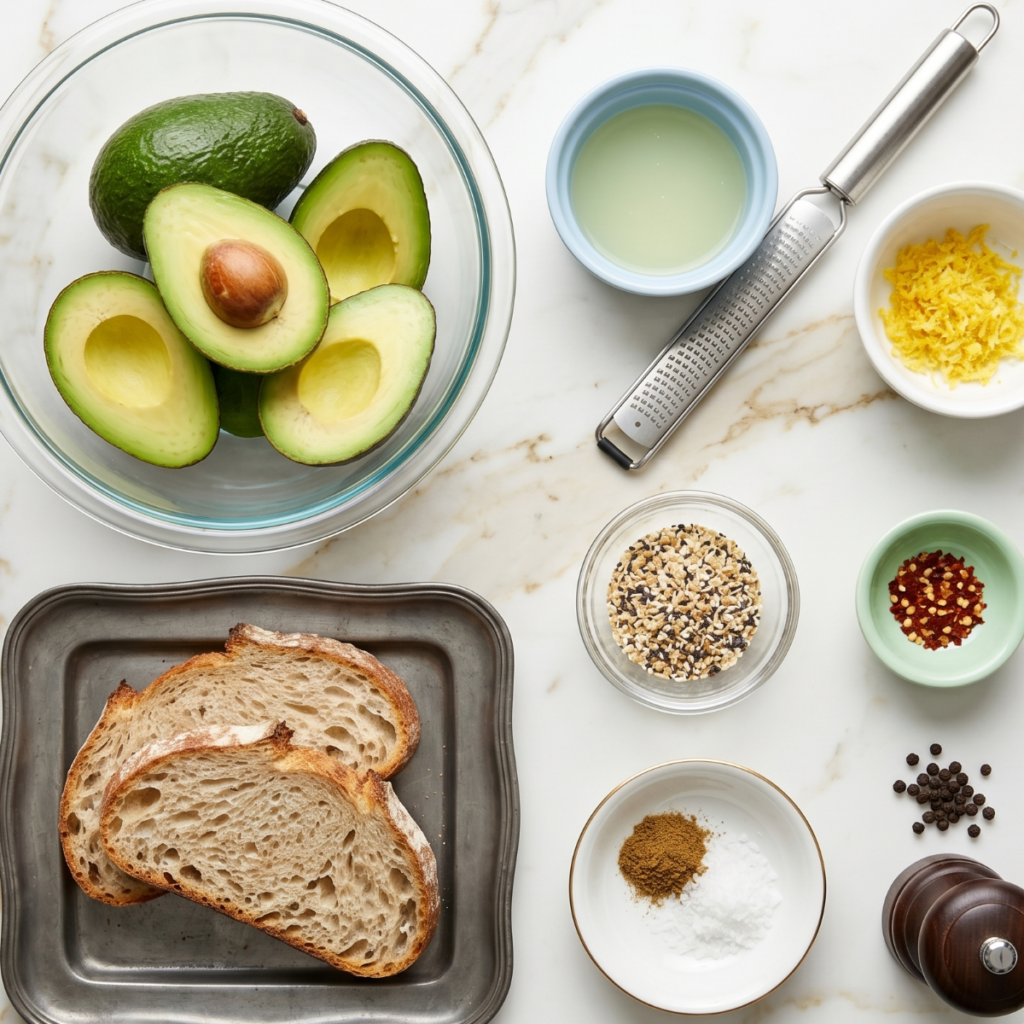
    • 2 ripe avocados – Ripe but not overripe; they should yield gently to pressure without feeling mushy; overripe avocados are stringy and bitter
    • 2 thick slices of good bread – Sourdough, whole grain, or a thick country loaf; the bread needs structure to hold the avocado without collapsing
    • 1.5 tablespoons fresh lemon juice – Squeezed directly into the mash while still warm; brightens the whole avocado and keeps it from browning
    • 1 teaspoon lemon zest – Added last for a fragrant citrus lift that lemon juice alone cannot give
    • 1 teaspoon everything bagel seasoning – The seasoning that takes avocado toast from fine to genuinely interesting; covers garlic, onion, sesame, and poppy in one pinch
    • 1/4 teaspoon red pepper flakes – Adds a gentle building heat; adjust to preference; Mia wants more, Ben wants exactly this amount
    • Flaky sea salt to taste – Added to the avocado in the bowl and again over the finished toast; flaky salt is noticeably better here than fine salt
    • Black pepper to taste – A few cracks of freshly ground black pepper over the finished toast
    • 1 tablespoon good olive oil – Drizzled over the finished toast for richness and a slightly grassy note that complements the avocado
    • Optional toppings: sliced cherry tomatoes, a fried or poached egg, microgreens, or extra lemon – Any of these make the toast a complete meal rather than a snack
    Step-by-Step Instructions

    Step 1: Toast the Bread

    • Toast the bread slices until they are deeply golden on both sides with a slight crunch at the surface; pale or soft toast collapses under the weight of the avocado within seconds of being assembled
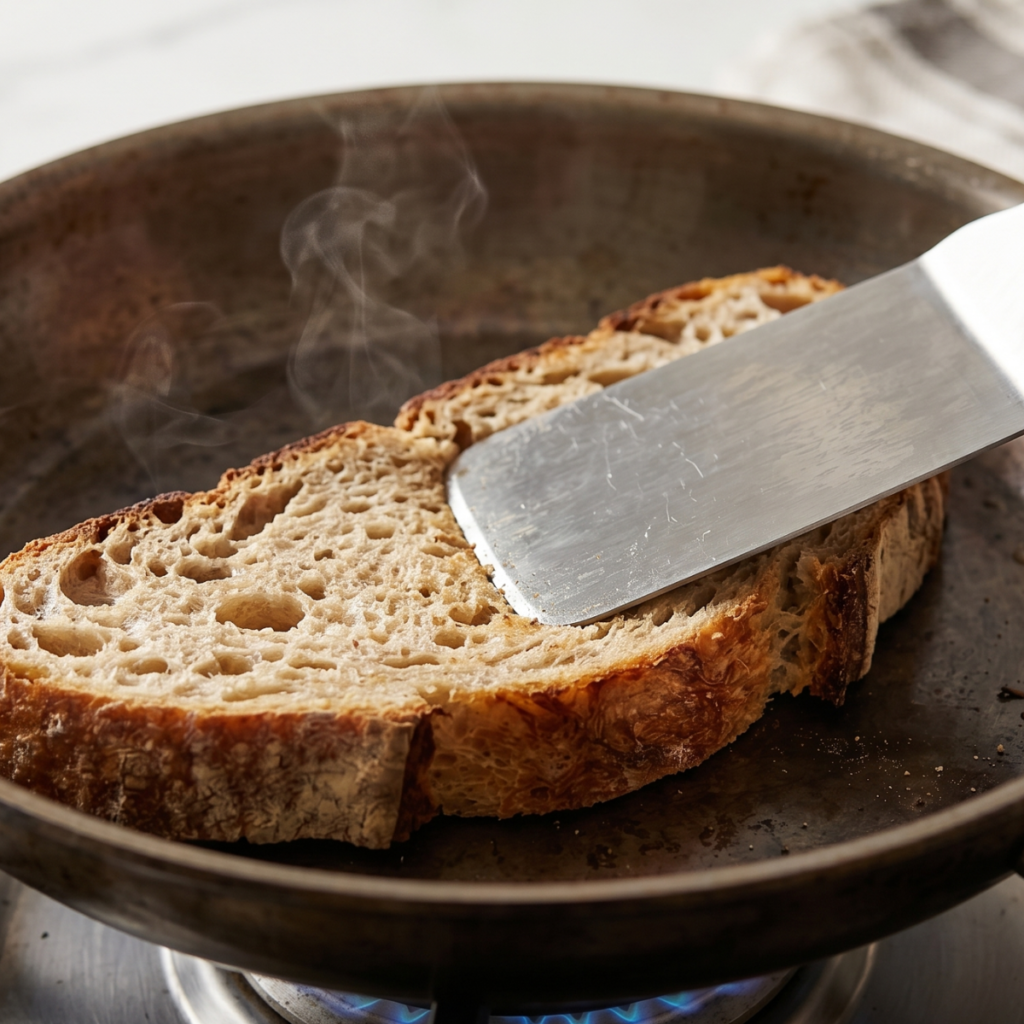
    • Use a toaster, toaster oven, or a dry skillet over medium-high heat; the skillet method gives a more evenly golden surface and a slightly crispier result than a toaster
    • If using a skillet, press the bread down gently with a spatula for the first 30 seconds so the whole surface makes contact with the pan and toasts evenly without domed spots
    • Let the toast cool for 60 seconds before adding the avocado; adding avocado to extremely hot toast steams it slightly and changes the texture
    Step 2: Season the Avocado

    • Halve the ripe avocados, remove the pits, and scoop the flesh into a medium bowl; if the avocados are perfectly ripe the flesh will come away from the skin in one clean piece
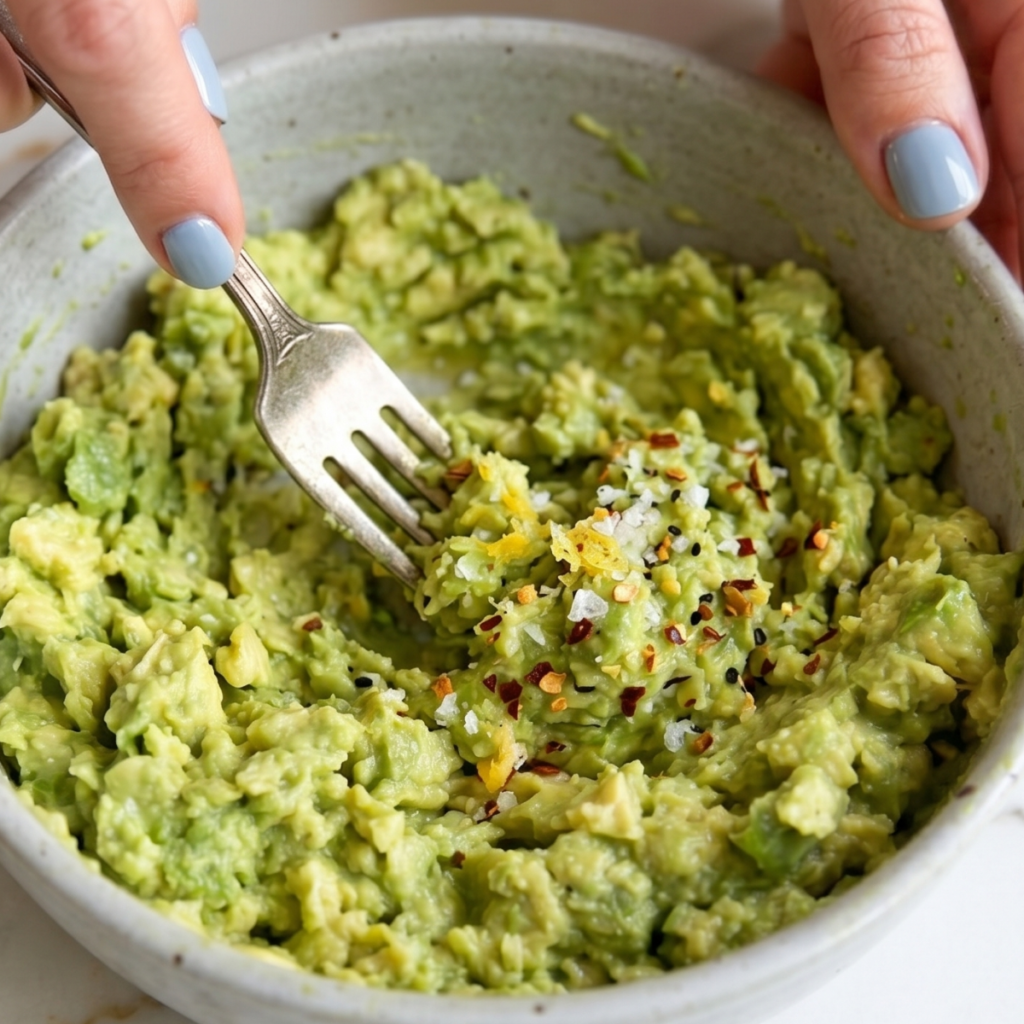
    • Add the lemon juice, flaky salt, and a few cracks of black pepper directly to the bowl and mash with a fork to your preferred texture; some people want completely smooth, some want chunky; both are correct
    • Add the lemon zest and stir it through the mash gently so it distributes evenly without being overworked; overworking the avocado after adding lemon zest dulls the bright fragrance you are adding it for
    • Taste the mash and adjust the salt and lemon before it goes anywhere near the toast; properly seasoned avocado mash should taste slightly more seasoned than feels right since the toast will dilute the flavor
    Step 3: Assemble and Season the Toast

    • Spoon the seasoned avocado mash generously onto each slice of toast and spread it to the edges with the back of the spoon, going all the way to the crust so every bite has avocado
    • Scatter the everything bagel seasoning evenly over the top of the avocado so it covers the whole surface with a visible layer of seasoning rather than being concentrated in one spot
    • Add the red pepper flakes over the everything bagel seasoning and then drizzle the olive oil in a slow, thin stream across the entire surface
    • Finish with a final pinch of flaky sea salt over the very top; the visual contrast of the white salt crystals against the green avocado is part of what makes this look as good as it tastes

    Step 4: Add Toppings and Serve

    • Add any optional toppings at this stage: halved cherry tomatoes placed cut-side up, a fried or poached egg placed on top of the avocado, a small handful of microgreens scattered over, or a few extra drops of lemon juice
    • Serve immediately while the toast is still warm and the avocado has not had time to oxidize; avocado toast is a right-now food and does not improve with waiting
    • Crack a final round of fresh black pepper over the finished plate and add an extra lemon wedge alongside for anyone who wants more brightness
    • For the Mediterranean version, add a small crumble of feta cheese and a few Kalamata olives over the top before serving for a version that could genuinely replace a full brunch plate

    Avocado Toast Variations

    Mia’s “Extra Everything” Version

    Mia discovered everything bagel seasoning by tasting it directly from the jar, which was not a sanctioned activity but produced a useful piece of information: she loves it. Her version uses a full teaspoon and a half of everything bagel seasoning spread liberally over every inch of the avocado surface, extra red pepper flakes, and an additional squeeze of lemon over the finished toast. She eats it with the satisfied focus of someone who seasoned it herself, which she now does every time. I let her control her own seasoning because the results are genuinely good and because arguing with Mia about quantities of everything bagel seasoning is not a productive use of a Saturday morning.

    Ben’s “Egg On Top, Obviously” Version

    Ben made his position on avocado toast very clear early: it is a snack unless it has an egg on it. For his version, fry an egg in butter over medium heat until the white is fully set and the yolk is still runny, then slide it carefully onto the assembled avocado toast so the yolk sits in the center. When Ben cuts into it and the yolk runs over the seasoned avocado and soaks into the toast, he nods once with the satisfaction of someone whose instincts about breakfast have been validated. He is not wrong. The egg version is a complete meal and significantly more satisfying than plain avocado toast.

    The Mediterranean Diet Avocado Toast Version

    This is my personal favorite version and the one I make on the mornings when I want breakfast to feel genuinely nourishing and a little bit special. Spread the seasoned avocado as directed and then add a generous crumble of good feta cheese, three or four Kalamata olives sliced in half, a handful of halved cherry tomatoes, a scatter of fresh oregano or basil leaves, and a drizzle of the best olive oil you have. A squeeze of lemon goes over everything at the end. It is vibrant and colorful and tastes like a proper Mediterranean breakfast. Both kids tried it once and Ben called it “the adult version,” which is entirely accurate and not an insult coming from him.

    Substitutions

    Everything bagel seasoning to homemade blend: Mix together one teaspoon each of sesame seeds, poppy seeds, dried minced garlic, dried minced onion, and flaky salt for a homemade version that tastes identical and costs significantly less. Make a jar and keep it in the pantry for every avocado toast going forward. Ben helped me make the first batch and now considers the jar his.

    Sourdough to gluten-free bread: Any thick, good-quality gluten-free bread works here as long as it is toasted properly golden. Thin or soft gluten-free bread collapses under the avocado quickly, so look for a country-style or sandwich loaf with some structure. Toast it slightly longer than you would regular bread for the firmest possible base.

    Fresh lemon to lime: Fresh lime juice gives a slightly more tropical, less sharp citrus note that works beautifully with avocado and pairs particularly well with the red pepper flakes. Use the same quantity of juice and zest. The flavor is distinctly different but equally delicious, and if you are out of lemons, it is a completely valid swap.

    Olive oil drizzle to sesame oil: A very small drizzle of toasted sesame oil in place of olive oil gives a nutty, slightly smoky finish that works particularly well with the everything bagel seasoning since both contain sesame. Use half the quantity since sesame oil is significantly more intense than olive oil: a few drops rather than a full tablespoon.

    Equipment

    • Toaster, toaster oven, or dry skillet for the bread
    • Medium bowl for the avocado mash
    • Fork for mashing: a fork gives more texture control than a blender or food processor
    • Microplane or fine grater for the lemon zest
    • Small spoon or the back of a large spoon for spreading the avocado
    • Sharp knife and cutting board for the avocados and optional toppings
    • Small bowls for the seasonings if you want to set up a topping station

    Storage Tips

    Make Ahead

    • Avocado toast is best made and eaten immediately; it is a right-now recipe that does not benefit from being assembled ahead of time
    • The seasoned avocado mash can be made up to 30 minutes ahead if you press plastic wrap directly against the surface to prevent oxidation; add the lemon juice generously and stir well before storing
    • Toast the bread fresh each morning; pre-toasted bread goes soft quickly and the whole point of the recipe is the contrast between crispy toast and creamy avocado

    Refrigerator

    • Store leftover avocado mash with plastic wrap pressed directly against the surface in an airtight container for up to 1 day; expect some surface browning but the flavor holds
    • Adding a thin layer of lemon juice over the surface before pressing on the plastic wrap slows oxidation significantly
    • Do not refrigerate assembled avocado toast; the bread goes soft and the avocado goes grey and the whole thing is disappointing

    Freezing

    • Avocado mash does not freeze well; the texture becomes watery and grainy on thawing and the flavor changes unpleasantly
    • The bread can be pre-sliced and frozen for up to 2 months; toast directly from frozen, adding 30 extra seconds to the toasting time
    • If you have very ripe avocados that need to be used, make the mash and refrigerate for up to 1 day rather than attempting to freeze it.

    Reheating

    • Avocado toast does not reheat; the concept of reheating this recipe goes against everything it stands for
    • If the toast has gone cold and soft before you could eat it, re-toast the bread separately and add fresh avocado mash; it takes two minutes and is genuinely worth the reset
    • Cold avocado mash on warm toast is actually fine and both kids eat it this way without complaint when the morning is rushed

    Family Secret Worth Sharing

    My mom always added a tiny pinch of cumin to her avocado mash, and I completely forgot about this until I made a batch that tasted slightly flat despite correct seasoning and remembered it mid-mash. Cumin in avocado does not make it taste like guacamole; it adds a warm, slightly earthy undertone that makes the avocado flavor itself taste deeper and more complex. A tiny pinch, maybe an eighth of a teaspoon, stirred in with the salt and lemon. Mia tasted a batch with it and a batch without and picked the cumin version without hesitation. Ben said the cumin one “tastes more like it knows what it is.” I wrote that down because it is completely accurate and also the best description of what cumin does to avocado that I have ever heard from anyone at any age.

    Troubleshooting FAQs

    The avocado toast tastes flat and bland no matter what I do. What is wrong?
    The avocado itself needs more seasoning than feels comfortable, and the seasoning needs to happen in the bowl before the avocado goes on the toast. Salt and lemon juice added to already-assembled toast sit on the surface rather than incorporating themselves throughout the mash. Season in the bowl, taste, season again, and taste again. Properly seasoned avocado mash should taste slightly over-seasoned on its own because the toast dilutes everything significantly. Add the cumin. This is the other thing most people skip, and it is the difference between flat and complete.

    The avocado turned brown before I could eat the toast. How do I prevent this?
    Lemon juice is the only reliable prevention. Add it generously while mashing and make sure it gets distributed throughout rather than just sitting on top. The acid in the lemon slows the oxidation process significantly. Eating the toast immediately also helps more than any other strategy; avocado toast is a right-now food and the longer it sits, the more it browns regardless of how much lemon juice went in.

    The toast went soggy almost immediately. What happened?
    Either the toast was not golden enough, the bread was too thin, or the avocado was too wet. Toast to deep golden, not pale beige, and let it cool for 60 seconds before adding the avocado. If the avocado is extremely ripe and watery, strain the mash through a fine mesh strainer for a moment before using. Thicker, denser bread also holds up significantly longer than thin sandwich bread.

    My avocados are not ripe yet. Can I speed it up?
    Place unripe avocados in a paper bag with a banana or an apple and fold the top closed. The ethylene gas from the other fruit accelerates ripening dramatically. At room temperature this typically works in one to two days. Do not refrigerate unripe avocados; the cold stops the ripening process completely, and you will be waiting indefinitely.

    The Five-Minute Breakfast That Made Everything Else Optional

    There are mornings in our house when this is the only thing anyone wants and nobody is apologetic about it. Ben eats his with an egg on top and calls it a complete meal, which it is. Mia seasons hers herself now and has strong opinions about everything bagel seasoning ratios that I do not argue with because she is right. This avocado toast sits naturally alongside our healthy savory breakfast recipes as one of the fastest and most satisfying starts to any morning, and on the days when I want to build a full brunch spread, it pairs beautifully with our easy weekend breakfast recipes that come together just as quickly. For the mornings when the table needs something that feels complete and genuinely nourishing without a lot of effort, this avocado toast next to our easy high-protein breakfast recipes covers every craving with almost no time at all. Some recipes become the ones you make without thinking about it and this one reached that status faster than anything else I have put in this rotation.

    Don’t forget to snap a picture of your avocado toast before that… (trust me, it will disappear quickly), and leave a rating below. We’d love to hear how this avocado toast recipe becomes part of your family morning story.
  • Potato Side Dishes Easy Crispy

    Potato Side Dishes Easy Crispy

    I pressed too hard, and the potatoes disintegrated into pieces. Ben looked at the tray and said “those are not smashed; those are destroyed.” Mia picked one up, ate it anyway, and said it tasted delicious. She was right, but I needed them to stay intact. That rubble batch taught me the technique behind the best potato side dishes easy enough to make every week.

    Why This Recipe Is Special

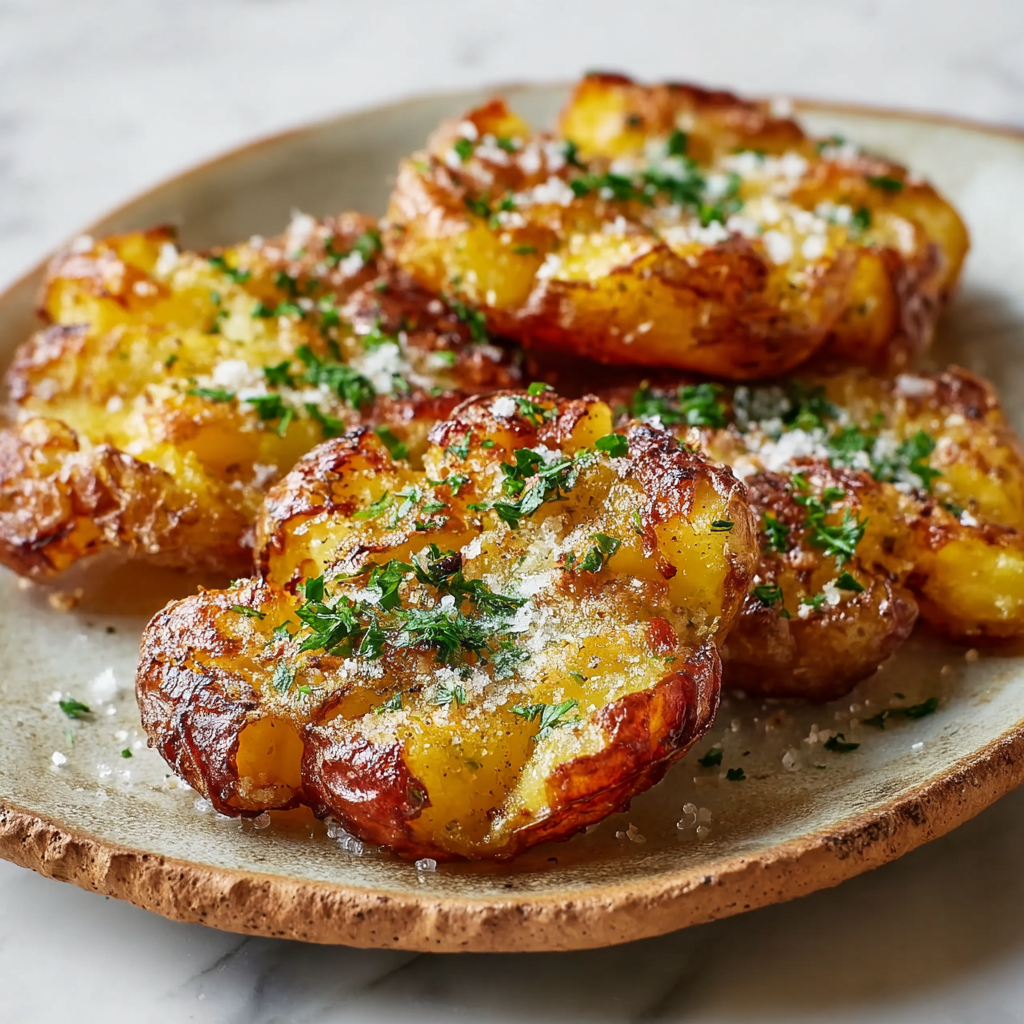
    Smashed potatoes sit in the sweet spot between roasted potatoes and mashed potatoes without being either of them. They are crispy on the outside where the edges have crisped and caramelized against the hot pan, soft and fluffy in the center where the potato is still tender from boiling, and covered in a golden parmesan crust that gets nutty and salty and slightly crackly in the oven. Garlic butter goes on before they bake, and fresh parsley goes on after, and the whole tray looks like something from a restaurant. Ben calls them “the fancy ones” and asks for them whenever we have company. They take forty minutes and feel like an occasion.

    How To Make Crispy Parmesan Smashed Potatoes

    The successful batch came on a weeknight when both kids were inexplicably at the kitchen table instead of anywhere else and decided to have opinions about potato technique. Mia wanted to do the smashing, which I allowed because she approached the task with the careful, deliberate energy of someone who takes potato-based responsibilities seriously. Ben was measuring the parmesan and eating approximately every third pinch, which is a completely consistent quality-to-consumption ratio for him. When those potatoes came out of the oven golden and blistered with the parmesan crust set into something genuinely beautiful, Ben said “okay these look like the real thing.” They looked exactly like the real thing.

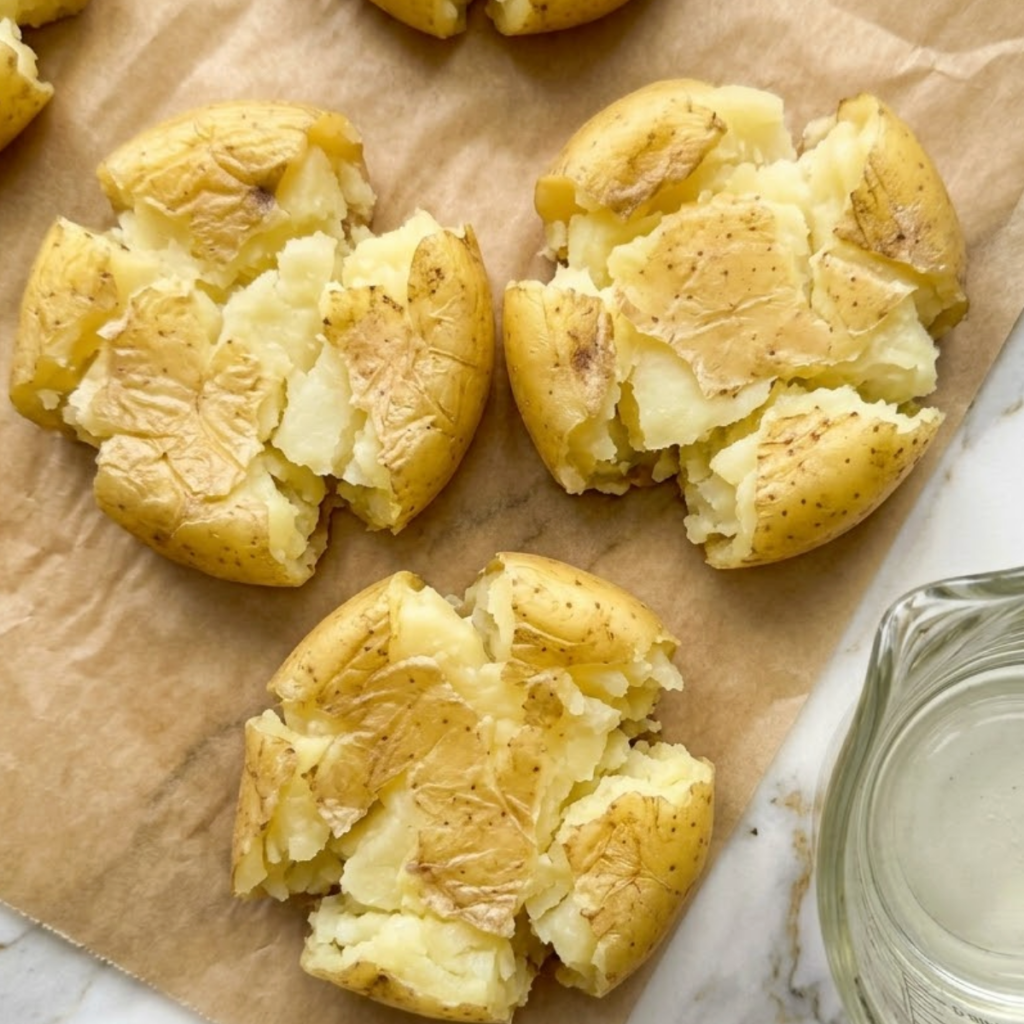
    The lesson from the rubble batch was about pressure and timing. You have to boil the potatoes until they are genuinely fork-tender all the way through, let them steam dry for a few minutes, and then press with the flat bottom of a glass or measuring cup using firm but controlled downward pressure. The goal is a disc about half an inch thick, not a pancake. If the potato cracks at the edges, that is exactly right, and those edges are where the best crunch lives. Ben mastered this on the second attempt and has been doing it perfectly ever since with a focused calm that I find impressive for a nine-year-old.

    Main Ingredients

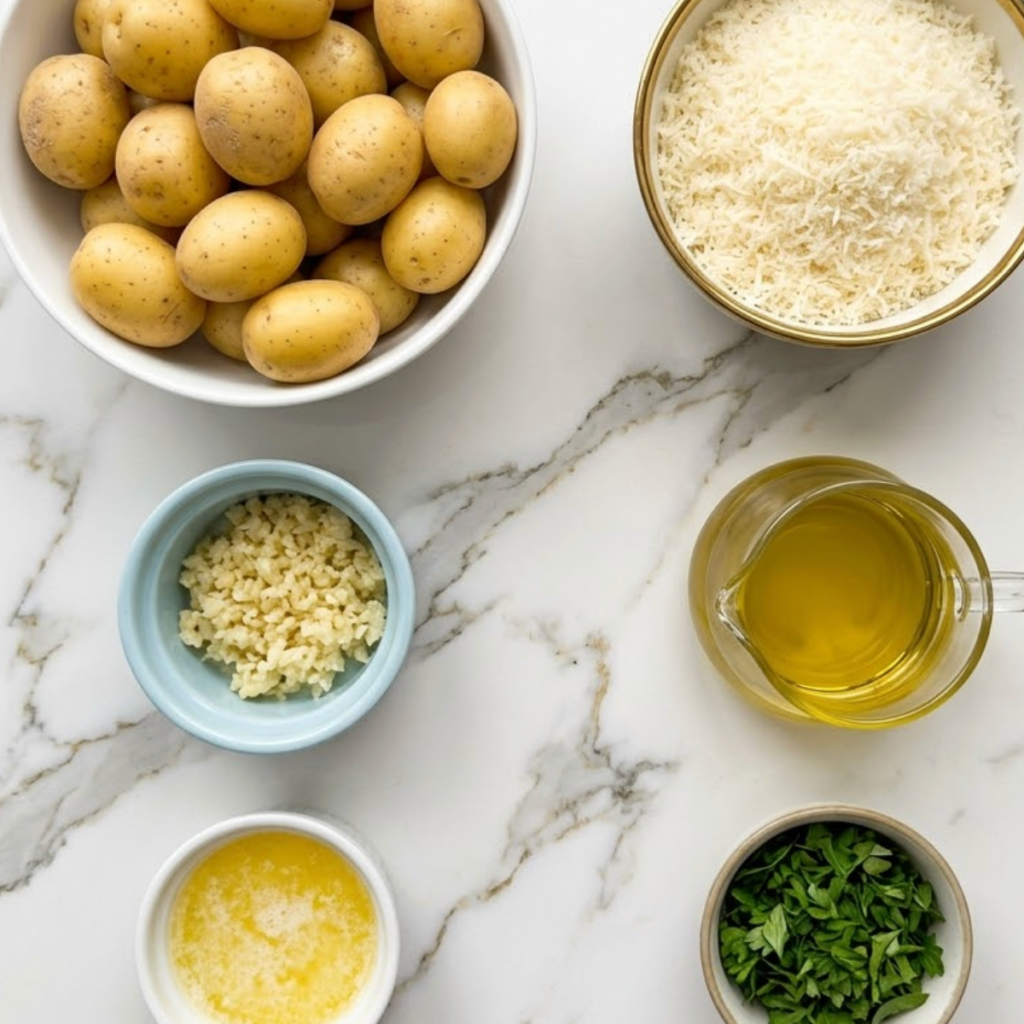
    • 1.5 lbs small yellow or baby potatoes – Small potatoes work best; they boil faster and each one becomes a perfect individual smashed disc after pressing
    • 3 tablespoons olive oil – Drizzled over the smashed potatoes before baking for golden crispy edges
    • 2 tablespoons unsalted butter, melted – Combined with the olive oil for a richer, more golden result than oil alone
    • 3 cloves garlic, finely minced or grated – Mixed into the butter and oil so every potato gets garlic flavor baked in from the bottom
    • 1/2 cup freshly grated parmesan – Scattered over the top after the garlic butter goes on; it bakes into a golden nutty crust that is the best part
    • 1 teaspoon dried rosemary or thyme – Optional but adds an herby warmth that pairs beautifully with the garlic and parmesan
    • Salt and black pepper to taste – Season the boiling water generously and season the potatoes again before baking
    • Fresh flat-leaf parsley, finely chopped – Scattered over the hot potatoes right after they come out of the oven for color and freshness
    • Flaky sea salt for finishing – A small pinch over the parmesan before baking makes every bite taste finished and intentional

    Step-by-Step Instructions

    Step 1: Boil the Potatoes

    • Place the whole unpeeled potatoes in a large pot, cover with cold water, and add two generous teaspoons of salt to the water before bringing it to a boil
    • Boil the potatoes for 20 to 25 minutes until completely fork-tender all the way through the center; a fork should slide in and out without any resistance
    • Drain the potatoes and spread them in a single layer on the prepared baking sheet; let them steam dry for 5 minutes so the surface moisture evaporates before smashing
    • The steam-dry step matters more than it seems; wet potato surfaces do not crisp properly in the oven and the parmesan will not stick evenly to a damp potato

    Step 2: Smash the Potatoes

    • Preheat your oven to 425 degrees F and drizzle two tablespoons of olive oil over the parchment-lined baking sheet before the potatoes go on
    • Using the flat bottom of a glass, measuring cup, or the heel of your palm, press each potato firmly and steadily downward until it is about half an inch thick; you want a disc with slightly craggy, cracked edges, not a thin, smeared pancake
    • The edges that crack and spread outward during smashing are the parts that will get the crispiest and most golden in the oven; do not try to tidy them up
    • Space the smashed potatoes at least an inch apart on the tray so the heat circulates around every edge during baking and nothing steams instead of crisps

    Step 3: Season and Bake

    • Whisk together the remaining tablespoon of olive oil, the melted butter, and the minced garlic in a small bowl, then spoon or brush the garlic butter generously over every smashed potato
    • Scatter the freshly grated parmesan evenly over all the potatoes and add a small pinch of dried rosemary or thyme and a pinch of flaky sea salt over the top of the parmesan
    • Bake at 425 degrees F for 20 to 25 minutes until the edges are deeply golden and crispy, the parmesan crust is set and golden, and the whole tray smells like a very good Italian restaurant
    • Do not open the oven in the first 15 minutes; the potatoes need consistent high heat without temperature drops to develop the proper golden crust

    Step 4: Finish and Serve

    • Remove the tray from the oven and immediately scatter fresh chopped parsley over all the potatoes while they are still hot so the herbs wilt slightly and stick to the surface
    • Add a final crack of black pepper and any extra flaky sea salt over the finished potatoes right before serving
    • Serve directly from the tray or transfer to a serving plate; these potatoes are best in the first ten minutes when the parmesan crust is at its crispiest and the edges are still shattering
    • Set out sour cream, aioli, or a squeeze of lemon alongside for dipping; the acidity of lemon against the garlic parmesan crust is one of the best flavor combinations this recipe produces

    Crispy Parmesan Smashed Potatoes Variations

    Mia’s “Extra Parmesan Everywhere” Version

    Mia did the parmesan scattering on the third batch and used a quantity that I can only describe as generous in the extreme. I said nothing because I could not think of a compelling argument against more parmesan. For her version, double the parmesan to a full cup and add half of it under the potatoes before baking and half on top. The underside parmesan turns into a lacy, deeply golden cheese crisp that lifts off the parchment in the most satisfying way, and Mia eats these pieces first with the focused satisfaction of someone who planned this outcome from the beginning.

    Ben’s “Smashed Potatoes on the Grill” Version

    Ben requested the grill version after watching a cooking video and presenting his case at dinner with a level of preparation I had not expected from a nine-year-old. Boil the potatoes as directed, let them steam dry, then smash and brush with the garlic butter mixture. Place them on a preheated grill over medium-high heat and cook for 4 to 5 minutes per side until grill marks develop and the edges crisp. Add the parmesan in the last 2 minutes with the lid closed. The smoky grill flavor against the garlic parmesan is genuinely excellent, and Ben described it as “the summer version,” which it absolutely is.

    The Sunburst Potatoes Party Version

    For gatherings and parties I make these slightly smaller using tiny fingerling or marble potatoes and arrange them on a large wooden board scattered with fresh herbs and lemon wedges. Press them extra thin, almost a quarter inch, so every bite is nearly all crust with a thin, soft center. The crust-to-potato ratio is dramatically different, and the result is closer to a very thick potato chip than a traditional smashed potato. Mia calls these “the fancy party ones” and stations herself near the tray. I have never once made enough of them for a party, and I keep making the same amount anyway.

    Substitutions

    Yellow baby potatoes to red potatoes or fingerlings: Red potatoes give a slightly earthier flavor and hold their shape beautifully under the smash. Fingerling potatoes are excellent for the party version since they are naturally smaller and create longer, more dramatic crispy shapes. Both boil and smash in exactly the same way as yellow potatoes.

    Parmesan to pecorino romano or Grana Padano: Pecorino romano is saltier and sharper than parmesan and gives the crust a more intensely savory bite. Grana Padano is milder and slightly sweeter. Both grate and melt in exactly the same way. Use slightly less pecorino than the recipe calls for since its saltiness is more pronounced.

    Olive oil and butter to ghee: Ghee has a higher smoke point than butter and adds a deeply nutty, slightly caramelized richness that makes the parmesan crust even more golden and flavorful. Use the same quantity as the combined olive oil and butter. This is the version I make when I want the potatoes to taste like something genuinely special.

    Fresh garlic to garlic powder: Half a teaspoon of garlic powder mixed into the oil and butter works well when fresh garlic is not available and gives a more mellow, evenly distributed garlic flavor throughout. Fresh garlic can burn at 425 degrees F if any pieces are too large, so finely grating it rather than mincing helps prevent any bitter spots on the finished potatoes.

    Equipment

    • Large pot for boiling the potatoes
    • Large rimmed baking sheet lined with parchment paper
    • Flat-bottomed glass, measuring cup, or small saucepan for smashing
    • Small bowl for the garlic butter mixture
    • Pastry brush or spoon for distributing the garlic butter
    • Microplane or fine grater for the parmesan and garlic
    • Sharp knife and cutting board for the fresh parsley
    • Wide spatula for lifting the finished potatoes off the tray

    Storage Tips

    Make Ahead

    • Boil and smash the potatoes up to 24 hours ahead, cover and refrigerate on the tray, then bring to room temperature for 15 minutes before adding the garlic butter and parmesan and baking
    • The garlic butter mixture can be made up to 3 days ahead and stored covered in the fridge; bring to room temperature before brushing so it spreads easily
    • These are one of the best potato side dishes, easy enough to prep entirely the night before a dinner party so the only thing needed on the day is the oven

    Refrigerator

    • Store leftover baked potatoes in an airtight container in the fridge for up to 3 days; they lose their crispiness but the garlic parmesan flavor holds beautifully
    • Keep them in a single layer if possible to prevent the parmesan crusts from sticking together and tearing when you try to separate them
    • Cold leftover smashed potatoes eaten directly from the fridge are a genuinely satisfying snack that both kids have discovered independently and neither is apologetic about

    Freezing

    • Freeze baked smashed potatoes on a parchment-lined tray until solid, then transfer to a freezer bag for up to 1 month
    • The texture changes slightly on freezing and thawing but reheating in a hot oven restores a good amount of the original crispiness
    • Boiled and smashed but unbaked potatoes freeze well for up to 2 months; add garlic butter and parmesan fresh before baking from frozen, adding 8 to 10 extra minutes to the bake time

    Reheating

    • Reheat in a 400 degree F oven on a parchment-lined tray for 8 to 10 minutes until the parmesan crust crisps back up and the edges are golden again; this is significantly better than any other reheating method
    • Air fryer reheating at 375 degrees F for 5 to 6 minutes gives excellent results and is Ben’s preferred method for every leftover potato in this house
    • Microwave reheating makes them soft rather than crispy but is perfectly acceptable for a quick weekday lunch when nobody is watching

    Family Secret Worth Sharing

    My mom always added a tablespoon of white wine vinegar to the potato boiling water, and I spent years thinking it was an unnecessary step until I made smashed potatoes without it and the interior texture was noticeably less fluffy and less creamy. The vinegar does something to the potato starch during cooking that gives the inside a fluffier, more tender quality and makes the outside skin slightly more pliable so it crisps rather than toughens in the oven. One tablespoon to the water before it boils. It does not make the potatoes taste like vinegar. It makes them taste more like the best version of themselves. Mia asked once why the potatoes tasted so good, and I said it was how I cooked them. Ben immediately said “what is the secret ingredient?” He is nine and he already knows there is always a secret ingredient. My mom would have found that absolutely delightful.

    Troubleshooting FAQs

    The potatoes are falling apart when I try to smash them. What went wrong?
    Either the potatoes were underboiled or they were too wet when you tried to smash them. Boil until a fork slides in and out with zero resistance, drain completely, and let them steam dry on the hot tray for a full five minutes before pressing. If a potato crumbles completely when pressed, it was undercooked; return the remaining ones to boiling water for another five minutes and test again. Overboiled potatoes also crumble since they have lost too much structural starch.

    The parmesan is burning before the potatoes are crispy. What do I do?
    The oven is too hot, or the parmesan was added too early. Check that your oven is actually at 425 degrees F and not running hotter. If the parmesan is browning too quickly, cover the tray loosely with foil for the first ten minutes and remove it for the last ten to fifteen minutes so the crust gets color without burning. Using freshly grated parmesan rather than pre-grated from a container also helps since pre-grated parmesan has added starch that can burn faster.

    The potatoes are not getting crispy on the bottom. What happened?
    The tray was not hot enough, the potatoes were not dried properly, or there was not enough oil on the tray. Preheat the baking sheet in the oven for five minutes before the potatoes go on for the best bottom crust. Make sure the potatoes are fully steam-dried after boiling and that there is enough oil pooling slightly under each potato on the tray. A cold wet potato on a cold tray will steam rather than crisp no matter how long it bakes.

    Can I make these without parmesan?
    Yes, and they are still excellent. Smashed potatoes with only garlic butter and herbs are genuinely good on their own. You can also top them with shredded cheddar for a different kind of melted cheese crust, or simply go plain with garlic butter, flaky salt, and herbs for a lighter version. The parmesan is what gives that distinctive nutty golden crust, but the technique and the garlic butter are what make the potatoes fundamentally worth eating.

    The Side Dish That Upstages Every Main Course

    I have made roasted chicken, braised short ribs, and grilled salmon alongside these potatoes on different occasions. Every single time, someone at the table mentions the potatoes first. Ben takes the most craggy-edged ones and considers this strategic. Mia checks every potato for parmesan coverage before choosing and has never once been satisfied with her first pick. These crispy parmesan smashed potatoes are one of the most reliable easy oven side dish recipes in our whole dinner rotation, sitting alongside our crispy potato side dish recipes that make any weeknight feel like it was planned with intention. For the nights when the whole table needs something to talk about before the main course even arrives, these potatoes next to our garlic parmesan dinner recipes make the whole meal feel like something genuinely memorable. That is a side dish worth having in the permanent rotation.

    Don’t forget to snap a picture of your potato side dishes easily before that… (trust me, it will disappear quickly!), and leave a rating below. We’d love to hear how this easy potato side dish recipe becomes part of your family dinner story.

  • 2 Secrets to Perfect Potato Recipes Side Dishes

    2 Secrets to Perfect Potato Recipes Side Dishes

    My mashed potatoes were too wet, and every fritter dissolved the moment it hit the pan. Ben tried to save one with a spatula, and it disintegrated. Mia said, “they became soup.” I laughed and started over. That fallen fritter disaster taught me the one prep step that makes these the crispiest, most satisfying potato recipes side dishes I have ever put on the table.

    Why This Recipe Is Special

    These are not the sad, dense potato patties you make just to use up leftovers. These are golden, crispy-edged fritters packed with sweet corn, sharp cheddar, and fresh chives that hold together beautifully and taste like something you made on purpose for the best possible reason. The outside goes genuinely golden and slightly crunchy from the pan, and the inside stays soft and potato-pillowy with pockets of melted cheese. Mia eats them plain, Ben eats them with sour cream and hot sauce, and I eat them standing at the stove because I cannot wait for a plate.

    How To Make Crispy Cheddar Corn Potato Fritters

    The successful batch came on a Sunday afternoon when both kids decided the fritter rescue mission from the first attempt had been dramatic enough that they wanted to supervise the second attempt personally. Mia was stationed at the mixing bowl and took the job of combining the corn and cheddar into the potato mixture with the seriousness of someone who has watched too many baking shows. Ben was in charge of the pan temperature and providing updates approximately every twenty seconds. When the first fritter went in and made that perfect sizzle and held its shape completely while going golden at the edges, both kids actually cheered. Ben said “we fixed it.” He was right, and he knew exactly which step we had fixed.

    The step that saved everything was squeezing the mashed potato mixture in a clean kitchen towel before mixing in the other ingredients. Leftover mashed potatoes hold a surprising amount of moisture, and that moisture is the enemy of a crispy fritter. Squeeze the potatoes until they feel dry and crumbly; add the egg, cheese, corn, and chives, and the mixture holds together firmly enough to form patties that stay intact from bowl to pan to plate. Ben watched me do this and said “that is the whole trick.” It is the whole trick.

    Main Ingredients

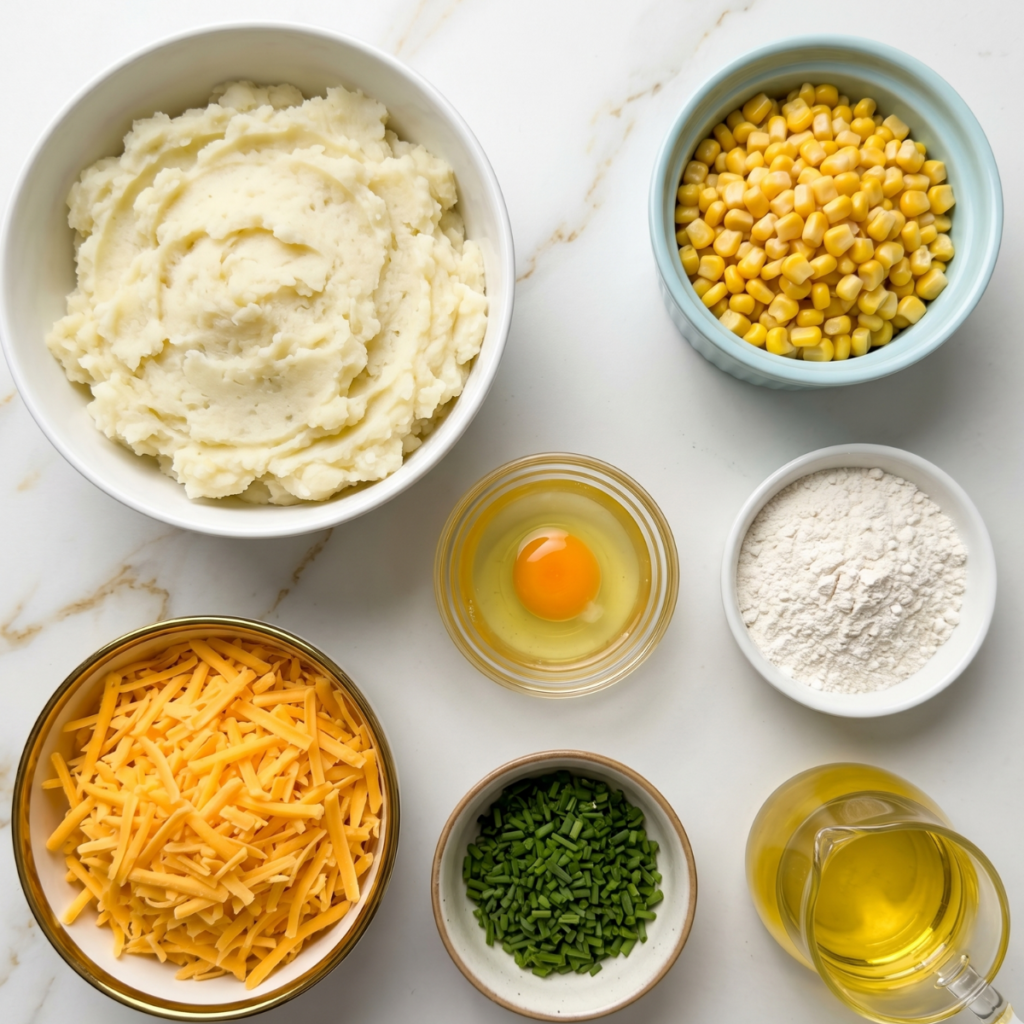
    • 2 cups cold mashed potatoes – Cold and well-chilled leftover mashed potatoes work best; fresh hot mashed potatoes are too soft and wet to form fritters that hold together
    • 1 cup frozen or canned corn, drained and patted dry – Adds sweetness and texture; patting dry is important so it does not add extra moisture to the mixture
    • 1 cup shredded sharp cheddar cheese – The sharper the cheddar the better the flavor; it melts into pockets throughout the fritter and gets golden at the edges
    • 1 large egg – The binder that holds every fritter together; do not skip it
    • 3 tablespoons all-purpose flour – Just enough extra structure to help the fritters hold their shape during cooking
    • 3 tablespoons fresh chives or green onions, finely chopped – Adds a fresh savory note throughout every bite
    • 1/2 teaspoon garlic powder – Savory depth that ties the potato and cheese together
    • 1/2 teaspoon smoked paprika – Gives the fritters a subtle color and warmth from the inside
    • Salt and black pepper to taste – Season the mixture generously before forming; cold potatoes absorb seasoning differently than hot
    • 2 to 3 tablespoons neutral oil for frying – Vegetable or avocado oil; enough to coat the bottom of the pan generously
    • Sour cream and extra chives for serving – The finishing touch that makes these feel like something worth sitting down for

    Step by Step Instructions

    Step 1: Prep the Potato Mixture

    • Place the cold mashed potatoes in the center of a clean kitchen towel, gather the edges, and squeeze firmly over the sink until as much liquid as possible has been removed; the potatoes should feel noticeably drier and slightly crumbly when done
    • Transfer the squeezed potatoes to a large mixing bowl and add the egg, flour, garlic powder, smoked paprika, salt, and pepper; stir until combined
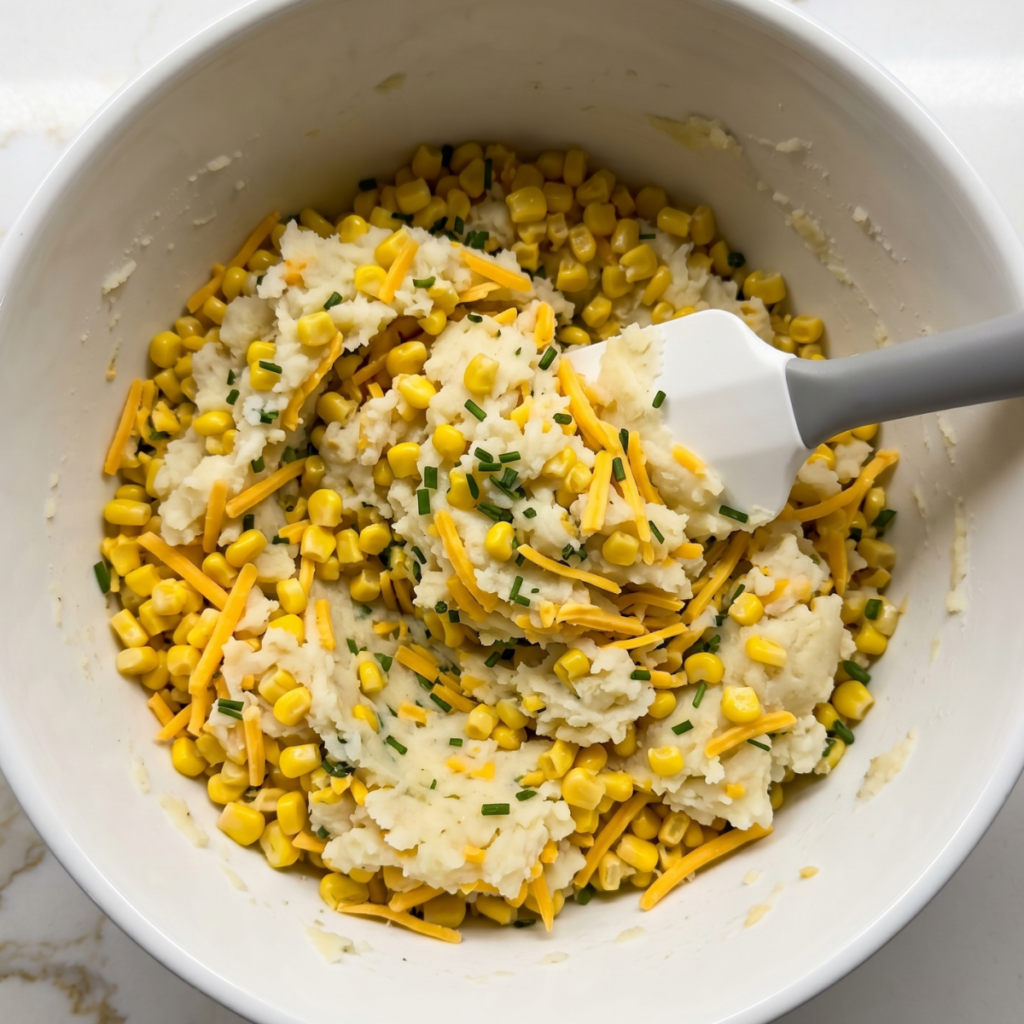
    • Fold in the shredded cheddar, drained corn, and chopped chives until evenly distributed throughout the mixture
    • Taste the mixture at this stage and adjust seasoning; cold mashed potatoes need more salt than you expect and an under-seasoned fritter will taste flat no matter how golden it gets

    Step 2: Form the Fritters

    • Scoop about a quarter cup of the potato mixture and shape it gently between your palms into a disc about half an inch thick and three inches across; do not pack too tightly or the fritters will be dense rather than light inside
    • Place the formed fritters on a parchment-lined plate or tray and refrigerate for 15 minutes before frying; this brief chill firms them up and makes them significantly less likely to fall apart in the pan
    • If the mixture feels too wet to hold its shape even after squeezing the potatoes, add another tablespoon of flour and stir gently before forming; this is a quick fix that works every time
    • This recipe makes approximately 8 to 10 fritters depending on how generous your scoops are; plan on two to three per person as a side dish

    Step 3: Fry Until Crispy

    • Heat the neutral oil in a large non-stick or cast iron skillet over medium heat until shimmering; the oil should sizzle immediately when the edge of a fritter touches it
    • Add the chilled fritters in batches of three to four without crowding; crowded fritters steam instead of fry and will never get genuinely golden
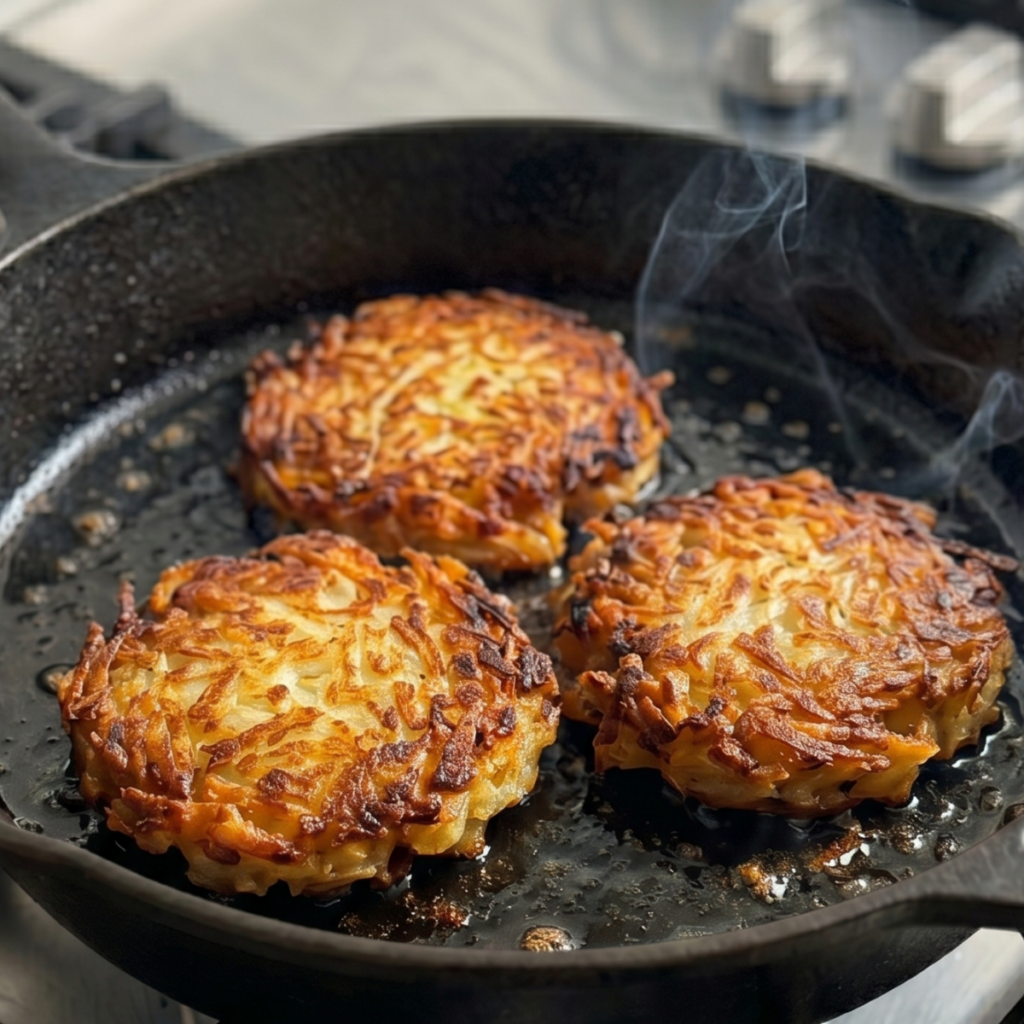
    • Cook undisturbed for 3 to 4 minutes on the first side until a deep golden crust has formed; do not move or press them during this time or the crust will break before it has set
    • Flip carefully with a thin wide spatula and cook for another 3 minutes on the second side until equally golden; transfer to a paper towel-lined plate and repeat with the remaining fritters

    Step 4: Drain, Garnish, and Serve

    • Transfer the finished fritters to a paper towel-lined plate for sixty seconds to absorb any excess oil from the surface
    • Move to a serving plate immediately after draining so the bottoms do not steam against the paper towel and lose their crispiness
    • Scatter freshly chopped chives over the top and serve immediately with sour cream alongside; these fritters are at their absolute best in the first five minutes out of the pan when the crust is at peak crunch
    • For a complete spread, serve alongside extra toppings like hot sauce, sliced avocado, or a simple green salad to balance the richness of the fried fritters

    Crispy Cheddar Corn Potato Fritters Variations

    Mia’s “All Corn, Extra Cheese” Version

    Mia’s relationship with corn in any context is enthusiastic and consistent. She increased the corn from one cup to one and a half cups during her mixing session with the bowl and did not tell me until after it was cooked. The extra corn made the fritters slightly sweeter and gave them more texture throughout, and Mia announced at the table that hers were “improved.” She was not wrong. For her version, use one and a half cups of corn and add an extra quarter cup of cheddar. The cheese pockets become more generous, and the sweetness of the corn is more prominent in every bite.

    Ben’s “Spicy Cheddar” Version

    Ben requested jalapeno in the fritters with the same calm inevitability he brings to every spice request in this kitchen. For his version, finely dice one small jalapeno and fold it into the mixture with the corn and cheese. Use pepper jack in place of half the cheddar for an extra heat layer. The fritters go golden the same way, but every bite has a building warmth that Ben describes as “the correct amount of flavor.” He dips his in hot sauce additionally, which he describes as “his personal touch,” and I have learned to stop commenting on this.

    The Baked Sheet Pan Version

    On the nights when frying a batch of fritters sounds like more standing at the stove than I have energy for, the oven version saves everything. Brush each formed fritter generously on both sides with oil and place on a parchment-lined baking sheet. Bake at 425 degrees F for 15 minutes, flip carefully, and bake for another 10 minutes until golden and crispy. They are not quite as deeply golden as the pan-fried version, but the result is genuinely good, and the cleanup is significantly easier. Ben calls this version “the responsible choice” and eats just as many of them.

    Substitutions

    Cold mashed potatoes to freshly mashed: If you do not have leftover cold mashed potatoes, make a fresh batch and spread them on a baking sheet to cool and dry out for 20 to 30 minutes before using. Fresh hot mashed potatoes have too much steam and moisture to form fritters that hold together. The cooling and drying time is the critical step whether you are using leftovers or fresh ones.

    Sharp cheddar to Gruyere or smoked gouda: Gruyere gives a nuttier, more complex flavor that feels slightly more elevated for a dinner party side dish. Smoked gouda adds a deeper smokiness alongside the smoked paprika that is genuinely excellent. Both melt beautifully and create the same golden cheese pockets in the finished fritter.

    All-purpose flour to gluten-free flour or cornmeal: A 1:1 gluten-free flour substitutes in exactly the same quantity with almost no change to the finished fritter. Cornmeal in place of flour adds a slightly grittier texture and a corn-on-corn depth of flavor that works beautifully alongside the corn in the mixture and gives the crust an extra crunch.

    Fresh chives to parsley or dill: Fresh flat-leaf parsley gives a slightly more herby, less onion-forward flavor that works beautifully. Fresh dill adds a brightness that pairs surprisingly well with the potato and cheddar and gives the fritters a more Eastern European character. Use the same quantity of either substitute.

    Equipment

    • Large non-stick or cast iron skillet for frying
    • Clean kitchen towel for squeezing moisture from the potatoes
    • Large mixing bowl for the fritter mixture
    • Quarter-cup measure or large cookie scoop for consistent fritter sizing
    • Thin wide spatula for flipping without breaking
    • Parchment-lined tray for chilling the formed fritters before frying
    • Paper towel-lined plate for draining after frying
    • Sharp knife and cutting board for the chives and garnish

    Storage Tips

    Make Ahead

    • Form the fritters up to 24 hours ahead and store on a parchment-lined tray covered with plastic wrap in the fridge; fry fresh at serving time for the best crispiness
    • The potato mixture can be made up to 2 days ahead and stored covered in the fridge; stir gently before forming and add a splash of flour if it has loosened slightly
    • These are one of the most practical potato recipes side dishes for entertaining since all the prep can be done completely ahead and the frying takes under fifteen minutes

    Refrigerator

    • Store cooked fritters in an airtight container in the fridge for up to 3 days; they will lose their crispiness but the flavor holds up beautifully
    • Layer between parchment sheets to prevent sticking and keep the edges from getting soggy against each other
    • Cold fritters eaten straight from the fridge are a legitimate snack that both kids have discovered and neither apologizes for

    Freezing

    • Freeze cooked fritters on a parchment-lined tray until solid, then transfer to a freezer bag for up to 2 months
    • Reheat directly from frozen in a 400 degree F oven for 12 to 15 minutes for a result close to freshly fried; do not microwave from frozen as they go limp
    • Raw formed fritters can also be frozen on a tray and then bagged; fry directly from frozen, adding 2 extra minutes per side

    Reheating

    • Reheat in a dry non-stick skillet over medium heat for 2 to 3 minutes per side for the closest result to freshly fried; the exterior crisps back up remarkably well
    • Air fryer reheating at 375 degrees F for 5 to 6 minutes is the best method for restoring crispiness with minimal effort; Ben discovered this and uses the air fryer for every leftover fritter
    • Oven reheating at 400 degrees F on a wire rack for 10 minutes keeps the bottoms crispy rather than steaming them against a flat sheet pan

    Family Secret Worth Sharing

    My mom always stirred a tablespoon of sour cream directly into the fritter mixture before forming, not just serving it alongside as a dip. She said it added a slight tang to the inside of the fritter that made the whole thing taste more rounded and less starchy. I thought this was just a personal preference until I made a batch without it, and the fritters tasted noticeably flatter even with everything else done correctly. The sour cream goes in with the egg and flour, just one tablespoon, and it disappears completely into the mixture without making it wet. Ben helped me make a batch once and stirred it in himself without asking what it was because he had seen me do it. He said later it tasted “more like a real thing.” That is exactly what one tablespoon of sour cream does to a potato fritter, and my mom knew that before anyone told her.

    Troubleshooting FAQs

    My fritters are falling apart in the pan. What went wrong?
    Three things cause this: the potatoes were not squeezed dry enough, the fritters were not chilled before frying, or the pan was not hot enough when they went in. Address all three and the problem disappears. Squeeze the potatoes until they feel genuinely dry, chill the formed fritters for at least fifteen minutes, and make sure the oil shimmers before the first fritter goes in. A fritter that hits a properly hot pan starts forming its crust immediately and is far less likely to fall apart during flipping.

    The fritters are not getting golden, they are just getting greasy. What happened?
    The oil was not hot enough, or the pan was overcrowded. Cold oil means the fritters absorb it instead of frying in it. Test the oil temperature by touching the edge of a fritter to the pan; if it sizzles immediately, the oil is ready. Also, fry in batches of three to four maximum so the oil temperature stays consistent. Crowded fritters drop the pan temperature and steam rather than fry, which is how you get greasy, pale fritters instead of golden, crispy ones.

    The fritters are golden on the outside but raw and pasty in the middle. How do I fix it?
    The fritters are too thick or the heat is too high. Flatten each fritter to about half an inch thickness before frying; thicker fritters need longer in the pan than the outside can handle before burning. Medium heat rather than medium-high gives the heat time to cook through the center before the exterior over-browns. A thinner fritter cooked on medium is what gives that perfectly golden outside and warm soft inside simultaneously.

    Can I use instant mashed potatoes instead of regular?
    Yes, and they actually work quite well because instant mashed potatoes tend to be drier than homemade. Make them slightly stiffer than you normally would by using slightly less water than the package directs, then cool completely before mixing with the other ingredients. Skip the squeezing step since they will already be dry enough. The flavor is simpler than homemade mashed potatoes, but the texture of the finished fritter is perfectly good.

    The Side Dish That Quietly Steals the Whole Dinner

    There is a moment at every dinner table when someone reaches for the side dish before the main course is even served and looks completely unapologetic about it. In our house that moment always happens with these fritters. Ben takes the corner ones because the crust is thicker there. Mia eats hers with so much sour cream that the fritter is barely visible underneath, which she considers a reasonable ratio. These crispy cheddar corn and potato fritters have become one of the most reliable easy weeknight side dish recipes in our whole dinner rotation, right alongside our comforting potato dinner recipes that make the whole table feel genuinely satisfied. For the nights when I want the full spread covered, these fritters next to our easy family dinner recipes mean every person at the table is eating something they actually wanted, and nobody is negotiating. That is a dinner worth making again.

    Don’t forget to snap a picture of your potato recipes’ side dishes before that… (trust me, it will disappear quickly!), and leave a rating below. We’d love to hear how this potato recipe side dish becomes part of your family dinner story.

  • 4-Step Fluffy Blueberry Cottage Cheese Breakfast Bake

    4-Step Fluffy Blueberry Cottage Cheese Breakfast Bake

    I used plain unsweetened cottage cheese and completely forgot the sugar. It came out tasting like warm blueberry cheese. Ben ate a square because he was hungry. Mia took one bite, set her fork down very carefully, and quietly changed the subject entirely. That silent review sent me back to the recipe, and this blueberry cottage cheese bake now starts every weekend morning exactly right.

    Why This Recipe Is Special

    This is the breakfast bake that looks like a treat, tastes like something genuinely special, and secretly has more protein per square than almost anything else on the breakfast table. The cottage cheese melts into the batter during baking and creates a soft, almost custard-like interior that you cannot get from regular flour-only bakes. The blueberries burst and collapse into jammy pools throughout the crumb, and the whole thing comes together in one bowl in under ten minutes of actual work. Mia calls it “the blueberry cake” and eats it on weekdays when I meal-prep it, which tells me everything I need to know.

    How To Make Blueberry Cottage Cheese Breakfast Bake

    The successful batch happened on a Sunday morning when both kids were already at the table before I had started, which is not a thing that normally happens voluntarily. Mia had heard the word “blueberry” and arrived in the kitchen with the focused energy of someone who has a strong position on blueberries. Ben was reading the cottage cheese container with the skeptical expression he reserves for any ingredient he does not recognize in a sweet context. When I explained that cottage cheese in baking makes things soft and adds protein and you cannot taste it as cottage cheese, he said “prove it.” I did. He had two squares and said nothing more about it.

    The thing that fixed the undersweetened batch was understanding that this batter needs sweetness from two directions: the sugar in the batter and a small handful of extra sugar scattered on top before baking. The top sugar caramelizes in the oven into a very thin, slightly golden crust that makes every bite taste finished rather than plain. It also makes the blueberries look like they are set in something glazed and intentional when the bake comes out, which Ben now calls “the professional look.” I let him claim it.

    Main Ingredients

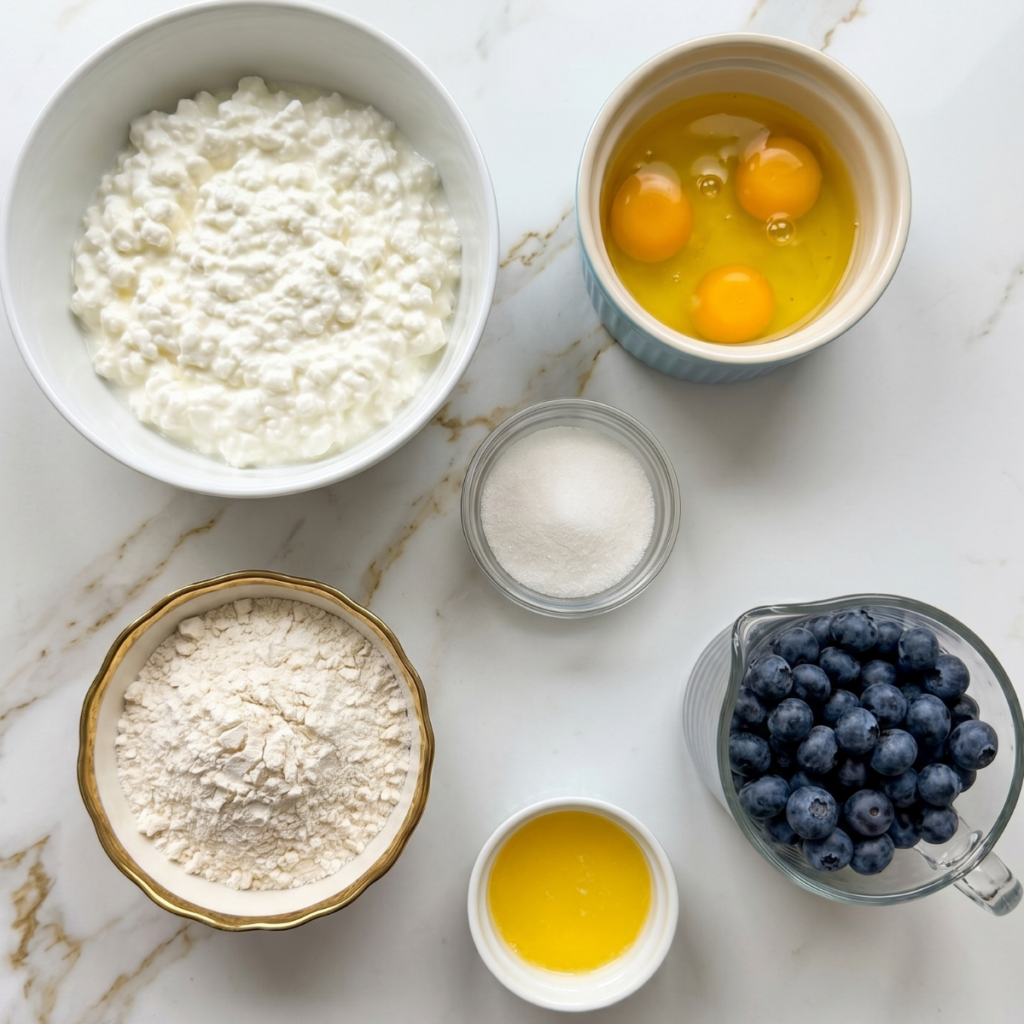
    • 2 cups full-fat cottage cheese – Full-fat gives the richest, creamiest result; low-fat works but the interior is slightly less custardy
    • 3 large eggs – The structure that holds the whole bake together; room temperature eggs incorporate more smoothly
    • 1/3 cup granulated sugar plus 1 tablespoon for topping – The batter sugar sweetens throughout and the topping sugar caramelizes into that thin golden crust
    • 1/3 cup all-purpose flour – Just enough to give the bake structure without making it cakey; it stays closer to a custardy baked good than a cake
    • 1 teaspoon vanilla extract – Rounds out the sweetness and the cottage cheese tang beautifully
    • 1 teaspoon baking powder – Gives a gentle lift without making the texture cakey
    • 1/4 teaspoon salt – Enhances every other flavor including the blueberry and the vanilla
    • Zest of one lemon – Brightens the whole bake and makes the blueberry flavor more vivid; do not skip this
    • 1.5 cups fresh or frozen blueberries – Fresh give slightly cleaner pockets; frozen work perfectly and turn the whole batter lavender as they thaw, which Mia approves of
    • 2 tablespoons melted butter – Stirred into the batter for richness and helps the top go golden in the oven

    Step-by-Step Instructions

    Step 1: Prep the Pan and Make the Batter Base

    • Preheat your oven to 375 degrees F and grease an 8×8 or 9×9 inch baking dish generously with butter or cooking spray; a well-greased pan is important here since the cottage cheese batter sticks more readily than a regular cake batter
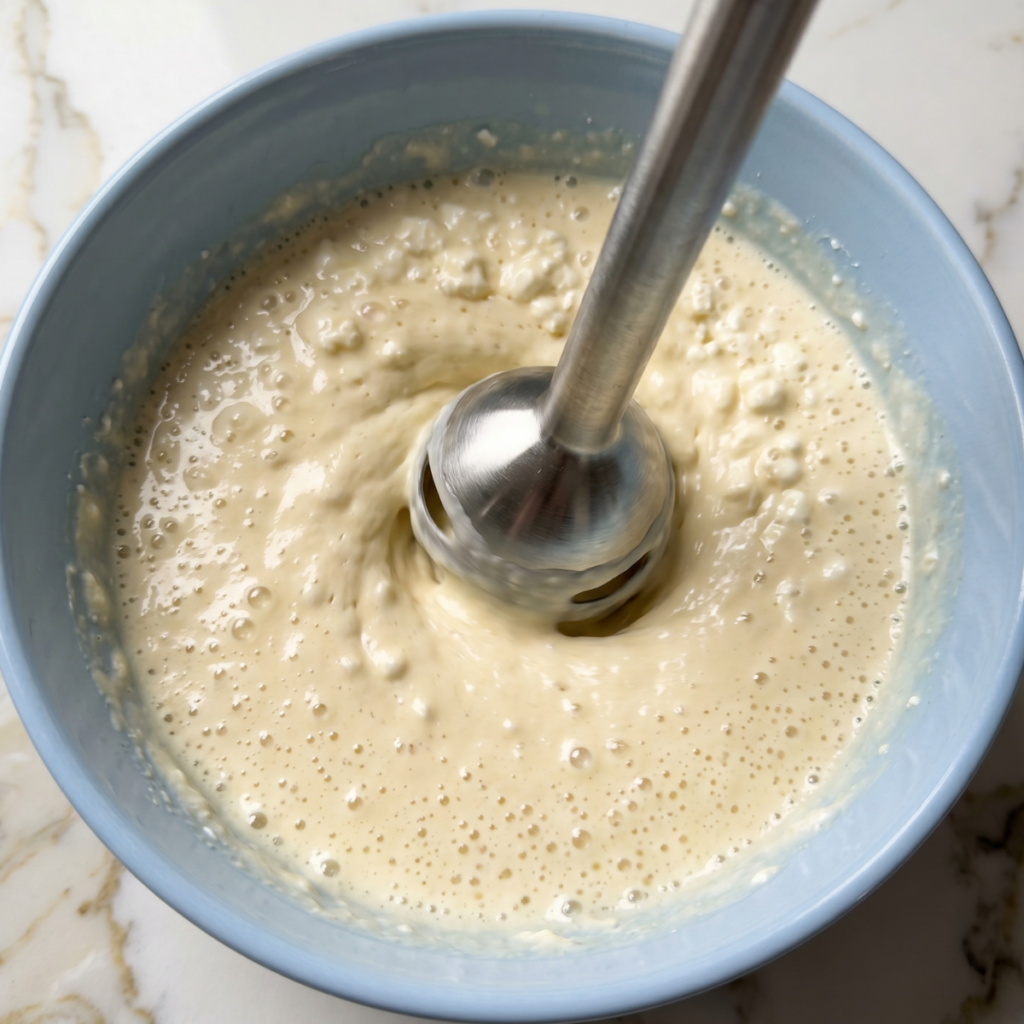
    • Combine the cottage cheese, eggs, granulated sugar, melted butter, vanilla extract, and lemon zest in a large bowl and stir until completely smooth and the sugar is dissolved into the mixture
    • If your cottage cheese has large curds, blend the mixture briefly with an immersion blender or in a regular blender for about 20 seconds for a smoother, more even texture throughout the finished bake
    • Taste the batter at this stage and check the sweetness; it should taste pleasantly sweet with a faint tang from the cottage cheese and bright lemon that makes you want to keep tasting it

    Step 2: Add the Dry Ingredients

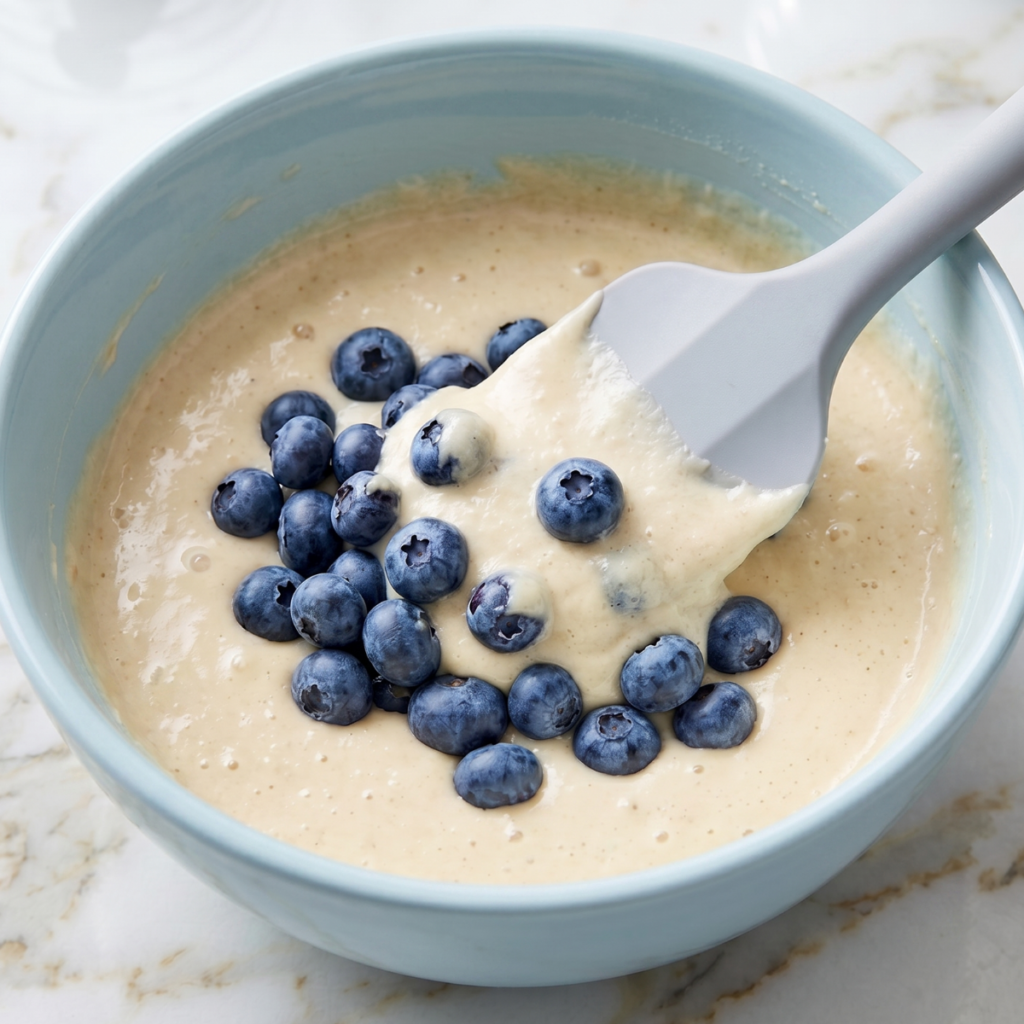
    • Sift the flour, baking powder, and salt directly over the cottage cheese mixture and fold gently with a spatula until just combined with no dry streaks visible
    • Do not overmix; the batter should look slightly lumpy and loose rather than smooth and thick, which is exactly right for the custardy texture this bake is known for
    • Fold in three-quarters of the blueberries with a few gentle strokes, reserving the remaining quarter for scattering on top so the surface has visible whole fruit
    • The batter will look very loose and pourable compared to a regular cake batter; this is correct and the cottage cheese thickens and sets beautifully in the oven

    Step 3: Pour, Top, and Bake

    • Pour the batter into the prepared baking dish and spread it evenly to the corners; the batter is thin enough that it mostly levels itself
    • Scatter the reserved blueberries evenly over the surface of the batter so the top will have visible jammy blueberry pockets after baking
    • Sprinkle the remaining tablespoon of granulated sugar evenly over the entire surface; this is the step that creates the thin, caramelized golden crust on top
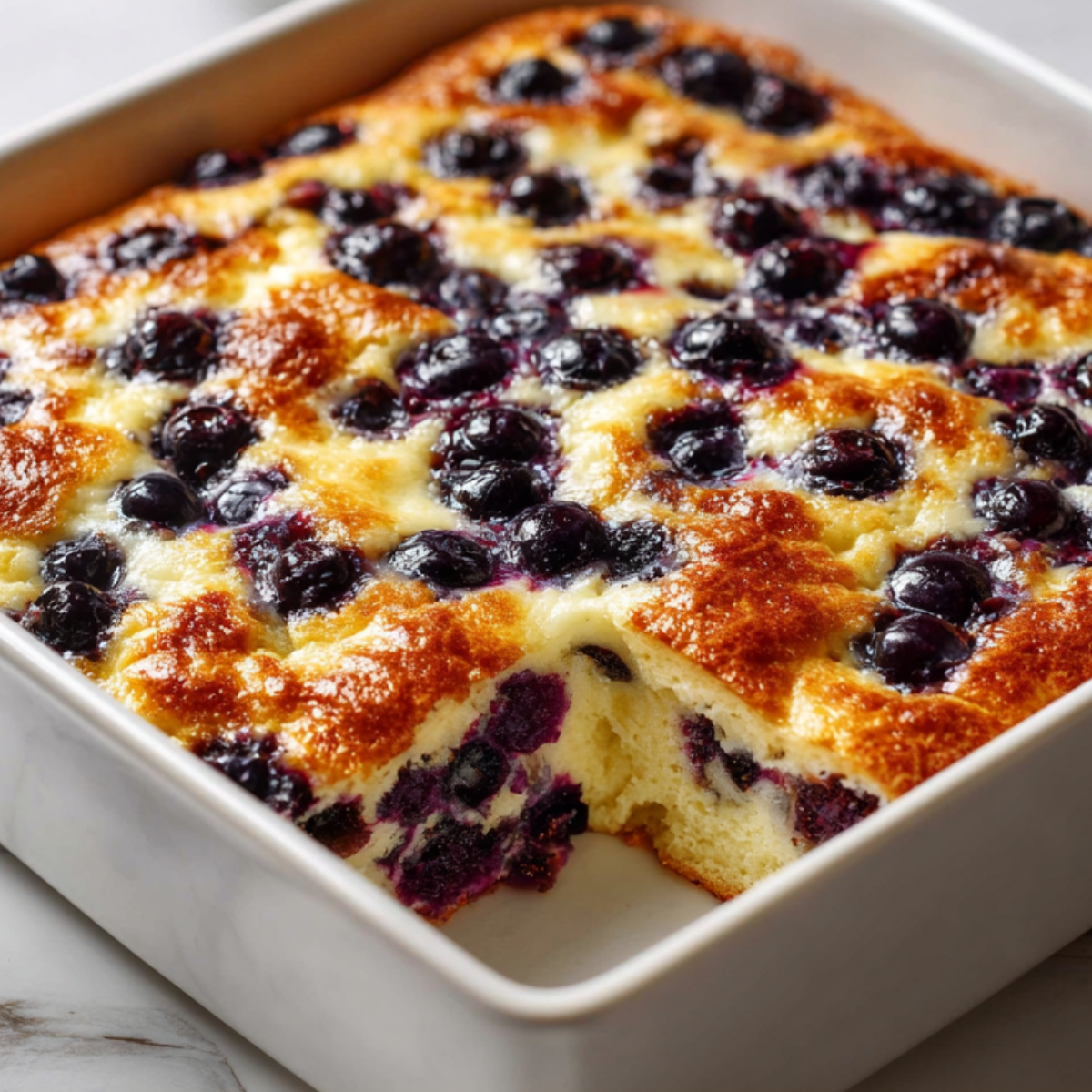
    • Bake at 375 degrees F for 35 to 40 minutes until the top is deep golden, the edges have set and pulled slightly from the sides of the pan, and the center feels just barely jiggly when you shake the dish gently

    Step 4: Cool, Cut, and Serve

    • Let the bake cool in the dish for at least 15 minutes before cutting; the cottage cheese layer needs this time to firm up from its custardy state into something that slices cleanly
    • Run a thin knife around the edges of the pan before cutting to release any spots that have stuck, then cut into squares with one clean downward press without sawing
    • Serve warm for the softest, most custardy interior, or at room temperature once fully cooled for cleaner slices that hold their shape on a plate
    • Dust with a small amount of powdered sugar right before serving if you want a finished presentation; a few extra fresh blueberries alongside each square look beautiful and taste even better

    Blueberry Cottage Cheese Breakfast Bake Variations

    Mia’s “Extra Blueberries and Lemon” Version

    Mia conducted a formal assessment of the blueberry-to-bake ratio after the first successful batch and determined that more blueberries were needed. She submitted this opinion while eating her second square and maintained it through the entire breakfast conversation. For her version, increase the blueberries to two full cups and add an extra teaspoon of lemon zest alongside the original amount. The bake turns a deeper purple where the blueberries concentrate, and the lemon flavor runs through every bite more prominently. Mia calls this “the correct version,” and I have been making it her way ever since.

    Ben’s “Prove It Is Protein” Version

    Ben remains scientifically interested in the protein content of this bake ever since I told him cottage cheese was the reason it offered more protein than regular breakfast cake. For his version, add two tablespoons of vanilla protein powder to the dry ingredients alongside the flour and increase the sugar by one teaspoon to compensate for the slight bitterness some protein powders bring. The texture is barely different, the protein content increases meaningfully, and Ben eats it before school while looking satisfied with himself for eating something nutritious that tastes like dessert. This version is a genuine win.

    The Mixed Berry Meal Prep Version

    The Mixed Berry Meal Prep Version is the version I make on Sunday when I want the whole week of breakfasts handled by Monday morning. Use one cup of blueberries and half a cup each of raspberries and chopped strawberries for a mixed berry version that is even more colorful and slightly more tart. Bake in a 9×13 dish for 30 to 35 minutes to account for the thinner layer and cut into twelve portions once cooled. Each portion goes into an individual container in the fridge and reheats in the microwave in sixty seconds. Ben grabs one before school and calls it “the berry thing,” which is a term of endearment from him.

    Substitutions

    Full-fat cottage cheese to ricotta: Whole milk ricotta substitutes in exactly the same quantity and gives an even smoother, more delicate texture since ricotta has smaller curds than cottage cheese. The protein content drops slightly, but the bake is silkier, and the flavor is slightly milder and creamier. Mia preferred the ricotta version, and I did not tell her the recipe had changed.

    All-purpose flour to oat flour or almond flour: Oat flour in the same quantity gives a slightly nuttier, heartier result that is still soft and custardy inside. Almond flour in the same quantity makes the bake denser and richer and keeps it lower in carbs, which is how this recipe works beautifully as a low-carb protein breakfast option without any major adjustments.

    Fresh blueberries to frozen: Frozen blueberries work perfectly and are what I use most often since they are always available and already measured. Do not thaw them before adding to the batter; adding them frozen keeps them from bleeding too much into the batter before it goes into the oven. The finished bake will have slightly more purple streaking throughout, which Mia considers an improvement.

    Granulated sugar to honey or maple syrup: Two tablespoons of honey or maple syrup in place of the granulated sugar in the batter gives a more complex, natural sweetness and a slightly denser texture. Reduce the sugar topping to a light sprinkle rather than a full tablespoon since liquid sweeteners make the top less likely to caramelize into the thin crust. The flavor is warmer and more rounded with either substitution.

    Equipment

    • 8×8 or 9×9 inch baking dish (glass or ceramic)
    • Large mixing bowl for the batter
    • Rubber spatula for folding
    • Immersion blender or regular blender (optional; for a smoother batter if using large-curd cottage cheese)
    • Zester or fine grater for the lemon zest
    • Fine mesh strainer for dusting powdered sugar
    • Sharp knife for cutting clean squares
    • Wire cooling rack for resting the dish before cutting
    • Measuring cups and spoons

    Storage Tips

    Make Ahead

    • Bake the full dish on Sunday and portion it into individual containers for the whole week of breakfasts; this is one of the best meal prep breakfast ideas that actually holds up beautifully for five days
    • The batter can be mixed the night before and stored covered in the fridge; stir gently before pouring into the pan and add two extra minutes to the bake time since the batter will be cold
    • Bake the day before serving and refrigerate overnight; the texture firms further overnight and the slices are actually cleaner and hold their shape better on day two

    Refrigerator

    • Store cut squares in an airtight container in the fridge for up to 5 days; the cottage cheese content means refrigeration is non-negotiable after the first day
    • Layer squares between parchment sheets in the container to prevent the blueberry tops from sticking together
    • The bake firms up in the fridge and the texture shifts from custardy to something closer to a dense, moist cake which is equally good and arguably easier to grab and go

    Freezing

    • Freeze individual squares wrapped tightly in plastic wrap and stored in a freezer bag for up to 2 months
    • Thaw overnight in the fridge or at room temperature for 30 minutes; the texture returns very close to the original once thawed
    • Do not freeze the whole uncut bake, as the cottage cheese layer can develop a slightly grainy texture when thawed in a large mass

    Reheating

    • Reheat individual squares in the microwave at 50 percent power for 45 to 60 seconds until just warmed through; full power can make the cottage cheese layer rubbery
    • Reheat in a 325 degree F oven for 8 to 10 minutes for the closest result to freshly baked with a slightly crisp top edge
    • These squares are genuinely excellent eaten cold straight from the fridge, which Mia prefers and Ben considers “acceptable for a school morning.”

    Family Secret Worth Sharing

    My mom always added a small spoonful of cream cheese to her cottage cheese bakes alongside the regular cottage cheese, about two tablespoons blended smooth, and I thought this was just her slightly extra approach to things until I tried leaving it out, and the interior of the bake was noticeably less rich and less velvety. The cream cheese adds a subtle dairy richness that cottage cheese alone cannot quite reach on its own, and it smooths out the slight graininess that some cottage cheese brands bring to baked goods. I blend it in with the cottage cheese before anything else goes into the bowl. Ben has never noticed it is in there, and Mia has never questioned why hers tastes slightly more special than anything she has had elsewhere. That is exactly the kind of secret worth keeping.

    Troubleshooting FAQs

    The bake is still jiggly and soft in the center after 40 minutes. Is it done?
    A very slight jiggle in the very center is acceptable and similar to cheesecake; it will firm up during the resting time. But if the center looks liquid or underset rather than just slightly wobbly, give it another 5 minutes and check again. The edges should be fully set, golden, and pulling from the pan sides. If the top is browning too quickly before the center is done, cover loosely with foil for the remaining bake time.

    The bake tastes bland and not sweet enough. What went wrong?
    The sugar was measured incorrectly, the cottage cheese was unsweetened and quite tangy, or the lemon zest overpowered the sweetness. Taste the batter before it goes into the pan and adjust with an extra tablespoon of sugar if needed. The batter should taste pleasantly sweet before baking since it does not gain sweetness in the oven other than from the caramelized topping. This is the exact mistake I made on my first batch, and Mia’s silent fork placement told me everything.

    The cottage cheese texture is grainy and visible in the finished bake. How do I fix it?
    Blend the cottage cheese briefly before mixing it with the other ingredients. Even 20 seconds with an immersion blender smooths out large curds completely and gives a uniform, silky interior without any visible curds. This single step is what separates a smooth custardy bake from one that looks like it has white lumps throughout. It takes less than a minute and makes a noticeable difference in the finished texture.

    Can I make this recipe dairy-free?
    Yes, with some adjustments. A good quality dairy-free cottage cheese or thick coconut yogurt substitute in the same quantity with a slightly different but still pleasant flavor. Skip the cream cheese addition in this case. Use dairy-free butter or coconut oil in place of the melted butter. The protein content will be lower depending on the dairy-free alternative used, but the bake will still have a pleasant soft texture and hold together well.

    The Breakfast Bake That Made Cottage Cheese Acceptable to a Nine-Year-Old

    Ben now requests this on Sunday mornings with a directness that suggests he has moved past his initial skepticism about cottage cheese entirely and would prefer we not discuss it. Mia asks for the blueberry version specifically, which is all the versions, because she has never once asked for a version without blueberries. This blueberry cottage cheese bake sits naturally alongside our healthy high-protein breakfast bake recipes as one of the most nourishing and genuinely satisfying starts to any morning, and on the weekdays when meal prep is the priority it works right alongside our easy protein breakfast meal prep recipes for a full week of breakfasts sorted in one Sunday hour. For the mornings when the whole table wants something sweet and filling that does not require standing at a stove, this bake next to our easy healthy morning recipes covers every breakfast preference without a single complaint. Some recipes earn their place in the permanent rotation quietly, and this one did it in a single successful Sunday morning.

    Don’t forget to snap a picture of your blueberry cottage cheese breakfast bake before that… (trust me, it will disappear quickly), and leave a rating below. We’d love to hear how this blueberry cottage cheese recipe becomes part of your family morning story.
  • Best Breakfast Enchiladas

    Best Breakfast Enchiladas

    I poured the entire can of enchilada sauce instead of half, and the tortillas dissolved overnight into something completely unrecognizable. Ben lifted one with a spoon and said “it went liquid.” Mia said it smelled right. These breakfast enchiladas became everything they are supposed to be the moment I measured the sauce properly, and the whole family has been asking for them every weekend since.

    Why This Recipe Is Special

    This is the breakfast casserole that makes Saturday morning feel like an occasion without making the cook feel like they are running a restaurant. Flour tortillas rolled around a filling of scrambled eggs, seasoned sausage, and cheese, covered in a creamy enchilada sauce and more cheese, then baked until golden and bubbling. You can assemble it the night before and bake it fresh in the morning, which means you get all the warmth and indulgence of a made-from-scratch breakfast without standing over a stove at seven in the morning. Mia calls it “the fancy breakfast,” and Ben calls it “basically dinner for breakfast,” which is the kind of review that makes me make it again every time.

    How To Make Breakfast Enchiladas

    The successful batch happened on a Friday night when I decided to get ahead of Saturday morning for once. Both kids were invested from the start. Mia was carefully spooning the egg and sausage filling onto each tortilla with the precision of someone who takes her job seriously, and she made each one so neat and even that I told her she had a future in food. Ben was rolling them and placing them in the dish and providing a running announcement of each one as it went in, as though narrating a very small sporting event. When I poured the sauce over the top and scattered the last of the cheese, Ben said “that looks like the real thing.” It looked exactly like the real thing.

    The lesson from the dissolved batch was a ratio lesson and an overnight lesson at the same time. Too much sauce means the tortillas absorb everything overnight and lose all structure. The right amount of sauce covers everything generously but leaves the tortillas with enough integrity to hold their shape through the bake. I also learned that adding a light layer of sauce to the bottom of the dish before the enchiladas go in prevents sticking and gives even more flavor from beneath. Ben watched me do this step once and called it “layered strategy.” He was not wrong.

    Main Ingredients

    • 8 medium flour tortillas – Medium tortillas roll more neatly than large ones and hold their shape better in the overnight soak
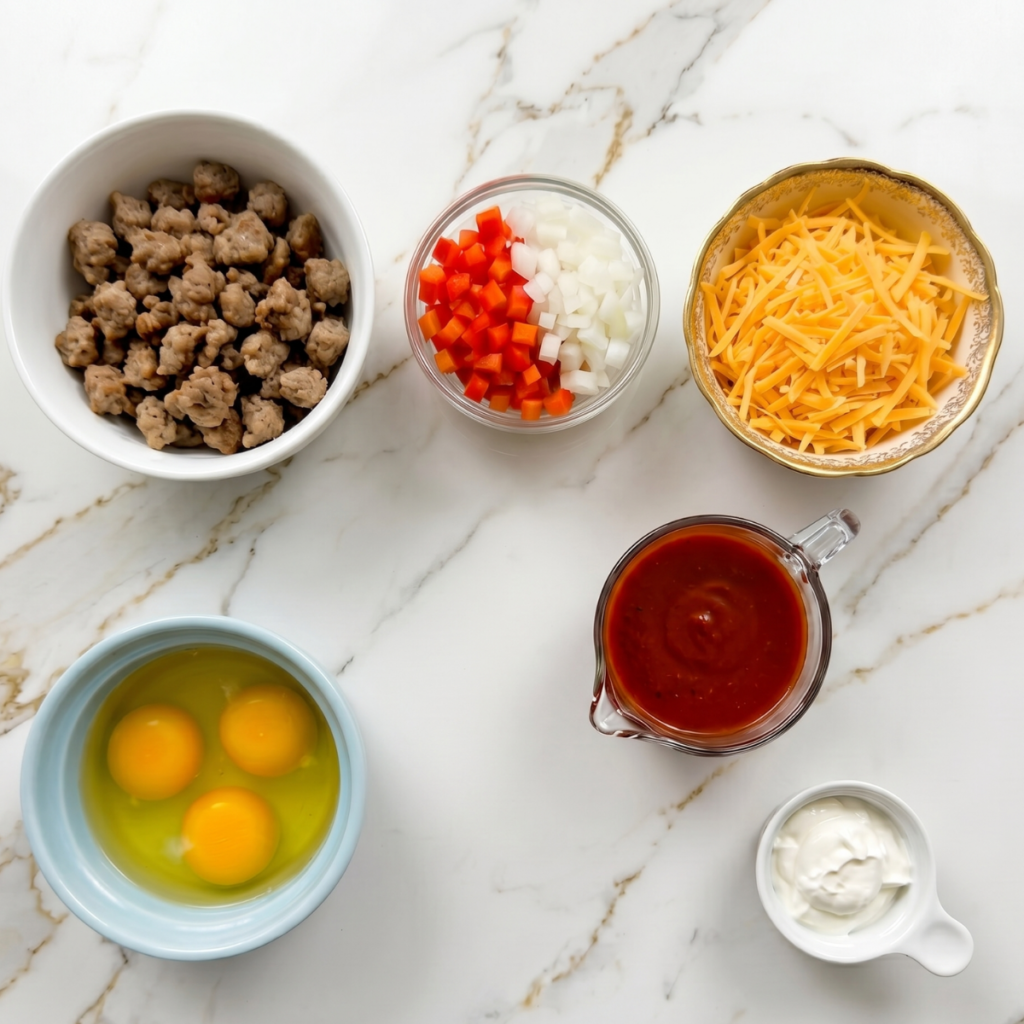
    • 1 lb breakfast sausage, crumbled and cooked – The savory base of every bite; cook it fully and drain any excess fat before it goes into the filling
    • 6 large eggs, scrambled – Scrambled low and slow so they stay soft; slightly underdone eggs finish cooking in the oven
    • 1 red bell pepper, finely diced and sauteed – Adds sweetness, color, and body to the filling
    • 1/2 small onion, finely diced and sauteed – Cooked with the pepper so it softens fully before going into the filling
    • 2 cups shredded cheddar or Monterey Jack, divided – Half stirred into the filling, half scattered over the top for the golden bubbly finish
    • 1 can (10 oz) red enchilada sauce – Use the whole can for the sauce; reserve two tablespoons for the pan bottom
    • 1/2 cup sour cream – Stirred into the enchilada sauce to create a creamy, slightly tangy coating that bakes into the most indulgent topping
    • 1/2 teaspoon cumin – Added to the sausage while it cooks for warmth throughout the filling
    • 1/2 teaspoon garlic powder – Savory depth in the filling
    • Salt and black pepper to taste – Season the filling generously before rolling
    • Fresh cilantro and sliced green onions for garnish – Added right before serving for a fresh bright finish against the golden cheesy top

    Step-by-Step Instructions

    Step 1: Make the Filling

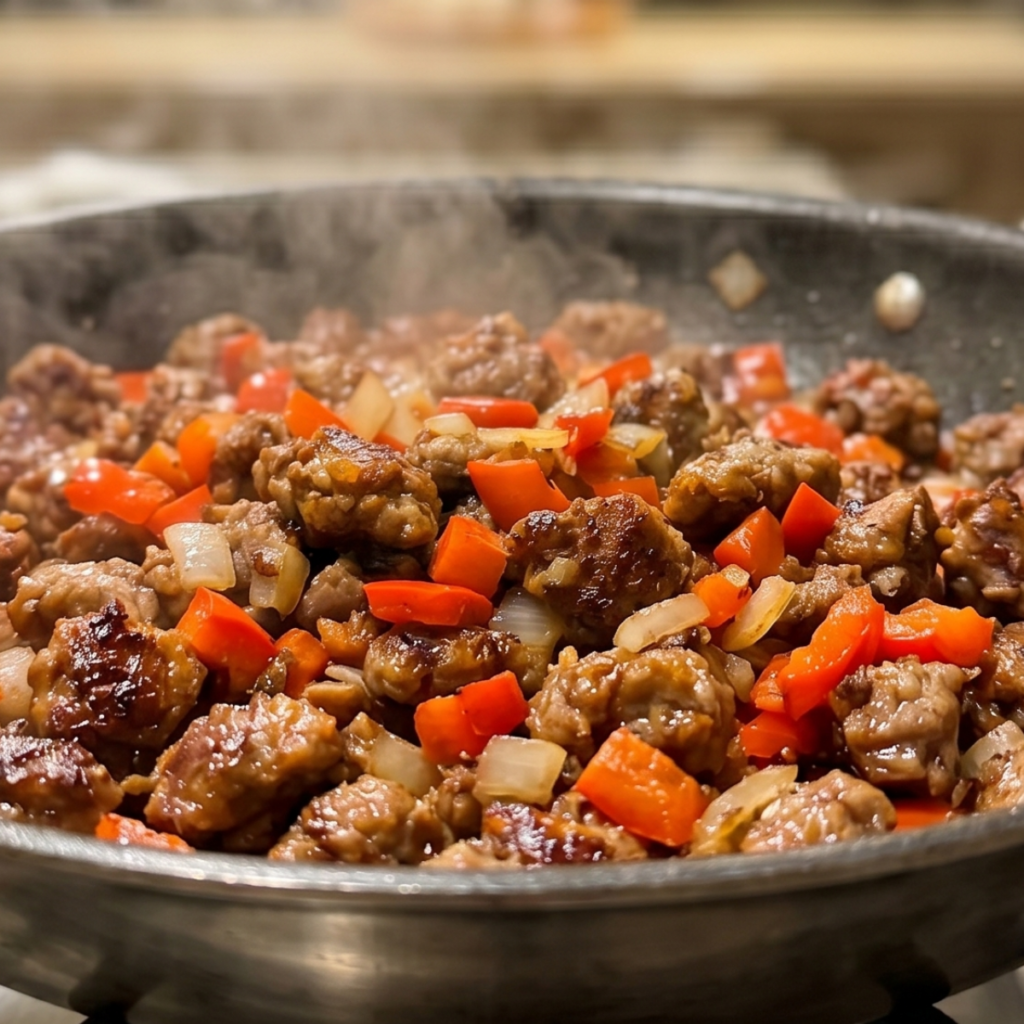
    • Cook the crumbled breakfast sausage in a large skillet over medium-high heat until deeply browned and cooked through; add the cumin and garlic powder in the last minute of cooking and stir so the spices bloom in the sausage fat
    • Transfer the cooked sausage to a bowl and use the same skillet to saute the diced onion and red bell pepper over medium heat for 3 to 4 minutes until softened and the onion is translucent
    • Scramble the eggs in a separate non-stick pan over medium-low heat until large soft curds form and the eggs are just slightly underdone; remove from heat immediately since they will finish cooking in the oven
    • Combine the sausage, sautéed vegetables, soft scrambled eggs, and one cup of shredded cheese in a large bowl; season with salt and pepper and stir gently until evenly mixed

    Step 2: Make the Sauce and Prep the Dish

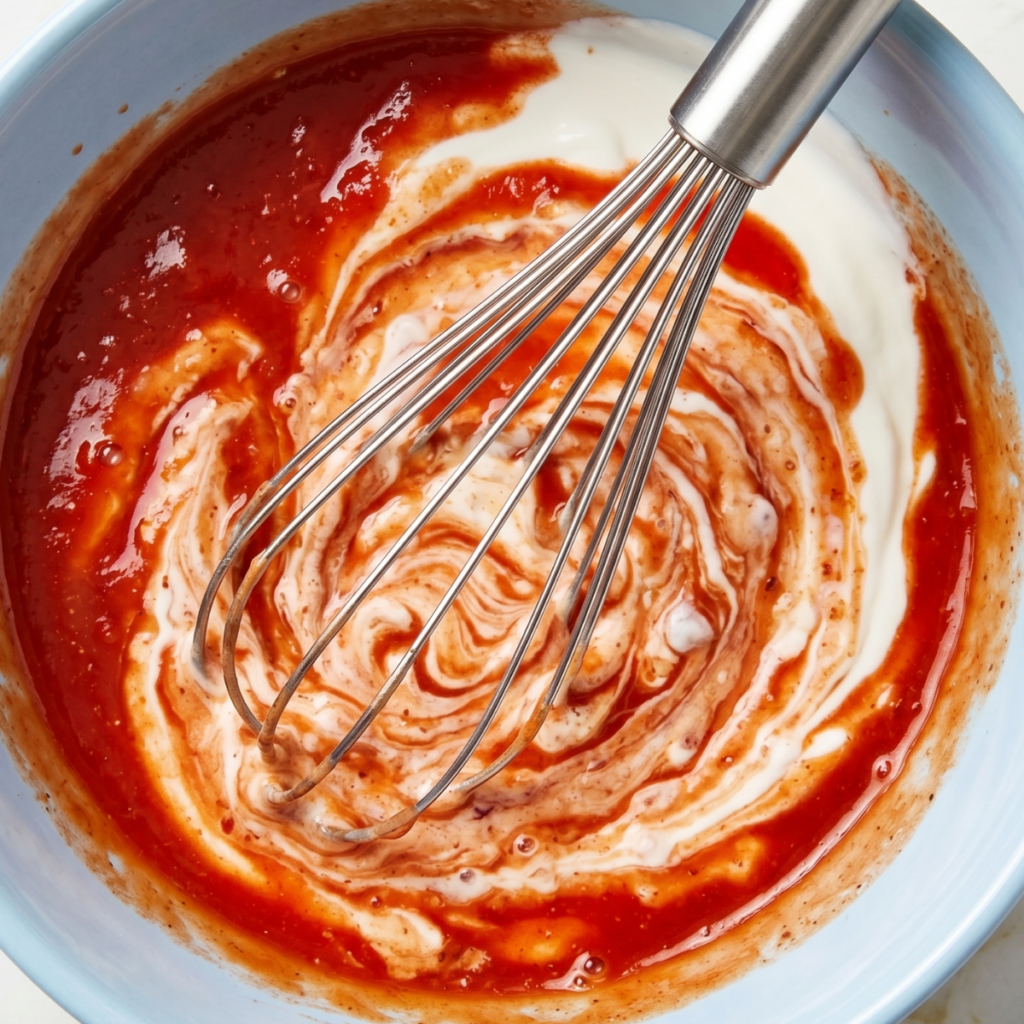
    • Whisk the enchilada sauce and sour cream together in a bowl until completely smooth; the sour cream adds a creamy, tangy quality that makes the sauce something genuinely special rather than just poured-from-a-can
    • Lightly grease a 9×13 inch baking dish and spread two to three tablespoons of the cream sauce across the bottom in a thin, even layer; this prevents sticking and adds flavor from underneath
    • Warm the flour tortillas for 20 to 30 seconds each in a dry skillet or microwave so they are pliable and roll without cracking; cold tortillas split open and the filling falls out
    • Taste the sauce and adjust with a pinch of salt or a small splash of hot sauce if you want a little more heat throughout

    Step 3: Roll and Arrange

    • Spoon a modest amount of filling down the center of each warm tortilla, leaving a small border at the edges so the filling does not spill out when rolling
    • Roll each tortilla firmly but gently and place it seam-side down in the prepared baking dish so it holds its shape without needing to be secured
    • Pack the rolled enchiladas snugly in the dish so they support each other during baking and do not unroll; a tight arrangement is actually better than leaving gaps
    • For the overnight version, stop here, cover tightly with foil, and refrigerate; take it out of the fridge. 20 minutes before baking to take the chill off

    Step 4: Sauce, Top, and Bake

    • Pour the remaining cream sauce evenly over the entire surface of the rolled enchiladas, spreading it gently so every tortilla is covered without flooding the dish
    • Scatter the remaining cup of shredded cheese evenly over the sauce so it covers the whole surface for maximum golden coverage during baking
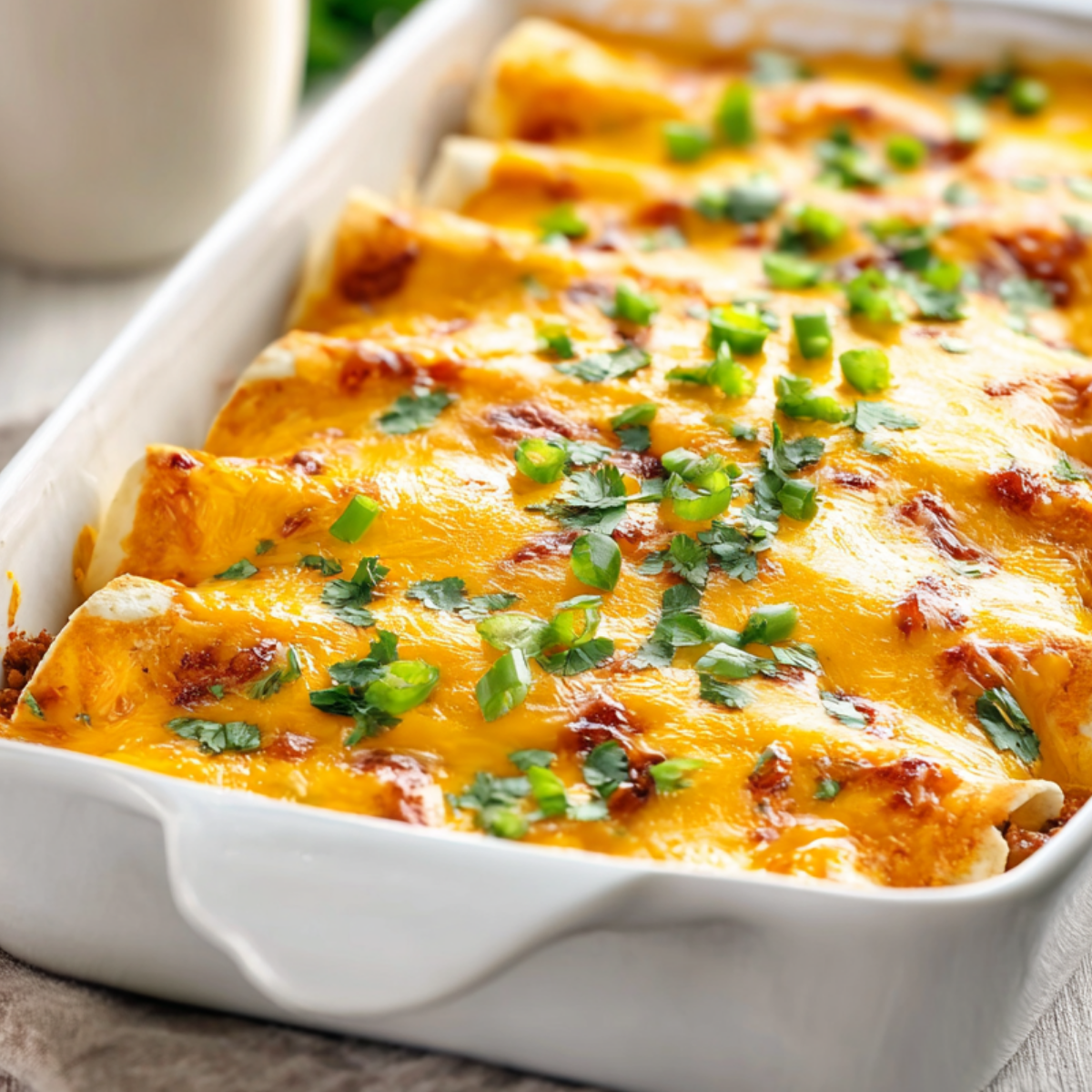
    • Bake covered with foil at 375 degrees F for 20 minutes, then remove the foil and bake for another 10 to 15 minutes until the cheese is golden, bubbly, and developing blistered spots on top
    • Let the dish rest for 5 minutes before serving; scatter fresh cilantro and sliced green onions over the top and serve directly from the baking dish with sour cream and hot sauce alongside

    Breakfast Enchiladas Variations

    Mia’s “No Sausage, Extra Cheese” Version

    Mia went through a phase of not wanting sausage in her breakfast and negotiated an alternative filling with the calm certainty of someone who has thought this through. For her version, skip the sausage entirely and double the scrambled egg and cheese in the filling, adding a handful of sautéed mushrooms and extra bell pepper for body. The filling is lighter, and the cheese does significantly more of the flavor work, which Mia describes as “more correct.” She has eaten three portions of this version in one sitting and shown no signs of regret.

    Ben’s “Spicy Sausage Upgrade” Version

    Ben has been requesting spicy sausage in every egg dish for the past year with a persistence I have come to respect. For his version, swap the regular breakfast sausage for hot Italian or spicy chorizo, add a finely diced jalapeno to the sauteed vegetables, and use pepper jack instead of Monterey Jack for the topping. The heat builds through every layer, and the whole dish smells like something from a serious brunch spot. Ben described his first bite of this version by simply saying “yes,” which is the most complete review he has given any recipe.

    The Hash Brown Breakfast Enchiladas Version

    This is the version I make when I want the dish to be a complete meal with no sides needed. Add a layer of thawed and squeezed frozen hash browns to the bottom of each tortilla before the egg and sausage filling goes on. The hash browns absorb the sauce from beneath during baking and turn into something soft and potato-ey and deeply satisfying inside every rolled enchilada. Ben discovered this version when I was cleaning out the freezer and added hash browns somewhat impulsively, and he immediately said it was his favorite version, which it genuinely is.

    Substitutions

    Breakfast sausage to ground turkey or chorizo: Ground turkey seasoned with the same cumin, garlic powder, salt, and a pinch of smoked paprika works well for a leaner version. Mexican chorizo gives a completely different and absolutely excellent result since the spiced fat from the chorizo perfumes the entire filling. Both substitute in exactly the same quantity.

    Red enchilada sauce to green enchilada sauce: Green enchilada sauce gives a brighter, slightly tangier result that pairs beautifully with the eggs and cheese. The overall color of the dish changes from golden-orange to a softer green-gold, but the flavor is equally good. Use the same quantity and the same sour cream ratio for the sauce mixture.

    Sour cream to Greek yogurt in the sauce: Plain full-fat Greek yogurt stirred into the enchilada sauce gives a slightly more tangy, higher-protein result that is almost identical in texture to the sour cream version. Make sure it is at room temperature before whisking, or it may curdle slightly when it meets the warm sauce.

    Flour tortillas to corn tortillas: Corn tortillas give a more traditional enchilada flavor and are naturally gluten-free. They are more prone to cracking when cold, so warm them very well before rolling and handle them gently. They also absorb the sauce slightly differently and give a chewier, more rustic texture that many people prefer.

    Equipment

    • 9×13 inch baking dish (glass or ceramic)
    • Large skillet for the sausage and vegetables
    • Small non-stick pan for the scrambled eggs
    • Large mixing bowl for the filling
    • Medium bowl for the sauce mixture
    • Aluminum foil for the covered bake and for overnight storage
    • Rubber spatula for the eggs and for spreading the sauce
    • Sharp knife and cutting board for the vegetables and garnish
    • Measuring spoons for the spice blend
    • Wide serving spoon for scooping portions from the dish

    Storage Tips

    Make Ahead

    • Assemble the full dish without the sauce and cheese topping up to 24 hours ahead; add the sauce and cheese right before baking so the tortillas do not over-absorb overnight
    • Alternatively, assemble completely with sauce, cover tightly, and refrigerate overnight; the tortillas will soften slightly but hold their shape through the bake if the sauce quantity is correct
    • The filling can be made up to 2 days ahead and stored in the fridge; assemble and bake fresh in the morning for a barely-any-effort Saturday breakfast

    Refrigerator

    • Store leftover baked enchiladas covered in the fridge for up to 3 days; the flavors deepen overnight and leftovers are genuinely excellent
    • Cover the dish tightly with foil or transfer portions to airtight containers for easier reheating through the week
    • The sauce and cheese topping soften in the fridge but the flavors hold up very well for a satisfying weekday breakfast reheated quickly

    Freezing

    • Freeze the assembled unbaked enchiladas without the sauce topping for up to 1 month; add the sauce and cheese fresh before baking from frozen and add 15 to 20 extra minutes to the covered bake time
    • Freeze individual baked portions in airtight containers for up to 2 months for the easiest possible weekday breakfast
    • Thaw overnight in the fridge before reheating for the best texture; microwaving from fully frozen makes the tortillas slightly chewy

    Reheating

    • Reheat individual portions in the microwave, covered with a damp paper towel, at 70 percent power for 90 seconds to 2 minutes until hot throughout
    • Reheat the full dish in a 350 degree F oven covered with foil for 15 to 20 minutes, then uncovered for 5 minutes to re-melt and slightly re-crisp the cheese topping
    • A small spoonful of fresh sour cream on top of each reheated portion brings everything back to life and makes leftovers taste nearly as good as day one

    Family Secret Worth Sharing

    My mom always added a small block of cream cheese to her enchilada sauce, about two ounces, and stirred it in while the sauce was warm so it melted completely and gave the whole thing a silky, almost velvety quality that you cannot get from sour cream alone. She said it was the thing that made her enchiladas taste like restaurant enchiladas, and she was not exaggerating. I add it every time now, just a small amount, melted into the sauce before the sour cream goes in. Ben tasted the sauce once before it went on and said “that tastes expensive.” It costs about thirty cents extra and transforms the whole dish. My mom called this kind of thing a “kitchen investment,” and she was always correct about that.

    Troubleshooting FAQs

    The tortillas dissolved overnight, and the dish looks like soup. What happened?
    Too much sauce and the tortillas soaked it all up overnight. Use the sauce quantity in this recipe exactly and do not be tempted to add extra for more coverage. The right amount covers generously without flooding. If you want to assemble the night before, you can also hold the sauce and cheese for the morning, pour it on cold, and bake straight from the fridge with great results.

    The filling is falling out of the enchiladas when I try to serve them. How do I fix it?
    The enchiladas were not packed tightly enough in the dish or the portions were overfilled. Roll them firmly and place them seam-side down immediately. Pack them snugly so they lean against each other; the tight arrangement is what keeps them from unrolling during baking. A modest filling amount rolls cleanly and stays contained, while an overfilled tortilla splits and spills every time.

    The cheese on top is not browning. What do I do?
    The foil was left on too long, or the oven is running cool. Remove the foil for the last 10 to 15 minutes as directed. If the cheese is still not browning, switch to the broiler for 2 to 3 minutes on an upper rack and watch every second since shredded cheese goes from golden to burnt very quickly under a broiler.

    Can I make this the night before and bake it in the morning straight from the fridge?
    Yes, and this is actually the preferred method for the most flavorful result. Take the dish out of the fridge 20 minutes before baking to take the chill off slightly, then bake covered for 25 minutes instead of 20 since the filling will be cold. Remove the foil and bake another 10 to 15 minutes for the golden top. The overnight rest lets the flavors meld beautifully, and the dish tastes even better for it.

    Saturday Morning Just Found Its Signature Dish

    Saturday mornings in our house used to mean cereal and everyone fending for themselves. Now they mean this dish is coming out of the oven golden and bubbling while both kids are still in pajamas asking how much longer. Ben eats his from the corner where the cheese is thickest and calls this a strategic decision. Mia pours extra sour cream over her portion and considers this mandatory. These breakfast enchiladas have become one of our most loved make-ahead breakfast casserole recipes in the whole weekly rotation, sitting right alongside our easy cheesy casserole recipes that make a weekend feel genuinely taken care of from the very first meal. For the mornings when the table needs something hearty and completely satisfying, this dish next to our easy weekend egg recipes covers every craving before the day even starts. Some recipes become the ones your family builds a whole morning around, and this one did exactly that.

    Don’t forget to snap a picture of your breakfast enchiladas before that… (trust me, they will disappear quickly!), and leave a rating below. We’d love to hear how this breakfast enchiladas recipe becomes part of your family morning story.
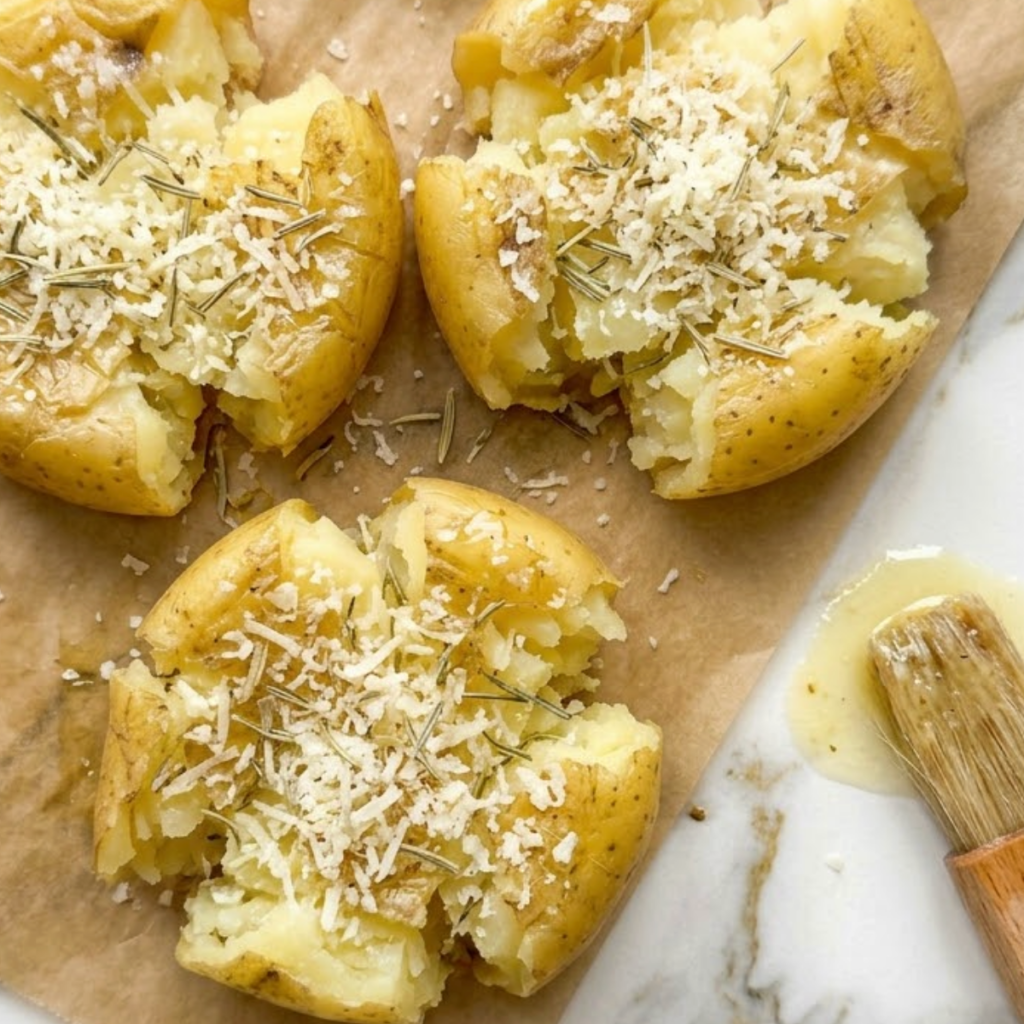
  • 3 Secrets to the Best Chocolate Chip Banana Bread Bars

    3 Secrets to the Best Chocolate Chip Banana Bread Bars

    I pulled them out too soon because I was impatient and the toothpick completely lied to me. The center was still fully liquid. Mia took one bite and said “these are definitely not done.” Ben tried to eat his with a spoon and called it “experimental.” That underbaked disaster taught me the one test that makes this chocolate chip banana bread set perfectly every time.

    Why This Recipe Is Special

    These are not regular banana bread bars. They are dense, fudgy, soft in the center with slightly crispy edges, and loaded with melted chocolate chips that pool on the surface and set into glossy chocolate streaks as they cool. The banana flavor is deep and sweet, and the bars are cut into clean squares that hold their shape on a plate. Mia calls them “banana brownies” and Ben calls them “the chocolate ones,” and both of those names are better than anything I came up with. They disappear within the hour every single time I make them.

    How To Make Chocolate Chip Banana Bread

    The successful batch came on a rainy Saturday when both kids had announced they were bored and needed a project immediately. Mia was mashing the bananas with a fork and taking her job extremely seriously, announcing “more” every time she thought they needed another mash. Ben was measuring the chocolate chips and quietly eating approximately every fifth one, which he considered a reasonable quality control ratio. When the batter went into the pan and those chocolate chips scattered on top started to look glossy and beautiful, both kids sat in front of the oven window like it was the most important thing happening anywhere in the world. In our kitchen at that moment, it was.

    The lesson that fixed the underbaked disaster was understanding that banana bread bars behave differently than a loaf. In a 9×13 pan the batter spreads thin and bakes faster, but the high banana moisture content means the center can look done on the toothpick while still being liquid underneath. The fix is twofold: the toothpick test plus the edge test. The edges should pull away from the pan slightly and feel set and springy when you press them gently. If the edges pass and the toothpick comes out clean, they are done. Ben now does the edge press test every single time and takes it more seriously than I do.

    Main Ingredients

    • 3 very ripe bananas, mashed – Brown-spotted or almost entirely black; the riper the banana the sweeter and more intensely flavored the bars
    • 1/2 cup unsalted butter, melted – Melted rather than creamed for a denser, fudgier bar rather than a cakey one
    • 3/4 cup brown sugar, packed – Brown sugar adds depth and a subtle molasses note that white sugar cannot give these bars
    • 2 large eggs, room temperature – Room temperature eggs incorporate more evenly and give the bars a more even texture
    • 1 teaspoon vanilla extract – Rounds out the banana flavor and the chocolate without competing with either
    • 1.5 cups all-purpose flour – Spoon and level; too much flour and the bars become dry and cakey rather than fudgy
    • 1/2 teaspoon baking soda – Reacts with the natural acid in the banana for a gentle lift without making these too cakey
    • 1/2 teaspoon salt – Enhances every other flavor; do not skip it
    • 1/2 teaspoon cinnamon – Warm spice that bridges the banana and chocolate flavors beautifully
    • 1.5 cups chocolate chips, divided – One cup stirred into the batter, half cup scattered over the top for those glossy pools of chocolate on the surface

    Step-by-Step Instructions

    Step 1: Prep the Pan and Mash the Bananas

    • Preheat your oven to 350 degrees F and line a 9×13 inch baking pan with parchment paper, leaving an overhang on both sides for easy lifting
    • Peel the ripe bananas into a large bowl and mash thoroughly with a fork until almost completely smooth with only a few small lumps remaining; very ripe bananas will mash easily in about 60 seconds
    • The bananas should look like a thick paste rather than a chunky mixture; large banana chunks do not incorporate evenly into the batter and create wet spots in the finished bars
    • Melt the butter and let it cool for 5 minutes before adding it to the bananas; hot butter added directly can begin cooking the eggs when they go in and affect the texture

    Step 2: Mix the Batter

    • Add the melted cooled butter, brown sugar, eggs, and vanilla extract to the mashed bananas and stir with a spatula until completely combined and the mixture looks smooth and uniform
    • Sift the flour, baking soda, salt, and cinnamon directly over the banana mixture and fold gently with the spatula until just combined with no visible dry flour streaks remaining
    • Do not overmix; stir only until the flour disappears and stop immediately because overworked batter makes tough, cakey bars rather than tender, fudgy ones
    • Fold in one cup of the chocolate chips with a few gentle strokes so they are evenly distributed throughout the batter without being broken up

    Step 3: Pour, Top, and Bake

    • Pour the batter into the prepared pan and spread it evenly to the corners with an offset spatula so the bars bake to a consistent thickness throughout
    • Scatter the remaining half cup of chocolate chips evenly over the entire surface of the batter so every bar will have visible chocolate pools on top
    • Bake at 350 degrees F for 22 to 26 minutes until a toothpick inserted in the center comes out with just a few moist crumbs and the edges have pulled away from the sides of the pan slightly
    • Check both the toothpick and the edges; the edges should feel set and spring back gently when pressed and should look golden and slightly pulling away from the parchment

    Step 4: Cool, Cut, and Serve

    • Let the bars cool in the pan for at least 20 minutes before attempting to lift or cut them; hot bars will crumble and the chocolate chips need time to reset from liquid back to glossy pools
    • Lift the entire slab out of the pan using the parchment overhang and transfer to a cutting board for slicing
    • Cut into bars using a sharp knife in one clean downward press without sawing; wipe the knife between cuts for the cleanest edges that do not drag the melted chocolate across the surface
    • Serve at room temperature for the best flavor and texture; the chocolate chip pools are at their most beautiful glossy finish once the bars have cooled completely

    Chocolate Chip Banana Bread Variations

    Mia’s “Double Chocolate” Version

    Mia made an announcement after the first successful batch that the bars needed more chocolate, and she was not asking; she was informing. I respect that kind of conviction in a six-year-old. For her version, add three tablespoons of cocoa powder to the dry ingredients alongside the flour and increase the chocolate chips to two full cups, one cup in the batter and one scattered lavishly on top. The bars go darker, richer, and significantly more chocolate-forward while staying just as fudgy. Mia describes the result as “the correct amount of chocolate” and has been eating them this way ever since.

    Ben’s “Banana Cheesecake Bars” Version

    Ben discovered cheesecake-swirled banana bread at a bakery once and came home with a very specific request and a description that was more detailed than necessary. For his version, beat four ounces of softened cream cheese with two tablespoons of sugar and one egg until smooth, then drop spoonfuls over the batter before the chocolate chips go on top and swirl once with a skewer. The cream cheese layer bakes into a slightly tangy, creamy swirl that turns these into something genuinely special. Ben calls this version “the bakery one” and requests it for every occasion that could possibly justify a special occasion dessert.

    The Healthy Banana Bars Version

    On the weeks when I want something that feels like a treat but carries a little more nutritional goodness, this version is the one I reach for. Replace the all-purpose flour with whole wheat flour and swap the butter for the same quantity of coconut oil. Reduce the brown sugar to half a cup and add a tablespoon of honey for sweetness. The bars are denser, slightly nuttier, and a touch less sweet than the original, but both kids eat them just as happily, and I feel genuinely good about putting them in lunchboxes. Mia calls them “the healthy ones” with a tone that suggests she suspects I am up to something, which I am, but the bars are good enough that she eats them anyway.

    Substitutions

    All-purpose flour to oat flour: Certified gluten-free oat flour substitutes in the same quantity and gives a slightly nuttier, more wholesome flavor that pairs beautifully with banana. The bars will be a touch more delicate when warm, so give them the full 20-minute cooling time before cutting.

    Brown sugar to coconut sugar: Coconut sugar substitutes in exactly the same quantity and gives a slightly more caramel-like, less sweet result. The bars will be a shade darker in color, and the banana flavor will be more prominent since coconut sugar has a milder molasses note than brown sugar.

    Unsalted butter to coconut oil: Refined coconut oil in the same melted quantity gives a very slightly lighter texture and a subtle tropical note that works beautifully alongside the banana. Unrefined coconut oil adds a more noticeable coconut flavor, which some people love and others find too prominent.

    Semi-sweet chocolate chips to dark chocolate chips or chunks: Dark chocolate at 60 percent or above gives a less sweet, more intensely chocolatey result that adults tend to prefer. Chocolate chunks rather than chips give larger molten pockets that are genuinely dramatic when you cut the bars. Both substitute in exactly the same quantity.

    Equipment

    • 9×13 inch baking pan
    • Parchment paper with overhang on both sides for easy lifting
    • Large mixing bowl for the batter
    • Fork for mashing the bananas
    • Rubber spatula for folding the batter
    • Offset spatula for spreading the batter evenly in the pan
    • Sharp knife for slicing; wipe between cuts for clean edges
    • Wire cooling rack for cooling the slab before cutting
    • Toothpick for testing doneness

    Storage Tips

    Make Ahead

    • These bars are genuinely better the next day once the flavors have settled and the texture firms slightly into that perfect fudgy density
    • Bake the day before, cool completely, and cut fresh the morning of serving for the cleanest presentation
    • The batter can be mixed up to 24 hours ahead and stored covered in the fridge; stir gently before pouring into the pan and add a few extra minutes to the bake time since the batter will be cold

    Refrigerator

    • Store cut bars in an airtight container at room temperature for up to 3 days; the refrigerator actually dries out the texture and is not recommended
    • If the weather is very warm and the chocolate is getting soft, a brief spell in the fridge is fine but bring back to room temperature for 15 minutes before eating
    • Layer bars between parchment sheets in the container to prevent the chocolate tops from sticking together

    Freezing

    • Freeze individual bars wrapped tightly in plastic wrap and stored in a freezer bag for up to 2 months
    • Thaw at room temperature for about 30 minutes and they come back to almost exactly the original texture and flavor
    • These bars are excellent eaten slightly frozen on a warm day, which Mia discovered by accident and now considers a feature rather than a defect

    Reheating

    • These bars are best at room temperature and do not need reheating
    • For a warm dessert, microwave one bar at 50 percent power for 20 seconds until just slightly warm; the chocolate chips turn back to liquid pools and the whole thing tastes like it just came out of the oven
    • A warm bar with a small scoop of vanilla ice cream is one of the genuinely best things about having made a full batch of these, and Ben discovered this combination on his own and has never looked back

    Family Secret Worth Sharing

    My mom always browned the butter before adding it to any banana bread recipe she made, and I thought this was a step that only applied to fancy baking until I tried it in these bars and understood immediately. Browning the butter takes about four minutes and gives it a deep, nutty, almost caramel quality that amplifies the banana flavor and makes the chocolate taste more complex. You melt it in the saucepan over medium heat, keep stirring until it foams and then goes golden and smells like toasted hazelnuts, and then let it cool before using it exactly as you would the regular melted butter. I told Ben what browned butter was once while we were making these and he leaned over the saucepan and said “that smells like something really good is about to happen.” He was completely correct. My mom would have liked him very much.

    Troubleshooting FAQs

    The bars are still liquid in the center after the full bake time. What happened?
    The toothpick test alone is not reliable for these bars. You need the toothpick plus the edge test. The edges should pull away from the pan sides slightly and feel set and springy when pressed gently. If the edges pass and the toothpick shows moist crumbs rather than wet batter, the bars are done. If the center still looks wet and jiggly when you shake the pan, add five more minutes and test again. The high banana moisture can make the center look underdone even when it is set.

    The bars came out dry and cakey instead of fudgy. What went wrong?
    Either the flour was packed into the measuring cup rather than spooned and leveled, the butter was not melted, or the batter was overmixed after the flour went in. All three of these cause a tougher, cakier result. Spoon the flour into the cup rather than scooping; use melted, not softened, butter; and stop folding the moment the flour disappears. Those three habits together produce the dense fudgy bar this recipe is supposed to be.

    The chocolate chips on top sank into the batter during baking. How do I prevent that?
    Scatter the top chocolate chips after the batter is already in the pan and do it right before it goes into the oven. If you add them to the batter and then spread it, they migrate downward during spreading. Adding them as a topping at the last second means they sit on the surface, begin melting immediately in the oven heat, and stay as visible glossy pools on top rather than sinking.

    Can I make these in a smaller pan for thicker bars?
    Yes. An 8×8 inch pan gives significantly thicker, more brownie-like bars. Increase the bake time to 30 to 35 minutes and rely on the toothpick plus edge test even more carefully since the thicker batter takes longer to set in the center. The texture will be denser and fudgier than the 9×13 version, which many people prefer. Ben prefers the thicker version and has made his position very clear on this matter.

    The Bars That Use Up Every Overripe Banana Before It Can Become Guilt

    There are always overripe bananas on our counter. Always. This recipe is why I have stopped feeling bad about them and started feeling excited. Ben watches the bananas all week like they are ripening on a schedule he personally approved. Mia declared last month that she prefers the bananas “really brown” which is something no one in this house said before these bars came along. This chocolate chip banana bread recipe sits naturally alongside our classic banana bread recipe as the other way we celebrate an overripe banana in this kitchen, and for the days when the dessert table needs both something fruity and something truly chocolate-forward, these bars next to our fudgy chewy browkies cover every craving at the table without a single overlap. For the weeks when the baking rotation needs something new to sit alongside our favorite healthy brownie recipes, these bars land in the same category of one-bowl chocolate treats that take thirty minutes and disappear in twenty. Some recipes earn a permanent place in the kitchen, and this one did that quietly and completely.

    Don’t forget to snap a picture of your chocolate chip banana bread before that… (trust me, it will disappear quickly!), and leave a rating below. We’d love to hear how this chocolate chip banana bread becomes part of your family baking story.

  • 4-Step Irresistible Creamy Pasta Salad

    4-Step Irresistible Creamy Pasta Salad

    I made it the morning of the party and tossed everything in the dressing four hours ahead. By the time it hit the table, the pasta had absorbed every single drop and looked deflated. Ben poked it and said “it absorbed itself.” Accurate. Once I learned to dress it at the right moment, this creamy pasta salad became the most requested dish I bring anywhere.

    Why This Recipe Is Special

    This is not a mayonnaise-heavy picnic pasta situation. This is shells, crispy bacon, sweet peas, tender shredded chicken, and a creamy, tangy dressing that coats everything just enough without drowning it. It tastes a little like a carbonara decided to become a pasta salad and nobody stopped it, which is exactly the right outcome. It works warm, at room temperature, or cold from the fridge. Mia eats it for breakfast when there are leftovers and considers this completely normal. I have stopped questioning it.

    How To Make Creamy Pasta Salad

    The successful version came together on a Friday afternoon when both kids had decided they were in charge of quality control. Mia was eating the peas straight from the bag and counting each one before it went in, which is not a useful kitchen contribution, but I found it genuinely endearing. Ben was crumbling the bacon and eating approximately half of it, which he described as “taste testing for consistency.” When I tossed the finished salad and that creamy dressing coated every shell and the bacon pieces and peas were distributed perfectly, both of them immediately grabbed a fork before I could get the bowl to the table. That is always the review I am working toward.

    The lesson that saved this recipe was timing the dressing. You dress the pasta when it is still just slightly warm, not hot and not fully cold. Warm pasta absorbs the dressing and carries the flavor into the shells rather than just coating the outside. Then you chill it for at least thirty minutes, taste it again, and add a small extra spoonful of dressing right before serving because chilling always mutes the flavor. Ben observed this second-dressing step once and asked if I was fixing it. I told him I was finishing it. He considered the distinction and said “okay, that makes sense.” It does.

    Main Ingredients

    • 12 oz medium pasta shells – Shell pasta catches the creamy dressing inside each piece; every bite has sauce in it no matter how you scoop
    • 2 cups cooked shredded chicken – Rotisserie chicken works perfectly; adds protein and makes this a complete meal rather than a side
    • 1.5 cups frozen peas, thawed – Do not cook them; just thaw and drain; they stay bright green and give a fresh sweet pop against the creamy dressing
    • 6 strips bacon, cooked crispy and crumbled – Must be genuinely crispy; soft bacon goes limp in the dressing and loses all texture contrast
    • 1/2 cup freshly grated parmesan – Stirred into the dressing and into the salad; adds saltiness and a depth that takes this beyond a basic pasta salad
    • 3 green onions, thinly sliced – Adds a fresh mild bite throughout every serving
    • For the dressing: 1/2 cup mayonnaise – Full-fat for the creamiest, most coating result
    • 1/2 cup sour cream – The tang that makes the dressing taste like something more than just mayo
    • 2 tablespoons white wine vinegar or lemon juice – Brightens the whole dressing and keeps it from being one-dimensionally rich
    • 1 teaspoon Dijon mustard – Adds depth and acts as an emulsifier that keeps the dressing smooth
    • 1 clove garlic, finely grated – Gives the dressing a savory base note that makes it taste homemade rather than store-bought
    • Salt and black pepper to taste – Season the dressing confidently; pasta absorbs a lot of salt and undersea Sunning is the main reason pasta salads taste flat

    Step-by-Step Instructions

    Step 1: Cook the Pasta and Make the Dressing

    • Cook the pasta shells in generously salted boiling water according to package directions until just al dente; do not overcook since the pasta will soften further as it absorbs the dressing during chilling
    • While the pasta cooks, whisk together the mayonnaise, sour cream, white wine vinegar, Dijon mustard, grated garlic, salt, and pepper in a large bowl until completely smooth
    • Stir half the grated parmesan into the dressing so it melts in and gives the base a slightly nutty, salty depth before any pasta goes in
    • Drain the pasta and let it cool for about 5 minutes until it is warm but not steaming hot; this is the ideal temperature for the first dressing toss

    Step 2: First Dress and Toss

    • Add the warm, drained pasta directly to the dressing bowl and toss gently but thoroughly until every shell is coated and the dressing starts to get absorbed into the pasta
    • Add the shredded chicken, thawed peas, and sliced green onions to the bowl and fold everything together with a large spoon until evenly distributed
    • Taste the salad at this stage and season with extra salt, pepper, or a splash more vinegar if anything feels flat; the pasta will absorb more seasoning as it chills, so be generous now
    • Cover the bowl tightly with plastic wrap and refrigerate for at least 30 minutes and up to overnight; the flavors meld and deepen beautifully with time

    Step 3: Add the Bacon and Final Dress

    • Remove the chilled pasta salad from the fridge and taste it again; it will need more seasoning and likely a little more dressing since the pasta absorbs the liquid during chilling
    • Add a spoonful of extra dressing, a small splash of vinegar, and an extra pinch of salt if needed; toss gently to redistribute everything evenly
    • Fold in most of the crumbled bacon at this stage, reserving a good handful for the top so it stays visible and gives a textural contrast on the surface
    • Sprinkle the remaining parmesan and the reserved bacon over the top and finish with a few extra sliced green onions and a crack of black pepper for presentation

    Step 4: Final Taste and Serve

    • Give the finished salad one final taste and adjust seasoning one last time; this is the moment it goes from good to genuinely great and the step most people skip
    • Transfer to a serving bowl if not already in one and make sure the bacon, peas, and green onions are visible on the surface so the salad looks as good as it tastes
    • Serve immediately at room temperature for the best flavor, or return to the fridge for up to 1 hour before serving if you need to keep it cold for a gathering
    • Set out extra dressing on the side if serving at a party; people always want more and having it ready means the bowl stays perfectly dressed through the whole meal

    Creamy Pasta Salad Variations

    Mia’s “Extra Peas, No Bacon” Version

    Mia went through a phase of refusing bacon that I do not fully understand and have stopped trying to explain. During this phase, she made her position very clear by removing every piece of bacon from her bowl with focused surgical precision and placing them on Ben’s plate without comment. For her version, double the peas to three cups and skip the bacon entirely. Add an extra tablespoon of parmesan into the dressing to make up for the lost savory depth. The salad is fresher, lighter, and genuinely lovely, and Mia eats two bowls every time, which is the only endorsement that matters.

    Ben’s “More Bacon and Carbonara Version”

    Ben has decided this pasta salad is essentially a cold carbonara, and he is not wrong. For his version, cook eight strips of bacon instead of six, use the pasta cooking water (a quarter cup, cooled) in the dressing alongside the vinegar for extra starchy creaminess, and add an extra half cup of parmesan throughout. The result is richer, saltier, and deeply satisfying in a way that justifies Ben’s carbonara comparison completely. He eats this with a very large fork and a very satisfied expression, and I find both of those things charming.

    The Cookout Crowd Version

    This is the version I double for every summer gathering, every potluck, and every occasion where I need a dish that disappears before anything else on the table. Double the entire recipe into a large mixing bowl, chill overnight, and dress again in the morning with an extra quarter cup of mayo mixed with a splash of vinegar. Transport it cold in the bowl covered with plastic wrap and let it sit at room temperature for twenty minutes before serving. It feeds twelve easily, holds up in the heat better than most cold salads, and the empty bowl always generates the question I most enjoy answering: what is in this?

    Substitutions

    Shell pasta to rotini or farfalle: Rotini spirals catch the creamy dressing in their grooves in a similar way to shells. Farfalle gives a more elegant presentation for a dinner party setting. Both cook in the same time range and work with exactly the same method. Avoid long pasta like spaghetti or linguine since the dressing does not cling to it evenly.

    Mayonnaise to Greek yogurt: Plain full-fat Greek yogurt in place of mayo gives a tangier, lighter dressing that is noticeably lower in fat. The texture is slightly less rich, and the dressing may need a touch more vinegar to balance. Use the same quantity and make sure the yogurt is at room temperature before whisking so it combines smoothly without curdling.

    Shredded chicken to canned tuna: Two well-drained cans of tuna transform this into a completely different but equally delicious pasta salad. The parmesan and peas work beautifully with the tuna in a way that feels Italian and intentional. Ben tried this version and called it “an acceptable swap,” which from Ben is genuine praise.

    Fresh peas to frozen and thawed: Frozen peas thawed in a colander under cold water for a few minutes are almost identical to fresh in both flavor and color. Fresh peas in season are slightly sweeter, but frozen are perfectly good and available all year, which makes this salad a recipe you can make any time rather than only in summer.

    Equipment

    • Large pot for boiling the pasta
    • Colander for draining the pasta
    • Large mixing bowl for the dressing and tossing
    • Whisk for the dressing
    • Microplane or fine grater for the garlic and parmesan
    • Large spoon or tongs for tossing the salad
    • Plastic wrap or airtight lid for chilling
    • Sharp knife and cutting board for the green onions and bacon

    Storage Tips

    Make Ahead

    • Make the salad up to 24 hours ahead without the bacon; add the bacon right before serving so it stays crispy and does not go soft in the dressing overnight
    • The dressing can be made up to 3 days ahead and stored in a sealed jar in the fridge; whisk it again before using since it may separate slightly
    • This is one of those rare salads that genuinely improves overnight as the pasta absorbs the dressing and the flavors deepen and settle into each other

    Refrigerator

    • Store covered in the fridge for up to 3 days; the pasta will continue to absorb the dressing and the salad will look less saucy by day two
    • Always re-dress with a fresh spoonful of mayo mixed with a splash of vinegar before serving leftovers; it brings the salad back to life immediately
    • Keep the salad covered to prevent the surface from drying out and the peas from going wrinkled

    Freezing

    • This salad does not freeze well; the mayo-based dressing separates when thawed and the pasta goes mushy
    • If you have leftover components separately, the cooked pasta can be frozen for up to 1 month and the bacon can be frozen for up to 2 months
    • The peas are best kept frozen raw and added fresh each time rather than freezing them as part of an assembled salad

    Reheating

    • This salad is served cold or at room temperature and does not need reheating
    • If the salad has been in the fridge and feels very cold and stiff, let it sit at room temperature for 15 to 20 minutes before serving so the dressing loosens and the flavors open up
    • A fresh crack of black pepper and a scatter of extra parmesan right before serving refresh the whole presentation after a night in the fridge

    Family Secret Worth Sharing

    My mom always added a teaspoon of sugar to her pasta salad dressing, and I spent years thinking it was unnecessary until I made a batch without it and the whole thing tasted sharper and less rounded than usual. The sugar does not make the dressing sweet; it balances the vinegar and the tang of the sour cream in a way that makes the whole dressing feel complete rather than slightly aggressive. I add it every time now and it is in the dressing ingredients in this recipe even though I forgot to mention it before the ingredient list. Add it. A small teaspoon. Mia asked me once why the dressing tasted so good and I told her it was a secret. She squinted at me for a moment and then said “is it sugar.” She is six years old and she was completely right. My mom would have found that very funny.

    Troubleshooting FAQs

    The pasta salad looks dry, and the dressing has disappeared. What happened?
    The pasta absorbed all of it during chilling, which is exactly what pasta does. This is not a problem; it is expected, and the fix is simple. Always make slightly more dressing than you think you need and always re-dress the salad right before serving. Mix one tablespoon of mayo with half a tablespoon of vinegar and a pinch of salt, fold it in, and the salad will look perfectly dressed again in under a minute.

    The pasta salad tastes flat and bland even though I seasoned the dressing. What went wrong?
    Two things cause flat pasta salad: not salting the pasta water enough and not re-seasoning after chilling. The pasta itself needs to be seasoned during cooking since it cannot absorb salt after it is cooked and drained. Also taste the salad again right before serving since chilling dulls every flavor significantly. A pinch of salt, an extra splash of vinegar, and another small squeeze of lemon will bring everything back immediately.

    The bacon went soft and chewy in the salad. How do I prevent that?
    Do not add the bacon until right before serving. Bacon loses its crispiness within about twenty minutes of being folded into a moist, creamy dressing. Cook it, crumble it, and keep it separately until the moment the salad goes on the table. For a party where the bowl will sit out for a while, keep a small bowl of extra crumbled bacon alongside so guests can add more as they serve themselves.

    Can I make this pasta salad without chicken to serve as a side dish?
    Absolutely, and it is excellent as a side. Simply leave out the chicken entirely, and the salad stands completely on its own as a creamy, bacon, and pea pasta side dish. You may want to add an extra half cup of peas and a little extra parmesan to compensate for the volume and flavor that the chicken was providing. It pairs beautifully with grilled meat, burgers, or anything coming off a barbecue.

    The Bowl That Never Makes It to the Table Intact

    There is a specific kind of compliment that happens when a dish disappears before you can announce what it is. That is what happens with this salad every single time I bring it somewhere. Ben has started referring to it as “the one that goes fast” and Mia requests it specifically for any occasion that involves eating outdoors, which she considers its natural habitat. This creamy pasta salad sits right alongside our creamy chicken salad recipes as one of the most crowd-pleasing cold dishes in our whole repertoire, and on the days when I want to serve it alongside something warm, it pairs beautifully with our easy summer dinner recipes that come together just as quickly. For the weeks when meal prep includes cold lunches, this pasta salad next to our easy cold pasta recipes means every lunch feels genuinely looked after rather than grabbed in a hurry. Some recipes become the ones people remember you for, and this one quietly has.

    Don’t forget to snap a picture of your creamy pasta salad before that… (trust me, it will disappear quickly), and leave a rating below. We’d love to hear how this creamy pasta salad becomes part of your family gathering story.

  • 5-Ingredient Freezer Breakfast Burritos

    5-Ingredient Freezer Breakfast Burritos

    I packed them so full they burst open the moment they hit the skillet. Scrambled egg everywhere. Ben said it looked like a breakfast crime scene. Mia said it smelled good, though, which is a very Mia way of looking at things. That exploding batch taught me the one rolling rule that makes these breakfast burritos stay sealed, crispy, and completely intact every single time.

    Why This Recipe Is Special

    These are the burritos I make on Sunday so Monday through Friday takes care of itself. Fluffy scrambled eggs, seasoned ground beef, roasted red pepper, cheddar cheese, and a seam that gets pan-toasted until it holds closed and stays golden. You can eat one fresh off the skillet or wrap a batch and freeze them for the week ahead. Ben grabs one before school without being asked. Mia asks if there are any left every single morning, whether or not she saw me make them. That kind of dependability from a breakfast recipe is genuinely worth talking about.

    How To Make Breakfast Burritos

    The successful batch happened on a Sunday morning when both kids decided they were going to help whether I had asked or not. Mia was whisking the eggs with an enthusiasm that got egg on the cabinet door, and she did not notice. Ben was browning the beef and providing a running update on how it smelled, which was “really good, actually really good, okay this is great.” When I laid the first properly filled burrito in the hot skillet seam-side down and heard that satisfying sizzle and watched it go golden, both kids pressed forward, and Ben said “that is what it is supposed to look like.” He was absolutely right.

    The rolling lesson that fixed everything was simple: less filling than you think you need, and the fold always goes sides first, then bottom up and over. You press gently to compact the filling slightly before rolling, place it seam-side down immediately in the hot pan, and do not move it for a full sixty seconds so the tortilla seals itself against the heat. The filling holds, the outside goes golden, and nothing explodes. Ben now rolls his own and has gotten very good at the technique, though he still overfills slightly and calls it “a preference.”

    Main Ingredients

    • 6 large flour tortillas (10-inch) – Large tortillas give you room to roll without overstuffing; do not use small ones or everything explodes, which I know firsthand
    • 6 large eggs – Scrambled low and slow for the softest, most custardy egg base
    • 1/2 lb ground beef or breakfast sausage – Cooked and crumbled; the savory backbone of every bite
    • 1 red bell pepper, finely diced – Adds sweetness and color; cook it with the meat so it softens fully
    • 1 small onion, finely diced – Adds depth and sweetness to the meat mixture
    • 1 teaspoon cumin – The warm earthy spice that makes everything taste intentionally seasoned
    • 1/2 teaspoon garlic powder – Savory depth without needing to mince anything
    • 1/2 teaspoon smoked paprika – Subtle smokiness that ties the egg and beef together
    • Salt and black pepper to taste – Season every component individually for the best result
    • 1.5 cups shredded cheddar cheese – Scattered over the hot filling so it melts before rolling
    • 2 tablespoons butter, divided – One for scrambling the eggs, one for toasting the burritos
    • 2 tablespoons milk or cream – Whisked into the eggs for the softest scramble
    • 3/4 cup refried beans – The family secret layer; 2 tablespoons per tortilla before the filling goes on
    • Salsa, sour cream, or hot sauce for serving – Optional but genuinely makes the whole experience better

    Step-by-Step Instructions

    Step 1: Cook the Meat and Vegetables

    • Heat a large skillet over medium-high heat and add the ground beef or sausage, breaking it into small crumbles and cooking until deeply browned with no pink remaining, about 5 to 6 minutes
    • Add the diced onion and red bell pepper to the skillet and cook for another 3 to 4 minutes until softened and the onion is translucent
    • Stir in the cumin, garlic powder, smoked paprika, salt, and pepper and cook for 30 seconds until the spices bloom and the whole kitchen smells like a weekend should
    • Transfer the meat mixture to a bowl and set aside; wipe the skillet clean and lower the heat to medium-low for the eggs

    Step 2: Scramble the Eggs

    • Whisk the eggs, milk, salt, and pepper together in a bowl for 60 seconds until fully combined and slightly airy
    • Melt one tablespoon of butter in the cleaned skillet over medium-low heat and pour in the egg mixture; let it sit undisturbed for 20 seconds until the edges just begin to set
    • Use a rubber spatula to push the eggs gently from the edges toward the center in slow, sweeping strokes; cook until large soft curds form and the eggs look just slightly underdone
    • Remove from heat immediately; the eggs will finish from residual heat and should be glossy and soft rather than dry and crumbly when they go into the burrito

    Step 3: Assemble the Burritos

    • Warm each tortilla for 20 to 30 seconds in a dry skillet or microwave until pliable; cold tortillas crack when you fold them and the whole burrito splits
    • Spread 2 tablespoons of refried beans across the lower half of the tortilla, then add a modest amount of meat mixture, a portion of scrambled egg on top, and scatter cheese over everything
    • Fold the left and right sides of the tortilla in toward the center first, then fold the bottom edge up and over the filling, and roll firmly away from you while pressing gently to compact the filling
    • Place the finished burrito seam-side down immediately and do not move it until you are ready to toast it; the seam will hold from its own weight and gravity is doing useful work here

    Step 4: Toast and Serve

    • Melt the remaining tablespoon of butter in a large skillet over medium heat until foamy, then add the burritos seam-side down and cook without moving for 60 to 90 seconds until the seam is sealed and the underside is golden
    • Roll each burrito to the next side and continue toasting for about 30 seconds per side until all four sides are golden and the whole burrito is warm throughout
    • Serve immediately with salsa, sour cream, or hot sauce on the side; the toasted exterior gives a satisfying crunch against the soft egg and melted cheese inside
    • For meal prep, skip the toasting step entirely; let the assembled burritos cool completely, wrap tightly in foil, and freeze for up to 2 months for the best grab-and-go breakfast all week

    Breakfast Burritos Variations

    Mia’s “Just Egg and Cheese Please” Version

    Mia went through a phase of eating everything separately, and in this case the phase has never ended. She inspects every burrito before taking a bite to ensure the beef is evenly distributed and not concentrated in one area, which she considers unfair to the other bites. For her preferred version, skip the meat entirely, double the scrambled egg, add extra cheese, and fold in a few tablespoons of salsa for flavor. She calls this “the simple one” and eats it faster than any other version at the table, which tells you everything about what she actually prefers.

    Ben’s “Extra Beef, Maximum Cheese” Version

    Ben’s position on protein is that more is always correct, and he applies this logic uniformly across all meals. For his version, use three-quarters of a pound of ground beef instead of half, increase the cheese to almost a full cup per burrito, and lean into the refried bean layer, which he calls “the secret layer,” and add extra. The beans act as a barrier that keeps everything else in place during rolling, and the extra meat makes these extremely filling. Ben considers this the definitive version and refers to the original as “the one with less beef.” He is not wrong that this is more substantial.

    The Full Freezer Prep Version

    This is the version I make when I want two weeks of school morning breakfasts handled in one Sunday hour. Double the entire recipe, assemble twelve burritos without toasting any of them, let them cool completely on a tray, then wrap each one tightly in foil and stack them in a large freezer bag labeled with the date. Microwave from frozen at 50 percent power for 2 to 3 minutes or reheat in the air fryer at 375 degrees F for 8 minutes for a crispy exterior. Ben says the air fryer version is better than fresh, and I am not going to argue with results.

    Substitutions

    Ground beef to chorizo: Mexican chorizo crumbled and cooked in place of ground beef gives a completely different but absolutely wonderful result. The spiced pork fat perfumes the whole burrito, and you can reduce the additional spices to just a pinch of garlic powder since chorizo is already heavily seasoned. Ben discovered this version by accident when the ground beef had run out and declared it “the better accident.”

    Flour tortillas to whole wheat tortillas: Whole wheat tortillas work in exactly the same size and method. They are slightly more dense than plain flour and have a nuttier flavor that works well with the egg and beef combination. Make sure to warm them before rolling since whole wheat tortillas crack more readily than plain flour when cold.

    Cheddar to Monterey Jack or pepper jack: Monterey Jack melts more smoothly than cheddar and gives a creamier, less sharp result that some people prefer in a burrito. Pepper jack adds a welcome heat that works especially well against the softness of the scrambled egg. Either substitutes in exactly the same quantity.

    Ground beef to black beans for a vegetarian version: One drained and rinsed can of black beans seasoned with the same cumin, paprika, and garlic powder substitutes directly for the meat. Saute the beans briefly with the onion and pepper so they pick up color and flavor rather than just dumping them in cold. The protein count drops, but the burrito is still filling and genuinely delicious.

    Equipment

    • Large skillet for the meat and for toasting the burritos
    • Medium skillet or the same skillet wiped clean for the eggs
    • Rubber spatula for the scrambled eggs
    • Medium mixing bowl for whisking the eggs
    • Sharp knife and cutting board for the pepper and onion
    • Large flat surface or clean cutting board for assembling the burritos
    • Aluminum foil for wrapping the meal prep version
    • Measuring spoons for the spice blend
    • Tongs for turning the burritos while toasting

    Storage Tips

    Make Ahead

    • Cook the meat mixture and scrambled eggs up to 2 days ahead and store separately in the fridge; assemble and toast fresh burritos in under 5 minutes on any morning
    • Assemble the full batch of untoasted burritos on Sunday and refrigerate wrapped in foil for up to 3 days for grab-and-go mornings that require zero cooking
    • Double or triple the recipe on Sunday and freeze the extras for up to 2 months; one prep session covers the whole month of weekday breakfasts

    Refrigerator

    • Store assembled untoasted burritos wrapped individually in foil in the fridge for up to 3 days
    • Toasted burritos can be stored but lose their crispiness in the fridge; reheat in a dry skillet rather than the microwave to restore some of the exterior texture
    • Store the meat and egg components separately if possible for the freshest assembly each day

    Freezing

    • Freeze assembled untoasted burritos wrapped tightly in foil and stored in a labeled freezer bag for up to 2 months
    • Do not freeze already-toasted burritos; the tortilla becomes tough and dry after freezing and the texture does not recover well
    • Freeze in a single layer first on a baking sheet until solid, then stack in the freezer bag so they do not fuse together and can be pulled out individually

    Reheating

    • Microwave from frozen still in the foil at 50 percent power for 2 minutes, then unwrap and microwave on full power for another 30 to 60 seconds until hot throughout
    • Air fryer reheating at 375 degrees F for 7 to 8 minutes gives a genuinely crispy exterior that the microwave cannot match; Ben calls this the best version and he is correct
    • Oven reheating from frozen at 350 degrees F wrapped in foil for 25 minutes, then unwrapped for 5 minutes, gives a result close to freshly made with no soggy tortilla

    Family Secret Worth Sharing

    My mom always put a thin layer of refried beans on the tortilla before anything else went on top, and I thought this was just her preference until I made burritos without it one morning and immediately noticed that everything slid around inside and the first bite was uneven. The beans act as a glue layer that anchors the filling in place, keeps the egg from migrating to one end, and adds a subtle earthy creaminess that makes the whole burrito taste more complete. I add about two tablespoons spread thinly across the lower half of each tortilla before the meat goes on. Mia does not know there are beans in hers and has eaten every one without comment. Ben knows, calls them “the secret layer,” and adds extra. That is exactly how recipes pass from one generation to the next, and I find it genuinely comforting every single time.

    Troubleshooting FAQs

    My burritos keep bursting open when I toast them. What am I doing wrong?
    Two things: too much filling or a seam that was not sealed properly before toasting. Use less filling than feels right, fold the sides in first before rolling, and place the burrito seam-side down the moment it is rolled without setting it on any other side first. The skillet heat seals the seam from underneath in the first sixty seconds, and once that seal is set, the burrito holds together through the rest of the toasting.

    The tortilla cracks when I try to roll it. What do I do?
    The tortilla is cold or dry. Warm each tortilla for 20 to 30 seconds in a dry skillet or wrapped in a damp paper towel in the microwave before filling. A warm, pliable tortilla rolls without any resistance or cracking. This is especially important with whole wheat tortillas, which crack more readily than plain flour when they are cold.

    The eggs are rubbery and dry in the finished burrito. How do I fix it?
    The eggs were cooked too far before rolling. Pull them off the heat when they still look slightly underdone and glossy; they will finish cooking from the residual heat of the filling and the skillet toasting. Eggs that go into a burrito already fully set will be overcooked and dry by the time the burrito reaches the table. Pull early every single time.

    The frozen burritos are soggy after reheating. What happened?
    The burritos were not cooled completely before wrapping and freezing, which trapped steam inside and made the tortilla wet. Always let assembled burritos cool to room temperature on a rack before wrapping in foil and freezing. The air fryer reheating method is also significantly better than the microwave for avoiding sogginess; the dry circulating heat crisps the exterior instead of steaming it.

    Sunday Prep, Monday to Friday Sorted

    Sunday afternoons in our kitchen smell like cumin and toasted tortilla, and it is genuinely one of my favorite things. Ben rolls his own now with the focused technique of someone who has been burned by an exploding burrito before and learned from it. Mia stacks hers in the freezer bag in height order, which she has decided matters. These breakfast burritos have become one of our most reliable healthy make-ahead breakfast recipes in the whole weekly routine, sitting right alongside our easy protein breakfast meal prep recipes that take Sunday prep and turn it into five days of easy mornings. For the weeks when I want both breakfast and lunch handled in one prep session, these burritos next to our high-protein meal prep recipes mean the whole week runs on autopilot and nobody is grabbing something bad out of desperation at seven in the morning. That is a genuinely good problem to have solved.

    Don’t forget to snap a picture of your breakfast burritos before that… (trust me, it will disappear quickly!), and leave a rating below. We’d love to hear how this breakfast burrito recipe becomes part of your family morning story.
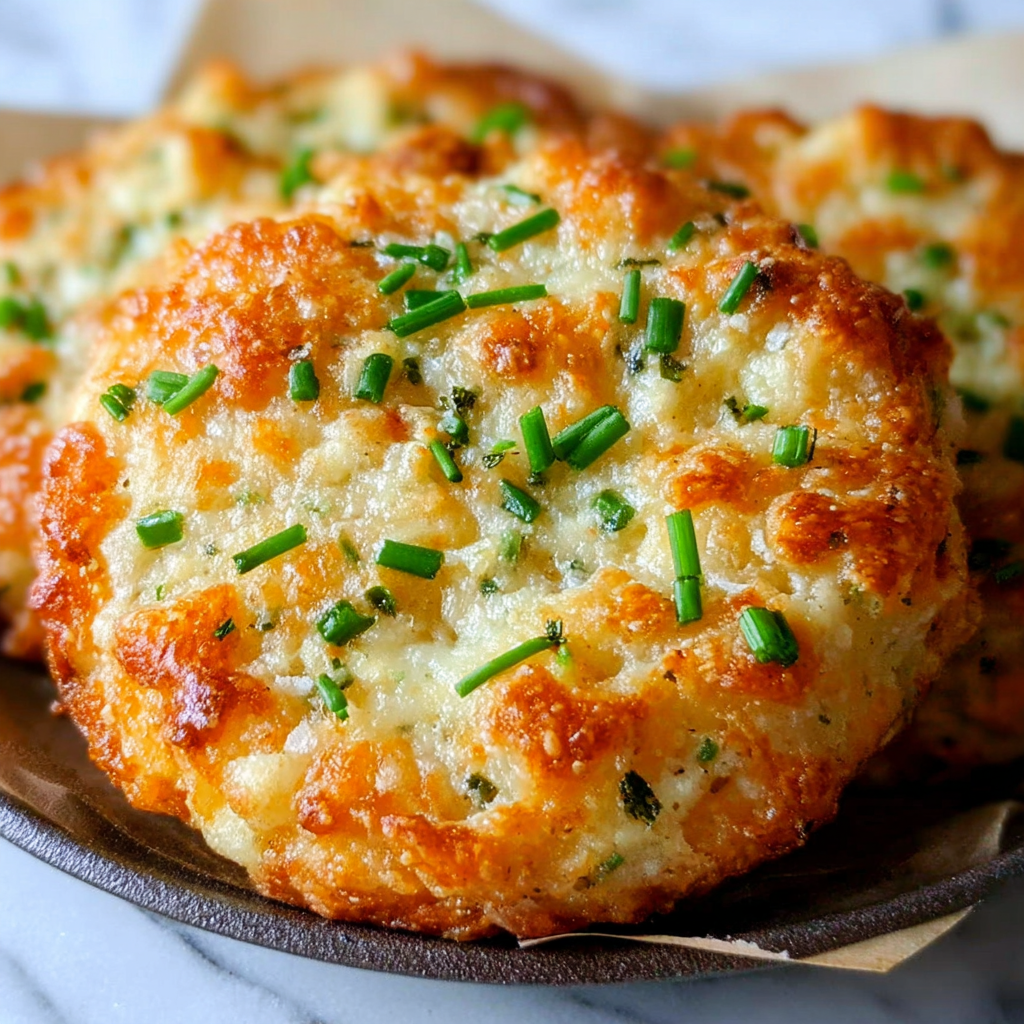
  • Creamy Low Carb Chicken Casserole With Broccoli and Bacon

    Creamy Low Carb Chicken Casserole With Broccoli and Bacon

    I added too much broth trying to stretch it, and the whole thing turned soupy and completely pale. Ben looked at his bowl and said “this is definitely more of a soup.” Mia ate it quietly, which is somehow worse than any complaint. That watery batch taught me exactly that this low carb chicken casserole needs to be rich, thick, and comfort food nobody questions.

    Why This Recipe Is Special

    This casserole is what happens when you take everything good about comfort food and remove everything that makes you feel slow and heavy afterward. Tender shredded chicken in a thick cream cheese and sour cream sauce, broccoli that goes slightly golden at the tips in the oven, crispy bacon on top that stays crunchy against the creamy base, and a generous layer of melted cheddar over everything. It is genuinely indulgent and genuinely low-carb at the same time, which Mia thinks is a trick and Ben calls “the good kind of math.”

    How To Make Low Carb Chicken Casserole

    The successful batch came together on a Friday evening when both kids were hungry and Ben had already asked what was for dinner three separate times in the span of ten minutes. Mia was crumbling the bacon into pieces with focused intensity and periodically eating a piece, which I had technically not authorized but also chose not to address. Ben was shredding the chicken and providing a commentary on each piece as though narrating a cooking show. When the casserole came out of the oven with that golden cheese on top and the whole kitchen smelling like bacon and cream, both of them went completely silent and just looked at it. That is always the review I am going for.

    The lesson that fixed the watery batch was understanding the cream cheese. It needs to be completely softened and beaten smooth before it goes into anything else, and it goes in at room temperature. Cold cream cheese does not incorporate evenly and leaves lumps that melt into thin, watery pools in the oven rather than a thick, velvety sauce. Ben helped me figure this out by reading the back of the cream cheese package very thoroughly and announcing that it said “best at room temperature.” He has been leaving the cream cheese out proactively ever since and calling it “science.”

    Main Ingredients

    • 3 cups cooked shredded chicken breast – Rotisserie chicken is perfect here; about 2 large breasts or one full rotisserie bird shredded
    • 3 cups broccoli florets, cut small – Cut into small similar-sized pieces so they cook through evenly and the tips go slightly golden
    • 6 strips bacon, cooked crispy and crumbled – Cook until genuinely crispy; soft bacon disappears into the sauce instead of staying on top as a crunchy contrast
    • 8 oz full-fat block cream cheese, room temperature – Block cream cheese only and genuinely room temperature; this is the foundation of the whole sauce
    • 1/2 cup sour cream – Adds tang and richness alongside the cream cheese; full-fat for the best texture
    • 1/2 cup chicken broth, low sodium – Just enough to loosen the sauce to the right consistency; do not add more than this
    • 2 cloves garlic, minced – The savory backbone that runs through the whole creamy sauce
    • 1 teaspoon onion powder – Adds depth without needing to dice anything
    • 1/2 teaspoon dried thyme – Subtle herby warmth that elevates the whole dish
    • 1/2 teaspoon smoked paprika – Adds color and a gentle smokiness that complements the bacon beautifully
    • Salt and black pepper to taste – Season confidently; cream cheese needs salt to bring out all its richness
    • 1.5 cups shredded sharp cheddar cheese, divided – Half stirred into the sauce, half scattered on top for the golden finish
    • Fresh chives or parsley for garnish – Optional but adds a clean, fresh finish against the rich golden top

    Step-by-Step Instructions

    Step 1: Prep the Broccoli and Bacon

    • Preheat your oven to 375 degrees F and lightly grease a 9×13 inch baking dish
    • Cook the bacon in a large skillet over medium heat until genuinely crispy, then drain on paper towels and crumble into pieces; reserve one tablespoon of the bacon fat in the skillet
    • Add the broccoli florets to the skillet with the reserved bacon fat over medium heat and cook for 3 to 4 minutes until bright green and just beginning to soften at the edges; the broccoli does not need to be fully cooked since it will finish in the oven
    • Season the broccoli with salt and pepper, then transfer to a plate and set aside while you make the sauce in the same skillet

    Step 2: Make the Cream Cheese Sauce

    • Reduce the skillet heat to medium-low and add the minced garlic; cook for 30 seconds until fragrant without letting it brown
    • Add the room-temperature cream cheese and stir constantly until it melts into a smooth, lump-free base, about 2 minutes; if it looks grainy, reduce the heat and keep stirring patiently
    • Add the sour cream, chicken broth, onion powder, thyme, smoked paprika, salt, and pepper and stir until the sauce is completely smooth, glossy, and thick enough to coat the back of a spoon
    • Remove from heat and stir in half the shredded cheddar until melted, then taste and adjust seasoning before combining with the other ingredients

    Step 3: Assemble and Top

    • Combine the shredded chicken and par-cooked broccoli in the skillet with the cream cheese sauce and stir gently until everything is evenly coated
    • Transfer the mixture to the prepared baking dish and spread evenly so every portion will have chicken, broccoli, and sauce in each scoop
    • Scatter the remaining shredded cheddar evenly across the entire surface so it covers every inch for maximum golden coverage
    • Distribute the crumbled bacon evenly over the cheese layer so it sits on top and stays crispy rather than sinking into the sauce during baking

    Step 4: Bake and Serve

    • Bake uncovered at 375 degrees F for 20 to 25 minutes until the cheese is melted, golden, and bubbling at the edges and the casserole is heated through completely
    • Let the casserole rest for 5 minutes before serving so the sauce thickens slightly and portions hold their shape when scooped
    • Garnish with fresh chives or parsley right before serving for a clean, bright finish that balances the richness of the dish
    • Serve directly from the baking dish with a wide spoon; pair with a simple green salad or extra roasted broccoli if you want something alongside it.

    Low Carb Chicken Casserole Variations

    Ben’s “Double Bacon on Top” Version

    Ben has never once in his life looked at a dish with bacon on it and thought there was enough bacon. He made this position very clear during the first successful batch by waiting until the cheese was scattered and then adding another generous handful of crumbled bacon on top before it went in the oven. He described this as “making it better.” He was not wrong. For the double bacon version, cook eight strips instead of six and reserve the extra for the very top layer where it stays visible and stays crispy. Ben considers this the definitive version and I have stopped suggesting otherwise.

    Mia’s “Extra Broccoli, Easy on Everything Else” Version

    Mia went through a broccoli phase when she was five that we all assumed was temporary and that has since proven to be permanent. For her version, add an extra cup of broccoli to the base mixture and reduce the bacon to four strips since she finds the smokiness slightly overpowering when there is too much of it. The extra broccoli soaks up the cream sauce beautifully, and every scoop has more green than gold. Mia calls this version “the healthy one” with complete confidence, and I do not correct her because the whole casserole is already low-carb.

    The Keto Meal Prep Version

    This is the version I make on Sunday when I want five days of genuinely satisfying lunches sorted in forty minutes. Double the whole recipe into two 9×13 dishes, bake both at the same time on different oven racks, and rotate halfway through for even browning. Let one cool completely and portion it into individual containers for the fridge. The cream cheese sauce holds its texture beautifully for four days and reheats into something that tastes almost identical to freshly made. Ben describes Sunday prep day as “the day Mom makes a lot of the good casserole,” and he is completely correct.

    Substitutions

    Block cream cheese to mascarpone: Mascarpone gives an even richer, silkier sauce with a slightly sweeter flavor that works beautifully in this casserole. Use the same quantity at room temperature. The sauce will be a touch more decadent and slightly less tangy than the cream cheese version, which some people prefer and which Ben would absolutely prefer if given the choice.

    Sour cream to full-fat Greek yogurt: Plain full-fat Greek yogurt gives a nearly identical result with a slightly more pronounced tang and a small boost in protein. Use the same quantity. Make sure it is full-fat and at room temperature before it goes into the sauce, or it may curdle slightly when heated.

    Bacon to pancetta or turkey bacon: Pancetta gives a more Italian-inspired depth that works surprisingly well with thyme and garlic. Turkey bacon works as a lighter option but must be cooked until very crispy to give any textural contrast against the creamy sauce; limp turkey bacon on a creamy casserole is a texture nobody wants.

    Sharp cheddar to gruyere or Colby Jack: Gruyere gives a nuttier, more complex melt that makes the casserole feel genuinely elegant. Colby Jack melts beautifully and gives a slightly milder flavor that works well for kids who find sharp cheddar too strong. Either substitutes in exactly the same quantity with almost no change to the method.

    Equipment

    • 9×13 inch baking dish (glass or ceramic)
    • Large oven-safe skillet for the bacon, broccoli, and sauce
    • Paper towels for draining the cooked bacon
    • Two forks for shredding the chicken
    • Rubber spatula for stirring the cream cheese sauce smoothly
    • Wide spatula or large spoon for serving
    • Sharp knife and cutting board for the broccoli and garlic
    • Measuring spoons for the seasoning blend
    • Grater if using block cheddar rather than pre-shredded

    Storage Tips

    Make Ahead

    • Assemble the full casserole up to 24 hours ahead without the bacon topping, cover tightly, and refrigerate; add the crumbled bacon right before baking so it stays on top and stays crispy
    • Cook the bacon and shred the chicken up to 2 days ahead and store separately in the fridge so assembly on dinner night takes under 15 minutes
    • The cream cheese sauce can be made a day ahead and stored covered in the fridge; reheat gently on low with a splash of broth to bring it back to a smooth, pourable consistency before assembling

    Refrigerator

    • Store leftover casserole covered in the fridge for up to 4 days; the cream cheese sauce stays smooth and rich and the flavors deepen overnight
    • Store in the original baking dish covered with foil or transfer portions to individual airtight containers for easier weekday lunches
    • The bacon topping will soften in the fridge; re-crisp by reheating in the oven rather than the microwave for the best texture recovery

    Freezing

    • Freeze individual portions in airtight freezer-safe containers for up to 2 months; cream cheese-based sauces can separate slightly when thawed but stir back together well when reheated gently
    • Freeze the assembled unbaked casserole without the bacon topping for up to 1 month; thaw overnight in the fridge before baking and add fresh crumbled bacon on top before it goes in the oven
    • Thaw frozen portions overnight in the fridge rather than at room temperature for the best texture and food safety

    Reheating

    • Reheat individual portions in the microwave at 70 percent power for 90 seconds to 2 minutes covered with a damp paper towel; stir once halfway through to redistribute the sauce
    • Reheat the full casserole in a 350 degree F oven covered with foil for 15 to 20 minutes, then uncover for 5 minutes to re-melt and re-crisp the cheese and bacon on top
    • A small splash of chicken broth stirred into any portion before reheating prevents the cream cheese sauce from tightening up and keeps the texture smooth and saucy

    Family Secret Worth Sharing

    My mom had a rule about any cream cheese dish that I thought was unnecessarily fussy until I understood why: always season the sauce twice. Once while it is on the heat and once again right before the casserole goes into the oven after everything is assembled. She said the chicken and broccoli absorb some of the salt when they are stirred into the sauce, and what tasted perfectly seasoned in the pan will taste slightly flat in the finished dish. I do this every time, and the difference is real. Ben watched me taste and re-season once and asked why I was adding salt again. I told him Grandma’s rule. He tried the seasoned bite and said “okay yeah, that’s right.” That is the best endorsement Grandma’s kitchen rules have ever received from a nine-year-old.

    Troubleshooting FAQs

    The cream cheese sauce is lumpy and grainy instead of smooth. What went wrong?
    The cream cheese was cold when it went into the pan. This is the single most common cream cheese sauce problem. Cold cream cheese breaks into small lumps that melt unevenly and create a grainy texture no amount of stirring can fully fix. Take it out of the fridge at least an hour before cooking, and if it still looks lumpy in the pan, reduce the heat to the lowest setting and stir very slowly and patiently until it smooths out.

    The casserole is watery and the sauce is thin after baking. What happened?
    Too much broth, or the broccoli was not par-cooked before it went in. Broccoli releases significant moisture during baking, and if it goes in raw, it floods the sauce. Cook it briefly in the skillet first, and the watery problem disappears entirely. Also measure the broth carefully; half a cup is the maximum this sauce needs, and adding more to stretch the dish is what turns it into soup. I know this from personal experience.

    The cheese on top is not browning. What do I do?
    Switch to the broiler for the last 2 to 3 minutes of baking with the casserole on an upper rack and the oven door slightly open. Watch it every single second because pre-shredded cheese goes from golden to burnt in under a minute under a broiler. Alternatively, make sure your oven is genuinely at 375 degrees F using an oven thermometer since ovens that run cool will produce a pale, unmelted cheese top regardless of bake time.

    Can I use frozen broccoli instead of fresh?
    Yes, but it needs one extra step. Thaw the frozen broccoli completely and then squeeze out as much moisture as possible in a clean kitchen towel before it goes into the skillet. Frozen broccoli holds significantly more water than fresh, and if it goes in unsqueezed, the extra moisture will make the sauce thin and watery in the oven. Properly dried frozen broccoli works just as well as fresh and saves the chopping time entirely.

    The Casserole That Made Friday Night Feel Like a Treat

    Friday evenings in our house used to be takeout territory. Now they are this casserole, a lot of crumbled bacon, and two kids who stop arguing about everything else the moment it comes out of the oven. Ben eats his from the corner of the dish because he claims the cheese-to-bacon ratio is better there. Mia loads her bowl with extra broccoli and judges the rest of us silently. This low carb chicken casserole has become one of our most beloved keto chicken and broccoli dinner recipes in the whole household, right alongside our healthy chicken casserole recipes that make a weeknight feel genuinely worth showing up for. For the Sundays when I want to get ahead of the whole week, this casserole next to our high-protein chicken meal prep recipes covers lunches and dinners without a single complaint from anyone at the table. Some recipes become the ones your family measures other dinners against, and this one quietly did exactly that.

    Don’t forget to snap a picture of your low carb chicken casserole before that… (trust me, it will disappear quickly!), and leave a rating below. We’d love to hear how this low carb chicken casserole becomes part of your family dinner story.
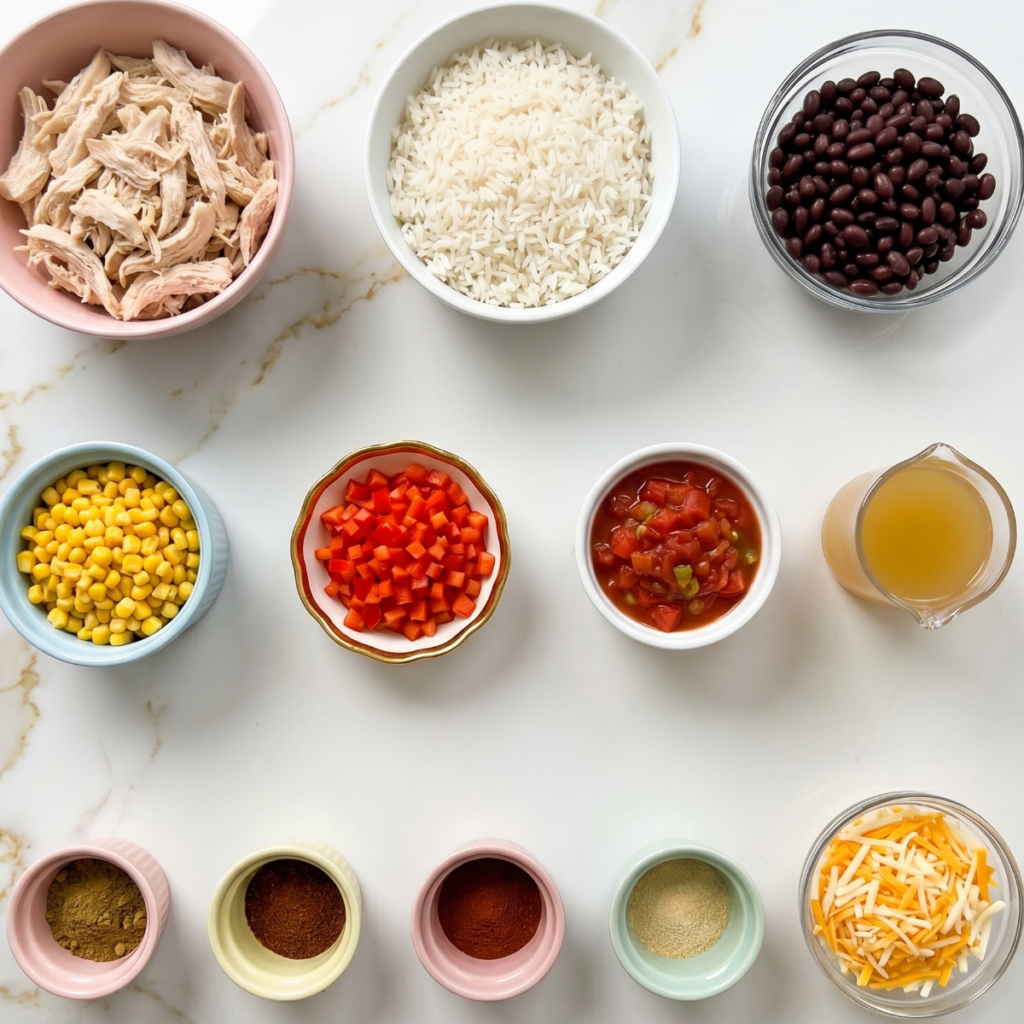
  • 3 Secrets to the Best Chicken Burrito Casserole

    3 Secrets to the Best Chicken Burrito Casserole

    I added the rice dry and straight from the bag. It came out crunchy in a way nobody wanted, and Ben bit into a piece and made a face that said absolutely everything. Mia tried to be polite and said it had “interesting texture.” It did not. Once I cooked the rice first, this chicken burrito casserole became the most satisfying Tuesday dinner we make.

    Why This Recipe Is Special

    This casserole has everything a burrito has but in a form you can scoop from a pan and serve to six people without anyone needing to roll anything. Tender shredded chicken, seasoned rice, black beans, corn, roasted red pepper, and a layer of melted cheese on top that goes golden in the oven. It comes together in one dish, feeds the whole table generously, and keeps perfectly for four days of lunches. Ben calls it a “deconstructed burrito” with the authority of someone who invented the concept. He did not invent the concept. I let him have it anyway.

    How To Make Chicken Burrito Casserole

    The successful version happened on a Wednesday night when both kids were doing homework at the kitchen table and periodically checking on their progress. Mia was in charge of draining the black beans, which she did with extreme seriousness and a commentary about how many beans were in the can. Ben was shredding the rotisserie chicken and eating approximately one piece for every three that went into the bowl, which he called “quality testing.” When the assembled casserole went into the oven and that warm cumin and cheese smell started filling the kitchen, both of them abandoned their homework entirely and sat at the table waiting. Homework was finished after dinner. Some things are worth the disruption.

    The thing that made this recipe genuinely great instead of just adequate was toasting the spices in the pan before anything else went in. Cumin and chili powder bloomed in a dry pan for about thirty seconds before the onion went in, and the whole flavor depth of the dish changed. Ben noticed it immediately the first time I did it and asked what was different. I told him I toasted the spices. He nodded seriously and said “that is the move.” It is absolutely the move.

    Main Ingredients

    • 3 cups cooked shredded chicken – Rotisserie chicken saves significant time; about 2 large breasts or one full rotisserie gives the right amount
    • 1.5 cups long-grain white rice, cooked – Must be cooked before it goes into the casserole; do not add it dry
    • 1 can (15 oz) black beans, drained and rinsed – Adds protein and body to every scoop; rinse them well to remove the canning liquid
    • 1 cup frozen or canned corn, drained – Adds sweetness and color; frozen corn thawed and drained works perfectly
    • 1 red bell pepper, diced – Roasted or fresh; adds sweetness and color throughout the casserole
    • 1 can (10 oz) diced tomatoes with green chiles – Rotel or equivalent; adds moisture and a gentle heat throughout the whole dish
    • 1 cup chicken broth, low sodium – Keeps the casserole moist during baking without making it soupy
    • 1/2 cup sour cream – Stirred into the mixture before baking for creaminess and a slight tang
    • 1 teaspoon cumin – The warm earthy backbone of the whole seasoning blend
    • 1 teaspoon chili powder – Depth and color; reduce to half for the kids’ milder version
    • 1/2 teaspoon smoked paprika – Adds subtle smokiness that makes the casserole taste slow-cooked
    • 1/2 teaspoon garlic powder – Savory depth throughout every layer
    • Salt and black pepper to taste – Season confidently at every stage
    • 1.5 cups shredded Monterey Jack or cheddar cheese, divided – Half stirred in, half scattered on top for that golden bubbly finish
    • Fresh cilantro and sliced green onions for garnish – Adds freshness and color against the golden cheesy top

    Step-by-Step Instructions

    Step 1: Cook the Base

    • Preheat your oven to 375 degrees F and lightly grease a 9×13 inch baking dish
    • Heat a large skillet over medium heat and toast the cumin, chili powder, and smoked paprika in the dry pan for 30 seconds until fragrant, then add a drizzle of oil and the diced red pepper and cook for 3 to 4 minutes until slightly softened
    • Add the garlic powder, drained tomatoes with green chiles, and chicken broth to the skillet and stir to combine; let it simmer for 2 minutes so all the flavors come together
    • Remove from heat, stir in the sour cream until smooth, then taste and season with salt and pepper before moving to the assembly stage

    Step 2: Assemble the Casserole

    • Combine the cooked rice, shredded chicken, black beans, corn, and half the shredded cheese in the large skillet with the sauce mixture and stir until everything is evenly coated
    • Transfer the entire mixture into the prepared baking dish and spread it evenly from edge to edge so every portion gets an equal amount of each ingredient
    • Press the mixture down gently with the back of a spatula so it is compact and level in the dish; this helps it cook evenly rather than having dry edges and a wet center
    • Scatter the remaining cheese generously over the entire surface in an even layer so it covers every inch and will melt into a golden, bubbly top

    Step 3: Bake the Casserole

    • Cover the baking dish tightly with aluminum foil and bake at 375 degrees F for 20 minutes so the filling heats through completely and the flavors meld together
    • Remove the foil and bake for another 10 to 15 minutes uncovered until the cheese on top is golden, bubbly, and beginning to develop those irresistible browned spots
    • Test the center of the casserole with a fork or spoon; it should feel hot all the way through and not lukewarm or cool in the middle before you pull it from the oven
    • Let the casserole rest in the dish for 5 minutes after coming out of the oven so the filling firms up slightly and portions lift cleanly with a spoon

    Step 4: Garnish and Serve

    • Scatter freshly chopped cilantro and sliced green onions generously over the top of the hot casserole right before serving for a fresh, bright finish
    • Serve directly from the baking dish with a large spoon, letting each portion include plenty of the cheesy top layer along with the filling beneath
    • Set out toppings alongside so everyone can customize their bowl: sour cream, sliced avocado, hot sauce, lime wedges, and extra cilantro for anyone who wants it
    • Leftovers scoop cleanly once the casserole has cooled and are honestly even better the next day when the flavors have had overnight to settle and deepen

    Chicken Burrito Casserole Variations

    Mia’s “No Spicy Please” Version

    Mia has operated a strict no-heat policy in our kitchen since approximately the age of three and shows no signs of relaxing it. For her version, skip the diced tomatoes with green chiles entirely and use a plain can of diced tomatoes instead. Reduce the chili powder to a quarter teaspoon and add an extra half teaspoon of garlic powder for depth. Mia eats two portions of this version without a single negotiation, which is the highest honor a recipe can receive from a six-year-old with strong opinions.

    Ben’s “Extra Black Beans and Cheese” Version

    Ben has two consistent positions on casseroles: more beans and more cheese. He announced both positions at the same time during the first successful batch, and I did not find either of them unreasonable. For his version, add an extra half can of black beans to the filling mixture and increase the topping cheese to two full cups spread across the whole surface. The cheese bubbles into thick golden pools on top, and the beans add extra heartiness to every scoop. Ben considers this the definitive version and refers to the original as “the one with less cheese.” He is not wrong.

    The Clean Eating Dairy-Free Version

    On the weeks when I am cooking for someone who avoids dairy, this casserole adapts beautifully. Replace the sour cream with a half cup of full-fat coconut milk or a plain unsweetened coconut yogurt and use a good dairy-free shredded cheese on top. The coconut milk gives a very subtle creaminess that nobody questions, and the dairy-free cheese melts and browns in the oven almost identically to regular cheese. The whole dish is also naturally gluten-free as written, which makes it one of the best healthy dinner casseroles for feeding a mixed-dietary-needs table without making two separate dishes.

    Substitutions

    White rice to brown rice or cauliflower rice: Brown rice works in the same quantity but needs to be fully cooked before it goes in since it will not cook further in the casserole. Cauliflower rice is a fantastic low-carb option; thaw and squeeze it very dry before using, or the casserole will be too wet. Both give a slightly different texture, but the flavor of the whole dish holds up beautifully.

    Sour cream to Greek yogurt: Plain full-fat Greek yogurt substitutes in exactly the same quantity and gives a nearly identical creamy tang in the filling. The casserole will be slightly higher in protein and slightly lower in fat. Use full-fat yogurt rather than low-fat, or the filling may separate slightly during baking.

    Rotisserie chicken to canned chicken: Two well-drained cans of canned chicken work in a time crunch, and the casserole still tastes fantastic. Break up any large chunks before mixing and season the filling slightly more generously since canned chicken has a milder flavor than fresh rotisserie chicken. The texture is softer, but the dish is still deeply satisfying.

    Monterey Jack to pepper jack: Pepper jack adds a gentle heat throughout the filling and melts just as beautifully on top. It is a particularly good swap for the adults who want a little more kick while keeping Mia’s portion of the casserole milder by scooping from one end of the dish. Half and half across the top works perfectly for mixed households.

    Equipment

    • 9×13 inch baking dish (glass or ceramic)
    • Large skillet for building the sauce base
    • Large mixing bowl or use the skillet for combining everything before transferring
    • Aluminum foil for covering during the first bake
    • Sharp knife and cutting board for the bell pepper and garnish
    • Two forks for shredding the chicken if not using pre-shredded
    • Wide spatula or large spoon for pressing the filling flat and serving
    • Colander for draining the beans and corn
    • Measuring spoons for the spice blend

    Storage Tips

    Make Ahead

    • Assemble the full casserole up to 24 hours ahead, cover tightly, and refrigerate unbaked; bake straight from the fridge, adding 10 extra minutes to the covered bake time
    • Cook the rice and shred the chicken up to 2 days ahead and store separately in the fridge to make assembly on dinner night take under 15 minutes
    • This is one of the best clean eating casserole recipes for weekly meal prep; make it Sunday and have four days of lunch sorted with almost no additional effort

    Refrigerator

    • Store leftover casserole covered in the fridge for up to 4 days; the flavors deepen overnight and leftovers are genuinely one of the best parts of making this
    • Keep the casserole in the baking dish covered with foil or transfer portions to airtight containers for easier individual reheating throughout the week
    • The cheese topping softens in the fridge but re-crisps beautifully in the oven or air fryer when reheated

    Freezing

    • Freeze the assembled unbaked casserole tightly wrapped for up to 2 months; thaw overnight in the fridge before baking
    • Freeze baked individual portions in airtight containers for up to 2 months for the easiest possible weekday lunch situation
    • Do not freeze with the sour cream already mixed in if possible; the dairy can separate when thawed and the texture becomes slightly grainy; replace with Greek yogurt for a more freeze-stable version

    Reheating

    • Reheat individual portions in the microwave, covered with a damp paper towel, at 70 percent power for 90 seconds to 2 minutes until hot throughout
    • Reheat the full casserole in a 350 degree F oven covered with foil for 20 minutes, then uncover for 5 more minutes to re-crisp the cheese
    • A splash of chicken broth over the top before reheating in the oven prevents the filling from drying out and makes leftovers taste almost identical to freshly baked

    Family Secret Worth Sharing

    My mom always added a full teaspoon of lime zest to her burrito filling, and I never thought about it until I made this casserole without it one night, and the whole thing tasted slightly flat. Not bad, just not quite right, like something was missing that I could not name. The lime zest does not make the casserole taste like lime; it lifts the whole flavor and makes the cumin and chili pop in a way they do not without it. I add it right when the sour cream goes in. Ben noticed the difference on a batch where I had forgotten it and said “this tastes kind of gray.” He did not mean the color. He meant the flavor. He was right. Add the lime zest. My mom was always right about these things.

    Troubleshooting FAQs

    The casserole is watery, and the filling is soupy instead of holding together. What went wrong?
    Either the rice was wet when it went in, the canned tomatoes were not drained, or the corn was not drained properly. Each of these ingredients carries liquid that adds up quickly in a baked dish. Drain everything thoroughly before it goes into the mixing bowl, and if using frozen corn, thaw and pat dry with paper towels. The filling should look well-coated and moist but not sitting in visible liquid when it goes into the baking dish.

    The cheese on top is not browning or bubbling. What happened?
    The foil was left on too long, or the oven temperature is running low. The uncovered portion of the bake time is when the browning happens, so the foil must come off for the last 10 to 15 minutes. If your oven tends to run cool, increase the temperature by 25 degrees F for the uncovered portion or switch to the broiler for the last 2 to 3 minutes with the door slightly open and the casserole on an upper rack.

    The rice is still crunchy in the finished casserole. How do I fix it?
    The rice was not fully cooked before it went in. This is the most common casserole mistake and the one I know from personal experience. Rice does not cook further in a casserole dish the way it does in a pot of boiling water. Cook the rice completely first, let it cool slightly, and then add it to the filling. If your casserole has already baked with undercooked rice, add a quarter cup of broth, cover tightly with foil, and return to a 350 degree F oven for another 20 minutes.

    Can I make this casserole in a slow cooker?
    Yes, with one adjustment. Use only half the chicken broth since the slow cooker traps steam and the filling will become wetter than the oven version. Layer everything in, cook on low for 3 to 4 hours, then scatter the cheese on top and cook uncovered on high for the last 15 minutes to melt it. You will not get the same golden baked cheese topping as the oven version, but the filling is rich, tender, and deeply flavorful.

    The Casserole That Fixed Tuesday Night

    Tuesday used to be the hardest dinner night in our house. Now it is the night everyone knows something good is happening. Ben serves himself a portion that looks ambitious and finishes it. Mia checks that her scoop has adequate cheese coverage before sitting down, which it always does. This chicken burrito casserole has become one of our most reliable healthy chicken dinner casseroles in the whole rotation, right alongside the other easy weeknight casserole recipes that carry us through the busiest weeks without a lot of effort or complaint. For the nights when the whole family needs a filling, satisfying dinner that covers every craving in one pan, this casserole next to our easy one-pot chicken and rice recipe means Tuesday dinner is genuinely something to look forward to. That is not a small thing.